
I used to daydream about writing for Law and Order back when it was still running*, not for its propulsive, plot-driven narratives, and certainly not its copaganda, but for the occasional, random, richly drawn secondary or even tertiary character(s); some random person who helps the plot along, but whom you probably won’t see again. True, there are a lot of stock interactions and tropes in Law and Order, like the one comedian John Mulaney has satirized as “guy who while being questioned by homicide detectives will not stop stocking crates…”, a kind of expository action-within-inaction reminiscent of the Sorkin walk, or any of HBO’s “sexposition” scenes.
But occasionally, and the reason I wanted to write for Dick Wolf, the episodes will also give time to brief encounters with memorable criminals. Yes, I want to know whodunnit, but the cream in my coffee, the a la mode on my pie, are the people, the characters. I’m not talking about dramatic flashbacks, but about artful, iceberg-like, less-is-more character moments. One that sticks with me was a brief interchange between Briscoe and a heroin addict being held for questioning.
The heroin addict has been detained for hours, and he needs his fix—badly—and he’d very much like to leave, now that he’s told the police everything he knows. Briscoe makes some wisecrack about how much money the addict is spending on heroin, and the addict launches into a brief, surprisingly cogent, economic disquisition on how well heroin has held its value in the marketplace. “Pot, cocaine,” he says disdainfully, “the price per gram has doubled over the past few years, but heroin’s still right where it always was. Gram-for-gram, ounce-for-ounce, heroin’s still your best value.” Not even Briscoe had a comeback for this sage advice.
Why do I love those exchanges? Because in a world of formulaic television, strange, vivid, serendipitous encounters are the stuff of life. I’ve written elsewhere about how I try to remain alive to possibilities, and I write down moments and exchanges I’ve been party to or eavesdropped upon. I hold onto them because even though they’re real and therefore could mean anything (or nothing), they feel like more than what they are—and maybe someday I’ll have a place to use them.
I’ve been pleased, in Bastard Verdict, that the character of Alan Wilson, a young, up-and-coming, petty criminal in an organized crime gang, has caught on. I needed someone with underworld ties to make the story work, but I needed him to be more than a conduit for the plot. To put flesh on his bones (so to speak), I created a backstory for him (one I know but don’t go into great detail about), and introducing him, I ripped off an exchange from my long-past drug days, and a deal I made in a pub bathroom.
I’d gone into the bathroom to wait for my dealer. When he came in, he was aghast that I was just standing there. “At least pretend you’re taking a piss,” he said to me all those years ago.
But how and why do some secondary characters strike a chord with readers where others don’t?
I’ve been pleased that some of my secondary characters have resonated with readers. Though I as I noted in the WHAT I LEARNED interview with the Indy Author/Matty Dalrymple, I had hoped the lawyer, Ewan Johnston would have garnered a bit more attention.
I remember an early reading of Faithless Elector in Oxford, where a young woman from the audience that day came up to me afterwards, wondering if I was going to give the cab driver more “stage time” in a future book. “I’m sure he’ll be back!” she said. I was glad the cabby had “landed” but sad that Mr. Fitzwilliam, the super in Professor Calder’s building had not. I wanted Fitzwilliam to resonate as the kind of good, everyday person whom we might all hope would (collectively) be the bulwark against the kind of conspiracy that’s unfolding. I even gave him a kind of heartwarming joke but no one mentioned him in reviews.
Special Agent in Charge Amanda Vega in Dark Network gets good reviews, but I’d also hoped that the courier, Jimmy May, would have engendered similar affection. While no one disparaged him, no one said, “will he be back?” He was, in Emergency Powers, as was Vega. In Emergency Powers, I brought back the cabby, but I had really hoped that Kirsten, the waitress at a tiny, Midwest airport would gain more traction than she did. Again, I wanted to juxtapose her ordinary, everyday-ness with the dire things going on in the conspiracy. Strangely, the bad guy, Frank Reed, even received some plaudits. I had one reader write to me to say how odd it was to be rooting for him.
I’m not sure why some secondary characters break through and others remain in the background, I’m pleased that the young criminal Alan Wilson, who becomes a kind of moral center in Bastard Verdict, seems to have become a favorite, with two reviewers expressing the hope that he’ll be back in a further installment.
I’ll see what I can do! 🙂
*Wait, L&O is back on the air?
# # #

James McCrone is the author of the Imogen Trager political suspense-thrillers Faithless Elector, Dark Network , and Emergency Powers–noir tales about a stolen presidency, a conspiracy, and a nation on edge. All books are available on BookShop.org, IndyBound.org, Barnes & Noble, your local bookshop, and Amazon. eBooks are available in multiple formats including Apple, Kobo, Nook and Kindle.
His current book, Bastard Verdict, debuted on May 18th. A noir political thriller set in Scotland, it’s available through the link above, or wherever you buy your books. His current, work-in-progress is a mystery-thriller set in Oregon’s wine country…A (pinot) Noir, called Witness Tree.
A Seattle native (mostly), James now lives in South Philadelphia with his wife and three children. He’s a member of the The Mystery Writers of America, Int’l Assoc. of Crime Writers, Int’l Thriller Writers, Philadelphia Dramatists Center and is the vice-president of the Delaware Valley chapter of the Sisters in Crime network. James has an MFA from the University of Washington in Seattle.
For a full list of appearances and readings, make sure to check out his Events/About page. And follow this blog!
His most recent short fiction is below. The first is available for online reading.
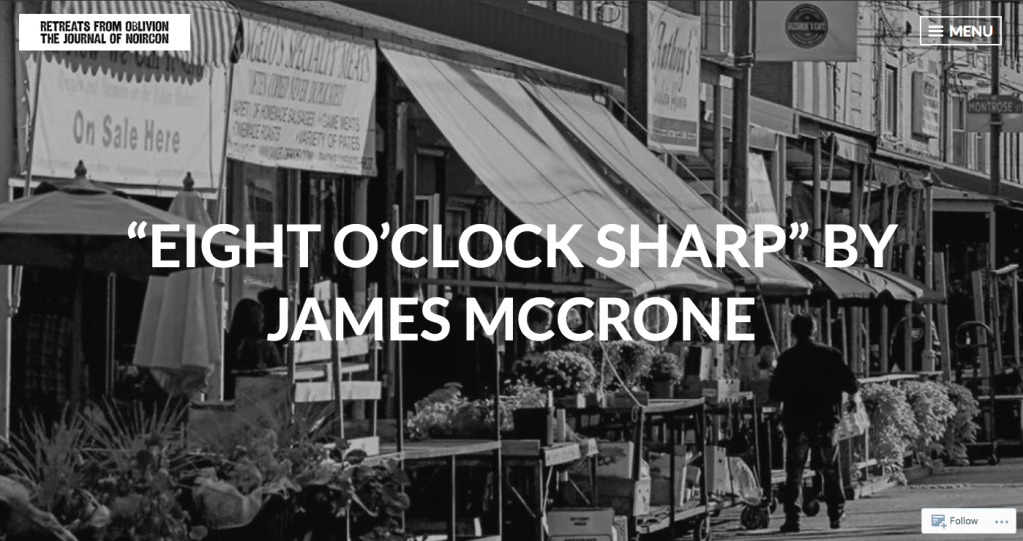
“Eight O’Clock Sharp” in Retreats from Oblivion: the Journal of NoirCon. (free online)
Set in Philadelphia’s 9th Street Market, Thomas is a man outside of time, forgotten, but trying to do the right thing while contending with avaricious forces.

“Ultimatum Games” in Rock and Hard Place magazine issue #7
A rare book heist, bad decisions. The narrator and his partner-in-crime clash over evolving bourgeois norms.

“Nostalgia” in Low Down Dirty Vote, vol. 3
An armed group tries to resurrect a past that never was as they struggle with change.
 Chosen Words - James McCrone