R. G. Belsky’s newest Clare Carlson mystery, Broadcast Blues, is a compelling and superbly human story of justice and corruption.
Approaching her 50th birthday, Clare Carlson finds that “getting the story” becomes increasingly dangerous in Belsky’s latest, tense mystery-thriller, Broadcast Blues. The trail she follows in her reporting on the horrific death of Wendy Kyle, a high-profile private investigator specializing in divorce cases, has a multitude of suspects who wouldn’t mind seeing her dead.
But it’s the little clues, the things not said (or suppressed) that call out to Clare Carlson. Not only does she have to navigate among a group of suspects–any of whom might be the killer–but she remains at odds with her managing editor, and the TV station where she works is up for sale to a hedge-funded media/entertainment colossus that couldn’t care less about news and the big stories that matter.
The deeper Clare digs, the more she identifies with the dead PI, a conflicted, driven investigator. Highly recommended.
NOTE: I received an advance review copy through NetGalley in exchange for an honest review.
Thank you to all who have read and followed the Chosen Words blog. I’m looking to post here more regularly this coming year as I wean myself from the various social media platforms.
Here is the final sunrise from South Philadelphia. It’s out there, presumably, behind the frigid cloud cover.
I hope that 2023 was good to you, and that ’24 will bring even better.
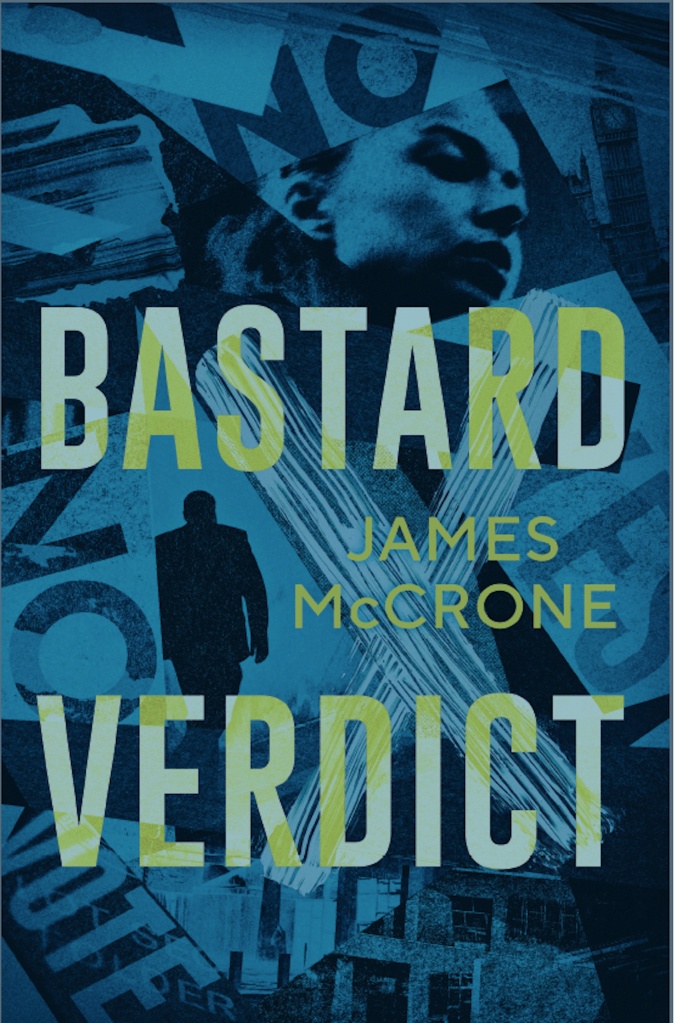
Not only did Bastard Verdict debut this year, but it brought new readers to my other books as well. I hope to finish my work-in-progress, Witness Tree in the next couple months, and I am also working on some short stories — “Coffin Corner” about a mortuary debt, “Raccoon Summer,” and “Black eyed Susan.”
YOU DON’T NEED TO WIN, JUST DON’T LOSE In politics, people cheat to win, or because they’re afraid to lose. The difference can be deadly.
Imogen will risk what’s left of her standing, her career–and maybe her life–to get at the truth.
James McCrone is the author of the Imogen Trager political suspense-thrillers Faithless Elector, Dark Network , and Emergency Powers–noir tales about a stolen presidency, a conspiracy, and a nation on edge. Bastard Verdict, his fourth novel, is about a conspiracy surrounding a second Scottish Independence referendum. To get the details right for the new thriller, he drew on his boyhood in Scotland and scouted locations for scenes in the book while attending Bloody Scotland.
All books are available on BookShop.org, IndyBound.org, Barnes & Noble, your local bookshop, and Amazon. eBooks are available in multiple formats including Apple, Kobo, Nook and Kindle.
He’s a member of MWA, Int’l Assoc. of Crime Writers, and he’s the new president of the Delaware Valley Sisters in Crime chapter. He lives in Philadelphia. James has an MFA from the University of Washington in Seattle. His current, work-in-progress is a mystery-thriller set in Oregon’s wine country…A (pinot) Noir, called Witness Tree.
For a full list of appearances and readings, make sure to check out his Events/About page. And follow this blog!
His most recent short fiction is below. The first is available for online reading.
“Ultimatum Games” in Rock and Hard Place magazineissue #7 A rare book heist, bad decisions. The narrator and his partner-in-crime clash over evolving bourgeois norms.
“Nostalgia” in Low Down Dirty Vote, vol. 3 An armed group tries to resurrect a past that never was as they struggle with change.
When people asked me what I was going to do in Scotland when I visited in 2019, I said I was going to attend the Bloody Scotland crime writers festival in Stirling, and I was going to Dundee and Glasgow to find “good places for murders.” I neglected to include this final bit when speaking to customs officials at border control.
As I’ve noted in earlier posts about getting the settings right, if you want a creepy, out-of-the-way place for a murder, or to have a body discovered, it’s crucial to see it for yourself.
One afternoon in Glasgow, I walked down along the Clyde, taking touristy photies of the Finnieston Crane. And then I wandered along the northside of the river, westward under the Anderston Quay and the Kingston Bridge.
I needed a place for someone to be killed. It was a difficult journey, not least because I liked the character very much. Nevertheless, I reluctantly followed the dictates of the plot, and my feet along the river toward the Anderston Quay area, which from a distance had looked a likely spot.
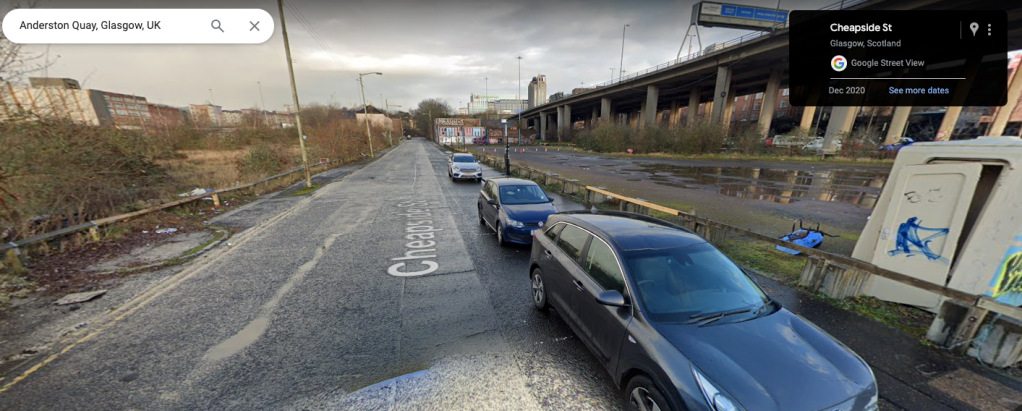
Redevelopment is coming to the the Anderston Quay–a couple of new buildings, a car park under the Kingston Bridge. But the rehabilitation (if it can be called that) hasn’t quite arrived at the loop road made by of Cheapside Street and Warroch St. Indeed, there is spare ground and tree cover to…spare.
I was excited looking over the area, but I worried there would be CCTV cameras about. There were not!
West side of the bridge.
East side of the bridge
In September of 2019, I had barely made a start on the book. I knew the character needed to die, but I hadn’t decided how or where I wanted him to die.
From Google Streetview
As I walked around the area, an idea came to me. I would have the character be attacked and killed as he went to his car, which he parked there more-or-less for free. Looking around, this seemed plausible, as there were a good number of cars parked along Cheapside–some of them for quite some time.
It was a desolate place. I saw no other person, and I walked around for more than an hour. So, for the story, I knew that there would be no one about; and, crucially, it would take time to discover the body, particularly if they shoved it in amongst the trees and brush. I decided that the assassins would steal the car into the bargain, to make it look like a car-jacking gone wrong.
So, I wrote:
<<Imogen found a televised news report about [spoiler-name removed]’s death on her computer. “The body,” the reporter began, “was found this morning along Cheapside Street by Anderston Quay. Mr. James McManus, a resident of the Glasgow Central Skyline apartments, who was walking his dog, telephoned police.”
The news report cut to McManus:
“It’s an open area, and I sometimes let the dog off the leash,” he began. McManus’s eyes shifted as a flicker of doubt ran across his face over whether he should be admitting that. “He found something by the fence on the other side of the street from the parking lot. He was quite excited by it. I couldn’t make out what it was because it—the man’s body—was on the other side of the fence. That’s when I went over and had a look myself.”
Imogen and Ross looked at one another with bleak disgust. His body, it seemed, had been tossed over the high fence like abandoned rubbish. The camera roved over the site, tucked under the Kingston Bridge. It was a weedy, desolate place, surrounded by grim, spare ground.
“The car has been stolen, too,” said the reporter. “We’re told that it’s been recovered where it was abandoned sometime late Saturday night or early Sunday morning, behind the Possilpark Library.”>>
Later, Imogen tries to pump the brakes on whether this was a calculated murder, or just some senseless, random killing:
<<“Let’s take a moment and examine the facts,” she said to Ian. “And whether this isn’t just some horrible coincidence. I mean, things like this do happen.”
“In America, maybe!” said Ian “But this is Scotland. There’s homicidal violence, sure: a bar fight? Practically any night of the week. A bit of aggro outside the chip shop? Some thieving or drug dealing? Again, sure. But murder? Robbing someone and murdering him? You’re not on.”
“You’re positive?”
“No,” he admitted. “No a hundred percent.”
“Can you get the police report?” she asked.
“No, I…” He thought for a moment. “I could, yeah. I’d have to be careful how I phrased my interest.”
“Let’s start there,” she said. “And, yes, we need to be careful. Because if [he] has been killed to keep him quiet, it might draw attention to us.”>>
YOU DON’T NEED TO WIN, JUST DON’T LOSE In politics, people cheat to win, or because they’re afraid to lose. The difference can be deadly.
Imogen will risk what’s left of her standing, her career–and maybe her life–to get at the truth.
James McCrone is the author of the Imogen Trager political suspense-thrillers Faithless Elector, Dark Network , and Emergency Powers–noir tales about a stolen presidency, a conspiracy, and a nation on edge. Bastard Verdict, his fourth novel, is about a conspiracy surrounding a second Scottish Independence referendum. To get the details right for the new thriller, he drew on his boyhood in Scotland and scouted locations for scenes in the book while attending Bloody Scotland.
All books are available on BookShop.org, IndyBound.org, Barnes & Noble, your local bookshop, and Amazon. eBooks are available in multiple formats including Apple, Kobo, Nook and Kindle.
He’s a member of MWA, Int’l Assoc. of Crime Writers, and he’s the new president of the Delaware Valley Sisters in Crime chapter. He lives in Philadelphia. James has an MFA from the University of Washington in Seattle. His current, work-in-progress is a mystery-thriller set in Oregon’s wine country…A (pinot) Noir, called Witness Tree.
For a full list of appearances and readings, make sure to check out his Events/About page. And follow this blog!
His most recent short fiction is below. The first is available for online reading.
“Ultimatum Games” in Rock and Hard Place magazineissue #7 A rare book heist, bad decisions. The narrator and his partner-in-crime clash over evolving bourgeois norms.
“Nostalgia” in Low Down Dirty Vote, vol. 3 An armed group tries to resurrect a past that never was as they struggle with change.
I needed to create a whole life for Imogen in Bastard Verdict, and it’s interesting how choices about a character can lead you to other revelations. And there’s no substitute for traveling the paths your characters will walk.
Imogen’s walk to work
I took two writing courses from the Sci-Fi writer Joanna Russ. She would drill through short story drafts, asking students, “What did the sky look like?” “Where is the sun?” “What are the smells in the air?” She didn’t mean that you had to give a moment-to-moment disquisition on the weather, but that you, the writer, had to know–and SEE–it in order to render a successful scene, regardless of which details you chose to use.
While scouting locations for Bastard Verdict, I was staying in Glasgow’s West End, which was fantastic. And I could see Imogen wanting to be there. I certainly did! And I hoped some of that enthusiasm came through on the page.
Bentinck St., near the park
She was a visiting scholar at University of Glasgow, and I decided that she should take a one-year lease on a flat on Bentinck Street in Glasgow’s West End. And that she could walk to work at the university (Adam Smith bldg) through beautiful and inspiring Kelvingrove Park–a fifteen to twenty minute walk. It seemed perfect.
A Glaswegian friend said that sounded nice, “but she doesn’t walk through there at night, right?” (I hadn’t thought about that, frankly.)
So, I started out one morning from Bentinck Street and I walked the route in early morning, and again in that night, coming down from campus.
Park entrance from Kelvingrove Street
That morning, I entered the park from Kelvingrove Street and ambled through, navigating by keeping the university’s high tower in view. I stopped twice to write down impressions, to make quick, written sketches of what I was seeing, what the air was like, who was about. Coming back through at night, I did not tarry anywhere. I didn’t feel threatened in any way, but I did see that maybe walking through the park late at night would be a mistake. Still, early morning and early evening was lovely.
Looking at the university’s skyline through the trees, I was reminded of Oxford’s “dreaming spires,” which I grew to love when we lived there on two separate occasions.
But there was a difference in the Glasgow University skyline.
So, as Imogen walks through the park with Ian Ross in fading daylight, I wrote:
<<Imogen stopped and turned round to face the main building’s neo-Gothic tower, looming over the park’s trees.
“It’s almost too dark now,” she said to him, “but I love seeing the university from here. I’ve only seen pictures of Oxford University’s ‘dreaming spires,’ but I think I like these better. There’s no dreaming here, but slow-burn energy, dark jets of coal fire poking out over the trees.”
“But not after dark,” said Ross. “Here, I mean.”>>
I liked the image of “jets of coal fire,” because that’s what I saw myself, and it reminded me of my boyhood in Edinburgh. Our tenement didn’t have central heating, only coal fireplaces in the main rooms. As a boy of ten years old, I was endlessly fascinated with the small bursts of coal fire poking through the embers.
As much as I liked it, though, I vacillated over whether to keep the passage in. Though the book’s written in third-person, it’s Imogen’s consciousness, we’re “looking over her shoulder,” and I wondered where (or whether) she’d seen a coal fire. She’s originally from the small town of Ripley, Ohio, right across the Ohio River from Kentucky. (She and Ewan, from Alyth, bond over their small-town experiences.)
Ripley, OH, is a bit west of “coal country.” The bituminous coal seams hew closer to the border with West Virginia. But it’s pretty close.
So I took a leap. I hope it works for readers.
Kelvingrove Park will end up playing yet another role later in the story…
YOU DON’T NEED TO WIN, JUST DON’T LOSE In politics, people cheat to win, or because they’re afraid to lose. The difference can be deadly.
Imogen will risk what’s left of her standing, her career–and maybe her life–to get at the truth.
James McCrone is the author of the Imogen Trager political suspense-thrillers Faithless Elector, Dark Network , and Emergency Powers–noir tales about a stolen presidency, a conspiracy, and a nation on edge. Bastard Verdict, his fourth novel, is about a conspiracy surrounding a second Scottish Independence referendum. To get the details right for the new thriller, he drew on his boyhood in Scotland and scouted locations for scenes in the book while attending Bloody Scotland.
All books are available on BookShop.org, IndyBound.org, Barnes & Noble, your local bookshop, and Amazon. eBooks are available in multiple formats including Apple, Kobo, Nook and Kindle.
He’s a member of MWA, Int’l Assoc. of Crime Writers, and he’s the new president of the Delaware Valley Sisters in Crime chapter. He lives in Philadelphia. James has an MFA from the University of Washington in Seattle. His current, work-in-progress is a mystery-thriller set in Oregon’s wine country…A (pinot) Noir, called Witness Tree.
For a full list of appearances and readings, make sure to check out his Events/About page. And follow this blog!
His most recent short fiction is below. The first is available for online reading.
“Ultimatum Games” in Rock and Hard Place magazineissue #7 A rare book heist, bad decisions. The narrator and his partner-in-crime clash over evolving bourgeois norms.
“Nostalgia” in Low Down Dirty Vote, vol. 3 An armed group tries to resurrect a past that never was as they struggle with change.








 Chosen Words - James McCrone