
Readers will sooner believe the fantastic than the implausible.
People who have read Faithless Elector are amazed that it came out well before the  2016 election (March, to be precise), long before either of the parties had chosen their candidates. At the heart of the stories is FBI Analyst-turned-Agent, Imogen Trager, whose patient, analytical approach is regarded as alien and “soft” by many of her colleagues—even while it is precisely her methods that are getting results.
Initially, she learns of the plot through her former academic advisor Duncan Calder and his current star graduate student, Matthew Yamashita. They have information no one else is looking at,and they’re in way over their heads; and they have less than a month to stop the plot before it’s too late. Later, pushed to the edges of the investigation, she picks the lock on the back door no one thought to look for, plunging her again deeper into danger.
The backdrop for the thrillers is a contested presidential election. The situations looming over the action ring true to our shared experience—a dangerously divisive campaign, accusations of voter fraud and dirty tricks…and then (in my story) the murders begin. The second thriller, Dark Network, has as its backdrop a fractured Justice Department. The FBI is leaking, the Attorney General is being undermined, politicians are spinning, social media is in an uproar…and a murderous dark network is gunning for anyone standing in its way.
In the third book Who Governs, begun in late ’17 and now with my editor, a beleaguered Attorney General is barely holding onto her job, and a president is busily staffing his sub rosa “kitchen cabinet” with loyalists. To be fair, I haven’t seen everything in advance: there are no Russians in my books, and “bot” is a word I have only recently learned. I definitely missed that part.
 So, did I just get lucky that many aspects of the novels jibe with our collective sense of democracy off the rails? Do I have a crystal ball?
This journey really began with the 2000 election. I had a rough draft of Faithless by then. I had the principal characters in place, but the setting and background came into sharp focus during the run-up to and fallout from the Bush-Gore election: a very close race, backroom dealing, voter fraud. It became clear to me that we were entering a new era, and that realization animated the story.
Initially, I harbored a naïve hope that Bush’s narrow, disputed win would produce a humble bipartisan administration, eager to reach across the aisle and govern with broad consensus. (I know.) What we got instead was a tight group who sought to fortify their hold on power through administrative, extra-democratic, and mendacious means—“yellow cake,” anyone?
So, no, I don’t have a crystal ball. I have the newspaper. Eighteen years ago, I gleaned what it might take to steal the presidency, and the more I read and paid attention, the more clearly I saw what a group who seized power would need to do to cement their status. And I wrote it, because it’s a good story. Moreover, it is in fact plausible.
Obviously, the stories are fiction. They aren’t about one administration/party or another, but rather the latent weaknesses in our laws and processes, and the theme is (certainly, it should be) worrying to liberals and conservatives alike.
James McCrone is the author of the Imogen Trager political suspense-thriller series Faithless Elector and Dark Network. The third and final book in the series, working title Who Governs, is coming soon.

Find them through Indybound.org. They are also available at Amazon, Barnes & Noble, and Powell’s Books.
Link to REVIEWS
 Interviews are a great way to get to know the person behind the stories, and maybe even learn a bit about how characters were created.
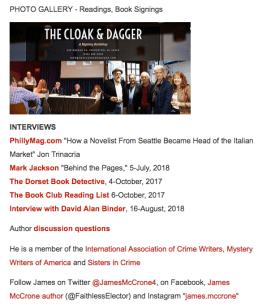 I love readings and book fairs for their chance to connect one-on-one with readers (and potential readers!); and interviews, like those on my
 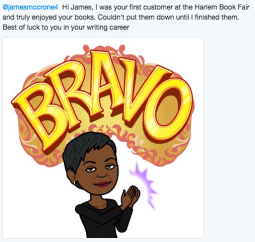 that it’s more useful as a means of connecting (or reconnecting) with readers after the fact than getting them in the first place.
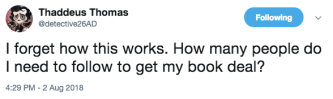 Because for writers, it’s all still decidedly analog. Whether a reader buys a physical book or an eReader isn’t the point: how s/he hears about it and makes a decision about reading it is. The personal appearance at a reading, a conference or at a book fair remains the crucial component for connection because those are the moments when the conversation is most focused on the work. Readers have insightful, sometimes difficult, questions. It’s harrowing, and incredibly rewarding.
 series, followed by an appearance at the Mystery Writers of America booth at the Harlem Book Fair (7/21) and then another reading as part of MWA Crime Fiction Reading Series at KGB Bar (8/2). At each of them I had at least two or three great conversations, and I’ve seen posts about the books.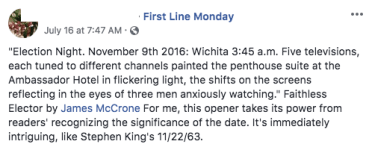
 On his blog,
 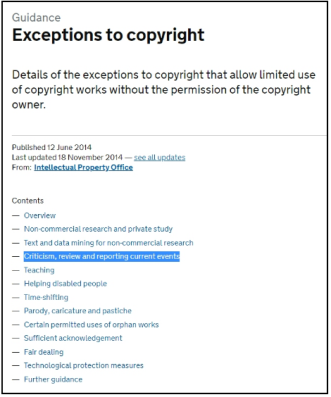 Campbell goes on to note in detail that Scottish Conservative party and anti-Scottish Independence news organizations seem not to have run afoul of the BBC’s gatekeepers.
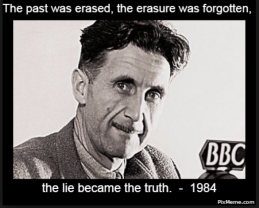 While this is particularly disturbing for pro-Independence voices, it also points up a larger contemporary epistemological problem: how do we know what we know, if the evidence and facts that underpin our opinions and action are so easily disappeared? How do we hold officials and others accountable when the record of their very words is so slippery?
 Chosen Words - James McCrone