Faithless Elector is 10 Years Old

Prescient then, dismayingly relevant now…and hopeful

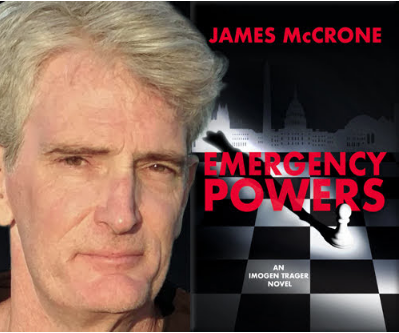
This week marks the ten-year anniversary of the publication of Faithless Elector, a thriller about stealing the presidency by manipulating the Electoral College. It kick-started the (fictional) career of Imogen Trager, a Justice Department agent in the FBI’s Voting Integrity.

The novel debuted in March of 2016, and its plot presaged many of the alarming things we contend with today—a shadowy, mendacious elite interested only in naked power, compromised officials, questions about voting integrity and much more.
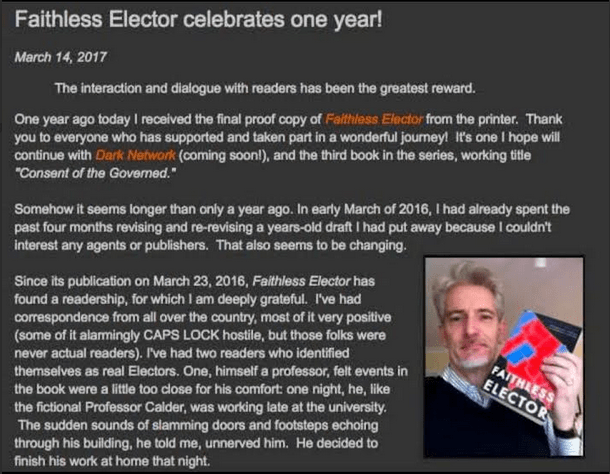
This reminder cropped up this morning.

In Faithless Elector, an idealistic, young graduate student working on his dissertation stumbles across a deeply suspicious number of deaths among Electors that no one else seems to have noticed.

He needs to get the information to someone who will believe him (he’s had conspiracy theories before), and who can do something to stop the plot before it’s too late. Which is where my recurring heroine and alter ego, Imogen Trager, a Justice Department agent in the FBI’s Voter Integrity makes her entrance.

The action covers just six weeks—a lifetime in politics…or the end of one—beginning in November, on the night of the 2016 general election and culminating on the day of the real presidential election, December 16, when Electors meet in their respective state capitols to cast their votes for president and vice-president.

As Imogen digs deeper into the case, she begins to suspect that some of her own colleagues might be working against her.

The novel sold well, and though I’ve since published three more (with another on the way!), it remains my best seller. The book was many years in the making, and as a result, it’s not about the current administration (Trump was not even the GOP’s candidate for president when the book came out) but about well-heeled forces undermining democracy, so intent on control that they’re willing to “shoot the hostage.”

What surprised many readers was that the conspiracy wasn’t tied to either of the main political parties, though it was parasitic on one of them. The most personally disturbing part of the book’s journey has been the continued sclerotic polarization of politics.

Imogen was (and is!) a heroine for our times not because she had an axe to grind but because she believed in justice, fairness and the sanctity of the vote. At the time, her stance was the least controversial or partisan part of the story.


James McCrone’s stories pose questions about the nature of power, the choices we make and the lessons we don’t learn.

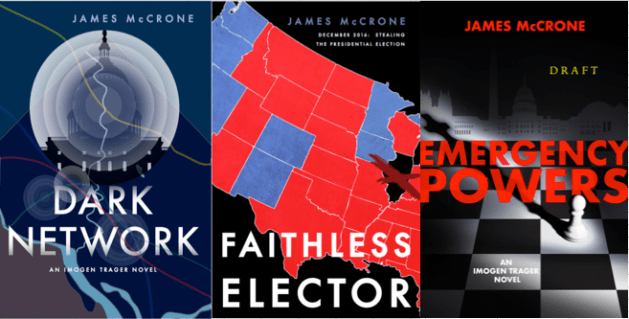
He’s the author of the Imogen Trager political suspense-thrillers Faithless Elector, Dark Network and Emergency Powers–noir tales about a stolen presidency, a conspiracy, and a nation on edge. Bastard Verdict, his fourth novel, is about a conspiracy surrounding a second Scottish Independence referendum. His current novel, Witness Tree, is out on submission.

All books are available on BookShop.org, IndyBound.org, Barnes & Noble, your local bookshop, and Amazon.

eBooks are available in multiple formats including Apple, Kobo, Nook and Kindle.

James is a member of Mystery Writers of America, Int’l Assoc. of Crime Writers, and he’s the current president of the Delaware Valley chapter of Sisters in Crime. He has an MFA from the University of Washington in Seattle, and he now lives and writes in Philadelphia, PA.

For a full list of appearances and readings, make sure to check out his Events/About page. And you can also follow me on Substack!

Some of his short stories are available FREE online. Links are HERE toward the bottom of the page.

Philadelphia Freedom!

Missed garbage pickup, South Philly

I’m sure I’m not the only one who’s glad to see the back of 2021. Professionally, last year played out like the opening of some noir tale about a small-timer who dreamed of and failed at making his mark…Back list sales languished, the pitches for my fourth thriller met with stony silence, the third act of a comedy play wouldn’t come together. The dismal list goes on.

But in the midst of all this, I started writing short stories again, something I hadn’t done in years. And while two of my three published novels feature South Philly, they’re not set here, aren’t about the place where I live.

All that changed this past year.

Each is set in Philadelphia, and each, while different in tone and detail, confronts the tension between the competing experiences of- and aspirations for the lives of the city.

And some of those stories have found excellent homes:

This past weekend (1/15/2022) “Eight O’Clock Sharp” debuted on Retreats from Oblivion: the Journal of NoirCon.
Later this month, “Ultimatum Games” comes out in Rock and Hard Place magazine issue #7
And in May ’22, “Nostalgia,” will be my contribution to volume 3 of the Low Down Dirty Vote anthology.

#7

In each of the stories above (and one or two that haven’t yet found a home), I wanted the conflict to be not just personal and unique to the characters, but also to represent the lived contention in modern cities, like my Philadelphia.

In “Eight O’Clock,” set in the 9th Street Market, Thomas is a man outside of time, forgotten, but trying to do the right thing while contending with avaricious forces. In “Ultimatum Games,’ about a rare book heist, the narrator and his partner in crime clash over evolving bourgeois norms. And in “Nostalgia,” an armed group tries to resurrect a past that never was as they struggle with change.

I’ve been thinking more about setting as character, and will be writing about that interplay in future posts.

# # #

James McCrone

James McCrone is the author of the Imogen Trager political suspense-thrillers Faithless ElectorDark Network and Emergency Powers–noir tales about a stolen presidency, a conspiracy, and a nation on edge. All books are available on BookShop.org, IndyBound.org, Barnes & Noble, your local bookshop, and Amazon. eBooks are available in multiple formats including Apple, Kobo, Nook and Kindle.

His next book, w/t Bastard Verdict, is a noir political thriller set in Scotland.

A Seattle native (mostly), James now lives in South Philadelphia with his wife and three children. He’s a member of the The Mystery Writers of America, Int’l Assoc. of Crime Writers, Int’l Thriller Writers, Philadelphia Dramatists Center and is the newly elected vice-president of the Delaware Valley chapter of the Sisters in Crime network. James has an MFA from the University of Washington in Seattle.

For a full list of appearances and readings, make sure to check out my Events/About page. And follow this blog!

Southern Gothic – Gladwell’s Grand Unified Theory

Malcolm Gladwell wrote a piece recently for Crime Reads in which he described his grand unified theory of thrillers. Briefly, he stated that “There are, structurally, four (4) essential narratives in [the thriller] genre.”

I tend to shy away from reductive theories, but they can be useful, too. And I think Gladwell is on to something. His four genres are cardinal in nature (and direction, too!):

1) In the Western, the hero comes to a world without justice or law, and establishes order.

2) In the Eastern, our hero works to improve and educate the institutions of law and order in a world where they are incompetent. (Think Sherlock Holmes and Agatha Christie’s sleuths.)

3) Third, is the Southern, where our hero, an outsider, restores order to a world that is hopelessly corrupt. “John Grisham’s novels are all Southerns,” Gladwell contends.

4) Last is the Northern, in which our hero works to perpetuate order from within a functional system. “The popular television show Law & Order is a classic Northern,” he notes, as is most Scandic-Noir.

It pains me to realize that while I’m drawn to “Western” thrillers (and Westerns), it seems (according Gladwell’s Theorem) that I’m writing Southern thrillers. Indeed, my favorite kind of Western stories are perhaps a subset of the genre, those in which not only is the world of the book or film without justice, but it’s going to take someone who’s even worse to put it right. And that person won’t be able to stay and enjoy it. They’ve made the world acceptable for decent people, which is why they must now leave.

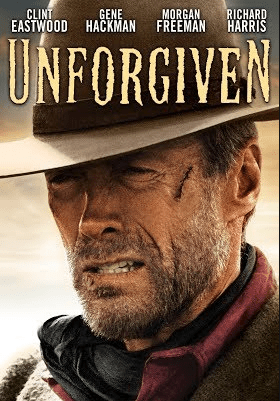
Unforgiven, Shane, True Grit and the Road Warrior movies spring to mind. But so do Hammett’s Red Harvest, and the Jack Reacher novels. They’re mythic tales—Unforgiven resonates heavily with medieval themes of good and evil, stories of knights and quests. A quest tale turned upside down, to be sure: the knight is a vile murderer, the damsel is a prostitute and the magic elixir which allows him to transform into a hero is corn whiskey.

Those are the Westerns I admire, and go back to. But what of the thrillers that bear re-reading? For the discussion, I’ll stick with well-known favorites: LeCarre’s George Smiley novels, Philip Kerr’s Bernie Gunther novels, Frederick Forsyth’s Day of the Jackal and Graham Greene’s Quiet American

Philip Kerr, to stick with Gladwell’s taxonomy, is writing Southerns. His recurring character, Bernie Gunther, is trying to inculcate something like morality or justice in the midst of Hell. Greene’s narrator, Fowler, can’t stop the war to come, any more than Gunther can stop the war he’s in, but he can do something, can strike a blow. By contrast, the wind blows Northern-ly for Smiley and Inspector Lebel, as they search and scratch and tighten the net around their quarry–Karla and the Jackal. Their dogged pursuit will prevail.

My protagonist FBI Agent Imogen Trager is a Cassandra figure, confronted with corruption no one else sees. She’s an outsider—even though as a Bureau Agent she should be the ultimate insider—made so by the very corruption and factiousness she opposes. She’s dedicated to law-and-order and accountability, because the opposite is thuggish, anarchic corruption and chaos. A Southern thriller, then, but with noir-ish elements of the Northern procedural. The conspiracy goes deep, and she knows that if you don’t get the root, it just grows back—perhaps stronger than before.

Whether the nomenclature of Gladwell’s Unified Theory is accurate (“eastern” and “northern” feel forced), it’s an interesting way to look at how thrillers operate. Fortunately, they’re not carved in stone, and there can be shared elements. His own take on Lee Child’s hero combines elements of both South and West(ern).

In each, we’re drawn to the problem, drawn in further by the situation and we want to watch our hero(ine) set it right. In the end, it’s just categories. It’s the details of why and how—and the characters—that will make it unique.

#   #   #

James McCrone

James McCrone is the author of the Imogen Trager political suspense-thrillers Faithless Elector and Dark Network about a stolen presidency, a conspiracy, and a nation on edge.The third book, Emergency Powers, is available NOW!

He’s at work on a fourth thriller, set in Scotland. A Seattle native (mostly), he now lives in South Philadelphia with his wife and three children.

Chaos Theory, Electoral College edition

SOCTUS-BldgA reader sent me a note asking whether a Supreme Court decision in favor of state laws governing Faithless Electors would make my thriller obsolete.
Sadly (for the nation)–No.

There would remain exploitable weaknesses—indeed, the very ones that are the linchpin of the plot in Faithless Elector would remain in place.

The vote can be suborned. I’ll explain.

The Supreme Court of the United States heard oral arguments regarding state-level Faithless Elector laws in Colorado and Washington State on May 13, 2020. At stake was whether state laws that bound Electors to vote as they pledged were Constitutional. They should issue their ruling in the coming weeks. (For much more background on this, including the relevant precedents, check out the Faithless Elector Argument Preview, posted on the SCOTUS-Blog. It’s informative, and not over-burdened with legalese.)

During oral arguments back in May, the Justices seemed keen to avoid electoral “chaos.” The chaos the Justices seem to want to avoid is that of Electors willfully or frivolously breaking their pledges. But even if the Court rules in favor of the state laws, the Electoral College vote will remain susceptible of being altered. (538.com does a nice job of contextualizing as well.)

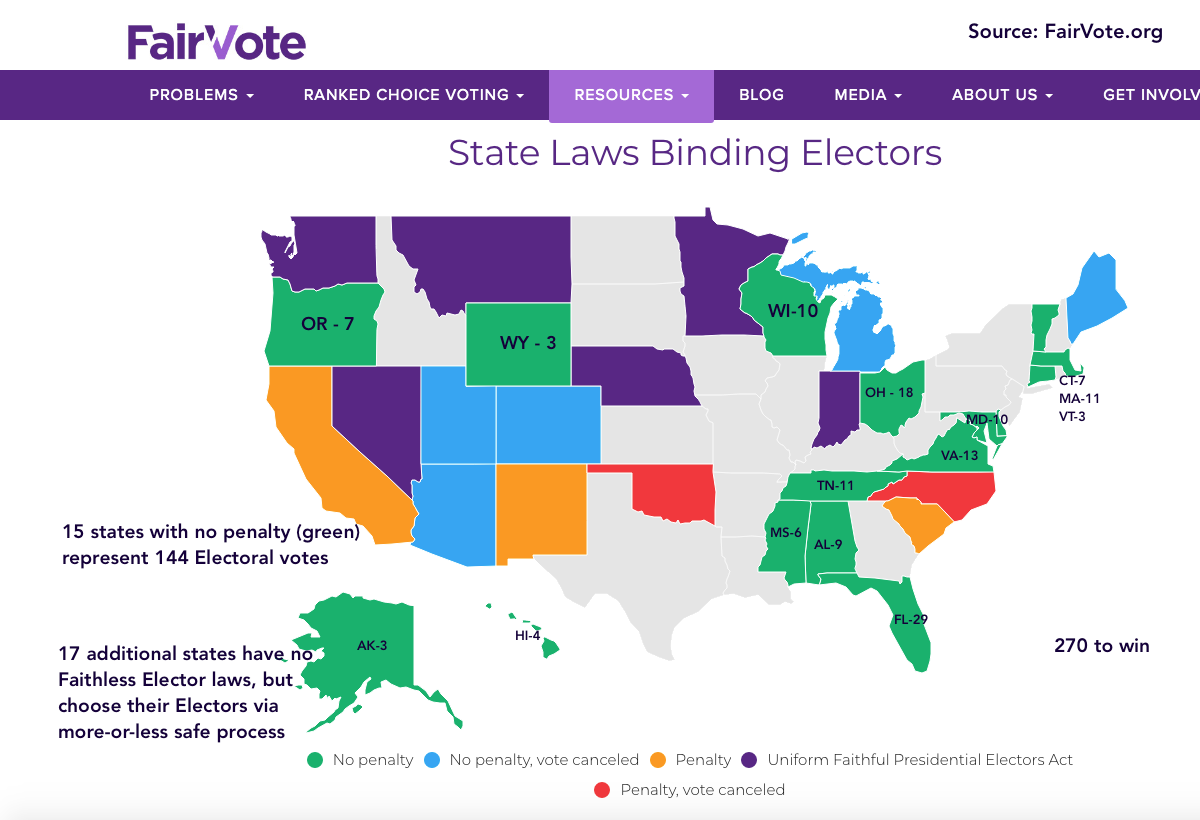
According to FairVote.org, along with those states with Faithless Elector laws, there are a total of 32 states that have no such laws. In that absence, Electors are therefore free actors.

2020-FE-no-penalty


Of the 32 states with no laws against an Elector breaking his/her pledge, 15 states (representing 144 Electoral College votes – light green on the map above) have no penalty whatsoever, while another 17 states are regarded as “safer,” or less likely to defect, even though they also have no such laws, because they have a strong, party-based vetting process. These states (gray on the map) represent 181 EC votes.

The question, then, is not whether the upcoming Supreme Court ruling will deal with willful petulance and protest votes. It seems likely that in upholding Washington and Colorado’s laws–if that’s how they rule–will deal with it. Up to a point.

Beyond that point, however, it means that there are 325 Electors who might be susceptible to voting against their pledge. No one is suggesting that all would vote against their pledge.

But in Faithless Elector, there is a very thin margin of victory for one candidate. Only three Electoral votes are needed to alter the outcome. In the real world, if the 32 states without laws against breaking an electoral pledge do nothing more to pass their own laws, and conspirators like those in my book were to target Electors in those states, they could reverse the supposed outcome of the presidential race.

It’s true that those who have been through party vetting would be far less likely to vote against their pledge. But for those who have read Faithless, you know that there are always inroads bad actors can make, and that fake news, fake voter fraud, corruption and murder, all figure into the Faithless conspirators’ equation to get the “right man” into the White House.

Chaos indeed. And worse.

#   #   #

The Imogen Trager #NoirPolitik Thrillers at a glance:

Faithless Elector – Everyone thinks the election is over, but six weeks is a long time in politics. An idealistic, young researcher stumbles onto a plot to steal the presidency, with deadly consequences.

Dark Network – Without law, there’s only power. FBI Agent Imogen Trager is alone and in grave danger from a conspiracy she failed to destroy. She’ll have to fight against time, a sinister network, and even her own colleagues to defeat it.

Emergency Powers (Oct. 1) – No battle plan survives contact with the enemy. The investigation that was FBI Agent Imogen Trager’s undoing may be the key to stopping a brutal, false flag terrorist attack meant to tighten a puppet president’s grip on power.

trilogy-draft

James McCrone is the author of the Imogen Trager political suspense-thrillers  Faithless Elector and Dark Network about a stolen presidency, a conspiracy, and a nation on edge.The third book, Emergency Powers, is coming October 1st, and he’s at work on a fourth book called Bastard Verdict (w/t) .

NetGalley-EmgPwrs


You can check out and review Emergency Powers for free on NetGalley.


_JMc-contact20Find them all through BookShop.org.  They are also  available at Amazon, Barnes & Noble, and Powell’s Books.

Link to REVIEWS

If you live in Philadelphia, you can pick up your copies at Head House Books, or in Princeton at Cloak & Dagger Books.
For a full list of appearances and links to reviews, check out:  JamesMcCrone.com