
Contemporary politico-corporate bullshitters have weaponized their discourse…
Harry Frankfurt’s Reflections on B. S. (1986), like Corinne Purtill’s recent essay “The difference between a snafu, a shitshow, and a clusterfuck,” does a nice job of distilling the differences, nuances and attendant dangers in an overlooked lexicon. But there’s more, piled higher and deeper.
 Like the differences between “shitshow,” “clusterfuck” and Snafu eloquently described by Purtill and discussed in an earlier post, there’s also a crucial difference between bullshitting and lying. As Frankfurt notes, the difference concerns truth value: one must believe that one knows the truth, in order to conceal it, to lie; whereas, the bullshitter has no necessary relation to truth.
Frankfurt notes that we have all dipped our toe in the swelling tide of bullshit (if not, er, stepped in it); and, like art, we all think we know it when we see it. Often, as the advice a father gives his son makes clear in Eric Ambler’s Dirty Story, we regard one as preferable to the other: “Never tell a lie when you can bullshit your way through,” says the father.
So, is bullshitting preferable to lying?
I would say that now, 30-plus years on from Reflections’ first printing, it’s the wrong question: in the corporate and political realm, bullshit and lying have become the same thing. Indeed, now, it’s lying by bullshitting.
Journalist Timothy Egan weighs in on a related subject with a NY Times piece this past week on euphemism: “The most egregious of political language fraud,” Egan writes, “as George Orwell noted in his seminal essay on the subject, is used for ‘the defense of the indefensible.’ To that end, the Trump administration has been a fount of criminal circumlocution.”
 Though Egan quotes from ‘Politics and the English Language,’ he may indeed be guilty of euphemism himself when he fails to call Trump’s “criminal circumlocution” what it is: bullshit.
Frankfurt’s notion of “truth value” evokes an image in which a lie erects a wall concealing the truth, while bullshit merely litters the pasture. Today, however, contemporary politico-corporate bullshitters have weaponized their discourse, and the most adept practitioners (Mark Zuckerberg, the current president,the Senate majority leader, Lindsay Graham spring to mind) now make the wall out of bullshit to hide or obscure the truth.
“Ah, they’re just bullshitting,” we say of the politician or the corporate flack, and so they often are. And we stop listening. More to the point, we may grow weary and stop paying attention. In either case, we’ve come no nearer to truth or accountability.
The misidentification of and our winking attitude toward bullshit carries dire consequences. In George Orwell’s “Politics and the English Language” (1946), he equates bad prose with oppressive ideologies, and he’s not wrong. Language exists to convey and reveal thought, and when it’s used to do the opposite, we should be concerned.
“Some comfortable professor defending Russian totalitarianism,” writes Orwell, can’t say outright: “‘I believe in killing off your opponents when you can get good results by doing so.’” People would be aghast. And rightly so. To get there, you would need to hide behind opaque, obtuse language, disguising what you’re saying (perhaps even from yourself), as:
“While freely conceding that the Soviet regime exhibits certain features which the humanitarian may be inclined to deplore, we must, I think, agree that a certain curtailment of the right to political opposition is an unavoidable concomitant of transitional periods…”
The above is a species of euphemism; and it might succeed as rhetorical pabulum precisely because it conjures no concrete images, and shades its meaning with ponderous, sonorous dependent clauses, but that’s not what rhetoric does today.
I part company with Egan’s euphemism diagnosis because it sounds like “spin,” an older form of deception. While it seeks to disguise, spin can at least be decoded by reading between lines. Bullshit in its contemporary guise, by contrast, is about overwhelming. It seeks to shift so much bullshit on everyone and anything that there is nowhere to step. If there were lines to read between, they’ve been buried under steaming mounds.
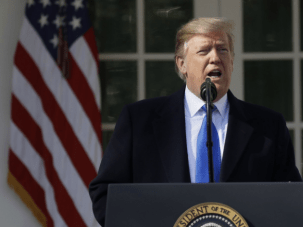 Trump’s speech this past Friday invoking emergency powers to build a border wall is the apotheosis (or nadir) of bullshit, and it differs from earlier bullshit only in degree. During his speech, if it can be called that, after a series of dismaying, unrelated digressions, after using the word “invasion” seven times; after flinging the bullshit every which way he can, he states that his emergency declaration isn’t actually urgent at all, but an expedient. And yet, admitting that, he will go forward. Because….ya know.
 The only truth attached to this administration was scrawled on the back of the First Lady’s jacket: “I really don’t care. Do you?”
Which is the administration’s surprisingly consistent message behind all the bullshit.
James McCrone is the author of the Imogen Trager political suspense-thriller series Faithless Elector and Dark Network. The third and final book in the series, Emergency Powers, is coming soon.

Find them through Indybound.org. They are also available at Amazon, Barnes & Noble, and Powell’s Books.
Link to REVIEWS

 intrigued to discover what happened during the times for which there’s no data. Where was he? What was he doing? The record is incomplete.
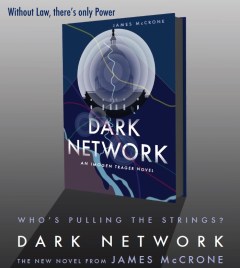 In an early scene from the book (p. 35), frustrated at the FBI’s lack of progress and in a fit of pique at her new boss, who keeps calling and texting her for status updates, Imogen considers turning her phone off. To do so, she admits sourly, would be “like an act of treason.” She sits at her desk seething, looking over the scant bits of evidence she has—wallet, keys, drop phone: “Or,” she thinks, “if you were committing treason, wouldn’t you turn it off?”
 In the Noirpolitik thriller Faithless Elector, the reason the faithless electors give for not voting as they pledged to vote (for switching) is presented as a vote of conscience. In the book, there were seeming irregularities in the Illinois vote count, allowing each faithless elector to say their switched vote was cast as a vote of conscience for the candidate who should have won the presidency.
 Perhaps I should have chosen Florida, particularly since the scandal, irrespective of the truth remains a volatile point of contention across both (now, all three) books and Florida is back in the news again…and likely, again.
 2016 election (March, to be precise), long before either of the parties had chosen their candidates. At the heart of the stories is FBI Analyst-turned-Agent, Imogen Trager, whose patient, analytical approach is regarded as alien and “soft” by many of her colleagues—even while it is precisely her methods that are getting results.
 So, did I just get lucky that many aspects of the novels jibe with our collective sense of democracy off the rails? Do I have a crystal ball?
 Chosen Words - James McCrone