
I was paralyzed with self-loathing that I might have just done something I (rightly) deplored.
Recently on Facebook, I copied and reposted a piece about the deaths of the four US soldiers in Niger. A good friend had put it on his Facebook page.
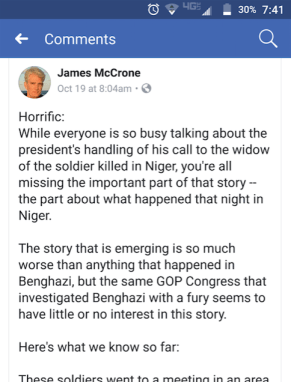 I read the post and was outraged. I copied, pasted and posted…adding “horrific” to the lead-in.
I felt it was important to do so. The message of the post seemed particularly important to me as something that cut through the noise of the issue: that the current president’s bewildering and reprehensible handling of the aftermath—while dismaying and frankly sickening—was a distraction; that there was more going on.
The issues in the post were:
- We had ignored (or had not consulted!) our intelligence experts;
- Our troops have been systematically neglected and undermined;
- Communication is abysmal or nonexistent.
- Years of outsourcing key portions of military operations (for private gain) and years of scrimping on equipment have left our fighting men and women exposed to greater danger than they already would be.
- As a result, four soldiers are dead.
A number of Facebook friends “liked” the post and shared it. Two friends, however, asked me what the source(s) were. They were themselves aghast at the criminal level of ineptitude described in the post, but the points about contractors and the French was new information, and they wanted to understand its provenance before reposting themselves.
Which is what I should have done.
The insidiousness of fake news is that it can work directly as dis-information; and, more subtly, it can also serve to undermine the very notion of truth. In the past, I’ve been more than happy to repost the debunking of fallacious stories propagated by reactionary wingnuts.
In this instance I was paralyzed with self-loathing that I might have just done something I (rightly) deplore just because it fit the kinds of things that make me angry. Because if I had just reposted something dubious, I was giving reactionaries a cudgel with which to strike at the battered and bloodied notion of truth, where they could say, “See? No one has regard for the truth. It’s just as we [the reactionaries] say: it’s all about your perspective and outrage…and everyone does it.”
I started tracing the story—now well after the fact. It seems to have started on a man named Bob Lamb’s Facebook page. I saw it picked up in the comments/forum section on Talking Points Memo (TPM), which referred to him. From there, it bounced around, and was reposted by me…and others.
I regret reposting what seems now to be “truthy.”
Here is the full text of the post. The notes in square brackets are mine.
While everyone is so busy talking about Trump’s handling of his call to the widow of the soldier killed in Niger, you’re all missing the important part of that story — the part about what happened that night in Niger.
The story that is emerging is so much worse than anything that happened in Benghazi, but the same GOP Congress that investigated Benghazi with a fury seems to have little or no interest in this story.
Here’s what we know so far:
These soldiers went to a meeting in an area near the border with Mali. This is a well known hot spot for ISIS activity. [true. this is backed up by everything I’ve now read.]
Our soldiers were not backed up by US Military air support. No, they were backed up by the French, who were not authorized to intervene or even fire a shot. [this was the original reporting, but it now seems that the French pilots were not asked to engage out of fear of “friendly fire.”]
Our soldiers did not have armored vehicles. They traveled in pickup trucks. [true]
Our soldiers were given faulty intel that said “it was unlikely that they would meet any hostile forces.” Of course, they walked into an ISIS ambush. It was chaotic and they took three casualties. [this is an odd part: the various reports say the soldiers knew it was an ISIS hotspot and had gone to the village to speak with one of the village elders.]
It took the French 30 minutes to arrive. [they were called in for support about an hour into the fight and by all accounts arrived quickly.]
When they did, they were not authorized to help. [by the troops on the ground, who were fighting at close quarters and didn’t want to risk “friendly fire (see above)] So, a dozen of our Green Berets fought a battle with more than 50 ISIS fighters, without help, for 30 minutes.
Finally, a rescue helicopter arrived, but it was not a US military helicopter. [I can find no reporting confirming this point.]
No, we apparently outsourced that job to “private contractors.” So, these contractors landed and loaded the remaining troops, the injured and the dead.
Here’s where this gets really bad ….
Because they were not military, they never did a head count. That is how Sgt. La David Johnson was left behind. [again, I’ve seen no reporting that confirms this]
That’s right …. they left him behind. [they did leave him behind, but why they did so remains an open question]
According to the Pentagon, his locator beacon was activated on the battlefield, which indicates that he was alive when they left him there.
They recovered his body 48 hours later, but are refusing to say where. According to his widow, she was told that she could not have an open casket funeral. This indicates that he was mutilated after being left behind on the battlefield. [it indicates that his body is not viewable; the reason is speculative]
This is what led to the nonsense we’re obsessing over. This is the real story. As usual, you’re allowing it to be about Trump’s distraction, but this is Benghazi on steroids.
The Trump Pentagon gave these men bad intel, no support, outsourced rescue people and then tried for more than a week to pretend it never happened. [our soldiers clearly had bad intelligence…]
In that time, Trump spoke on many occasions and never mentioned it. He tweeted attacks on many but never mentioned these men. [true]
Only after pressure from the media has he bothered to even acknowledge these men and their service
Please share, copy and paste. [which I did]
The post above indulges in “truthiness.” There is much that’s wrong and unknown about what happened, and our soldiers and their families deserve better. However, they—and we—are not served by adding seemingly true statements that fit our version of the facts.
I intensely regret my part in propagating this cynical pabulum. If any of the unsupported claims here turn out to be true, they will need addressing. In the end, it may be that these deaths are worse than what happened in Benghazi. It may be that out-sourced “contractors” left a man behind to die. It is true that we don’t properly support our military. But when outrage rides in on an obviously stolen horse, we would all do well to ask a few questions before rallying to follow it.
The current administration supplies us with a daily diet of callous cruelty and bumptious, self-dealing ineptitude. Adding in false claims undermines the very real effort to resist.
I thank the two friends who reminded me.
 James McCrone is the author of Faithless Elector and Dark Network, part of the Imogen Trager political suspense-thriller series. They are available at many local bookstores. Find them through Indybound.org. They are also available at Amazon, Barnes & Noble, and Powell’s Books. REVIEWS
If you live in Philadelphia, pick up a copy at Head House Books -or- Penn Book Center
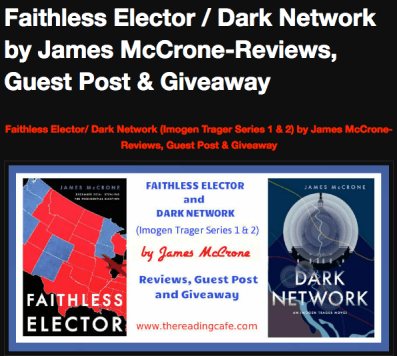
 Thank you to the over 1,000 people who signed up for the Goodreads Faithless Elector giveaway contest. There have been 25 lucky winners of a signed copy of Faithless Elector, the first Imogen Trager novel. Anyone living in or near Philadelphia or North Jersey who would like a signed copy of either Faithless or the second Imogen Trager novel, Dark Network (out Oct. 20!) should check out my appearance calendar on Facebook << https://www.facebook.com/pg/FaithlessElector/events/>>.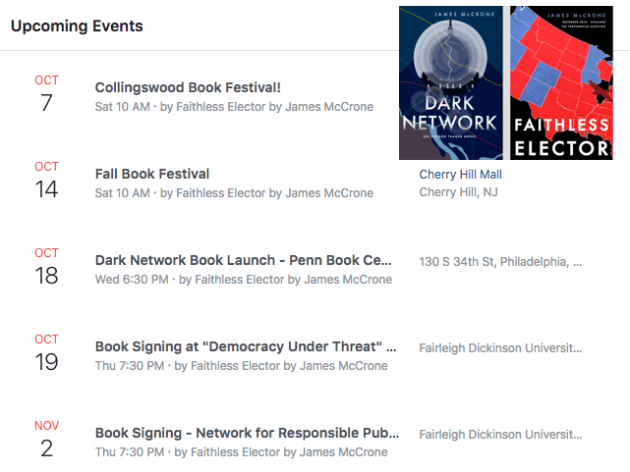
 John Le Carre’s new novel,

 Chosen Words - James McCrone