Without law, there is only power

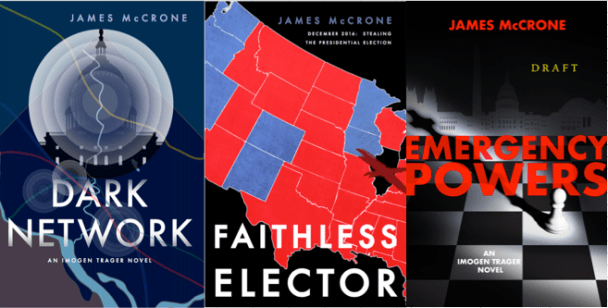
“Without law, there is only power,” is the tagline for the second book in the Faithless Elector series, Dark Network.

The books have been prescient about where we find ourselves today, attacks on the Electoral College, attacks on voting; naked power grabs by people from outside the parties who are nevertheless parasitic upon them (and who, like parasites, take over and destroy their hosts). There is a prison murder made to look like suicide, false flag attacks–and all written years before such events took center stage.

But I have to admit to a little naivety.

As the tagline above suggests, I had stupidly believed that the law might be a check on power. I had no inkling that the Dept. of Justice and the courts could be neutered (or weaponized) to the extent that we’re seeing today. The courts may indeed turn out to be a bulwark against the worst excesses of the current Trump administration, but I am not optimistic.

If I were writing Dark Network today I might use the tagline “when power is the law, there is no justice.”

Laws are not self-enforcing. We learned today, that DOJ lawyers are “being forced to choose between the president’s agenda and their ethical obligations as attorneys” (NYT, see link above).

With a supine congress, content to cede power to the presidency, there is little chance the administration will follow rulings that are contrary to its will. When the Supreme Court continues to abdicate its prerogatives, too, it’s unlikely that the administration will be compelled to do anything or uphold anything it doesn’t want to.

Voting is the crux of all three novels in the Faithless Elector series. It’s what the conspirators try to undermine and nullify. So, while I may have missed some of the viciousness and vindictiveness of the current administration in my novel, their real-world undermining of voting rights remains salient.

My alter-ego, and protagonist in all three books, FBI Agent Imogen Trager, is driven by her rage to oppose those who would take away or mitigate the right to vote. To do so, she has to navigate compromised and outright corrupt colleagues, a shadow paramilitary group and more to unmask who is pulling the strings and bring him to justice.

The “law” that Imogen fights desperately to preserve is that of the people to determine their own destiny. And in the real world, it’s also under daily threat.

Democracy Docket is fighting anti-voting legislation across the country, and it will be voting that brings some semblance of order and justice to the nation. “We are not powerless, and we must not act like we are,” writes Marc Elias.

I might add that they wouldn’t fight so hard to take away your vote if it wasn’t so important…and worrisome to them.

The Imogen Trager #FaithlessElector Thrillers at a glance:

trilogy-draft

Faithless Elector – Everyone thinks the election is over, but six weeks is a long time in politics. An idealistic, young researcher stumbles onto a plot to steal the presidency, with deadly consequences.

Dark Network – Without law, there’s only power. FBI Agent Imogen Trager is alone and in grave danger from a conspiracy she failed to destroy. She’ll have to fight against time, a sinister network, and even her own colleagues to defeat it.

Emergency Powers – No battle plan survives contact with the enemy. The investigation that was FBI Agent Imogen Trager’s undoing may be the key to stopping a brutal, false flag terrorist attack meant to tighten a puppet president’s grip on power.

# # #

James McCrone is the author of the Imogen Trager political suspense-thrillers Faithless ElectorDark Network and Emergency Powers–noir tales about a stolen presidency, a conspiracy, and a nation on edge. Bastard Verdict, his fourth novel, is about a conspiracy surrounding a second Scottish Independence referendum. His novel-in-progress is called Witness Tree, a (pinot) noir tale of murder and corruption set in Oregon’s wine country.

All books are available on BookShop.org, IndyBound.org, Barnes & Noble, your local bookshop, and Amazon.

eBooks are available in multiple formats including Apple, Kobo, Nook and Kindle.

James is a member of Mystery Writers of America, Int’l Assoc. of Crime Writers, and he’s the current president of the Delaware Valley chapter of Sisters in Crime. He lives in Philadelphia. James has an MFA from the University of Washington in Seattle.

For a full list of appearances and readings, make sure to check out his Events/About page. And follow this blog!

You can also keep up with James and his work on social media:
Mastodon: @JMcCrone
Bluesky: @jmccrone.bsky.social
Facebook: James McCrone author (@FaithlessElector)
and Instagram/Threads “@james.mccrone”

Et In Arcadia Ego

(“Even in Arcadia, there am I”)

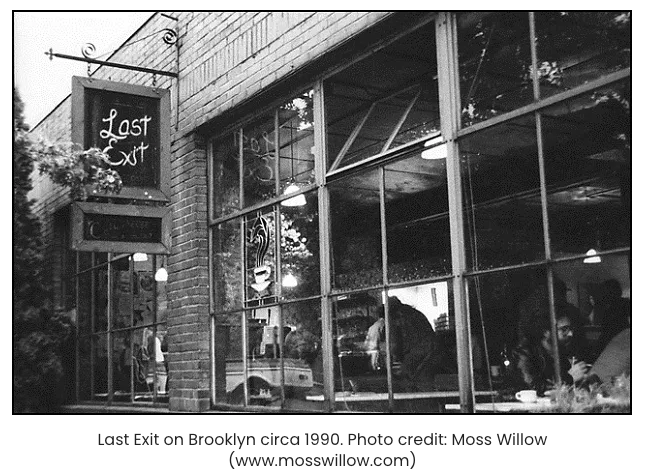
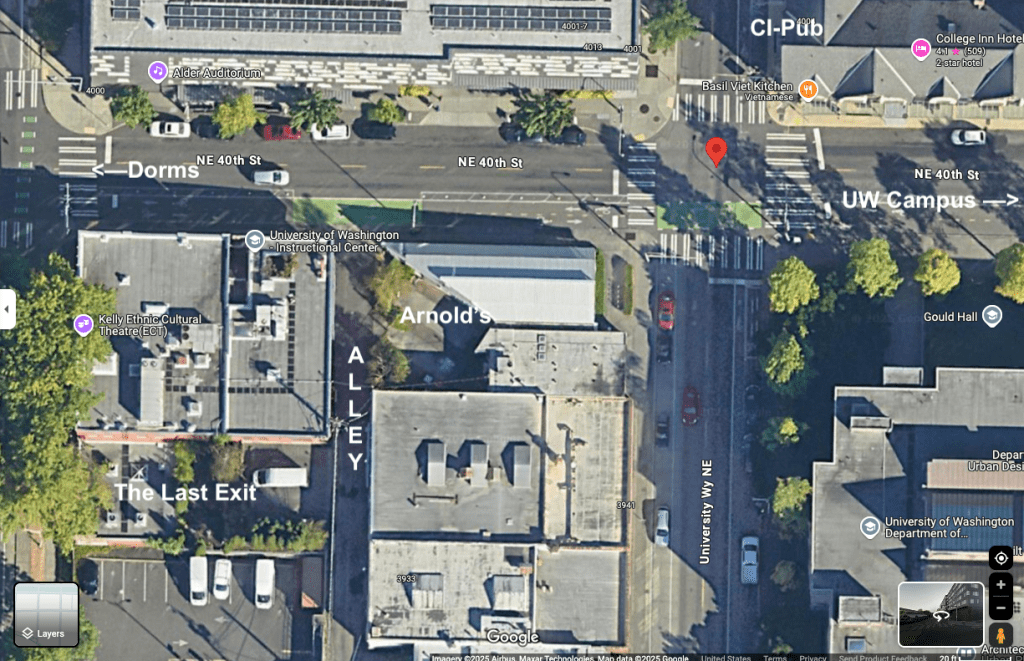
There was a place, at NE 40th Street and University Way in Seattle’s University District, where even recently, some 40 years on, I could locate and remember a former, younger self, one now slowly fading. That intersection was quite literally a crossroad for me–between the Last Exit on Brooklyn, the College Inn Pub and Arnold’s. And the University of Washington.

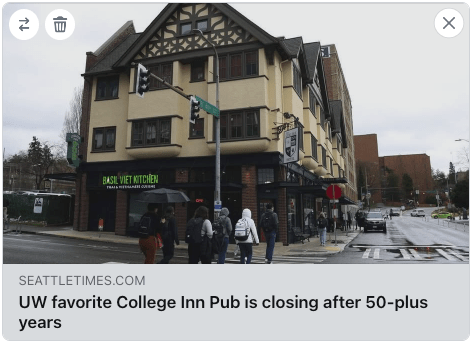
The news that The College Inn Pub will close after 50 years has hit me hard. I have read that you die by degrees; that is, you’re not really gone until the last person who remembers your face dies. But I think parts of us disappear even while we’re living.

The “I” in the translation above is meant to be death itself, present everywhere, even in the happiest places. Which that corner certainly was. It also leapt out at me because Arnold’s Video Arcade, scene and locus of much misspent youth, was diagonally across the street.

This post isn’t meant to be a cranky whinge about how great things used to be and how soulless and rotten they are now. Change is a constant, you can’t put lightning in a bottle, and lots of other cliches that for all their threadbare, hackneyed-ness nevertheless articulate a truth. It’s that when things that are (or were) a part of you disappear, it feels like losing yourself, or like reaching out in the dark to touch a wall you know should be there. But it’s not. People, places and things locate you, give you context, guidance, maybe even comfort.

The Pub anchored the northeast corner of NE 40th Street and University Way in Seattle’s University District, an area just west of the University of Washington campus that was a focal point for the lives of me and my friends from 1979 until about 1994, by which time I had moved to another part of the city, first Belltown, then Beacon Hill and then the Rainier Valley.

Diagonally across the intersection from the Pub stood Arnold’s, a video arcade. Just around the corner, on Brooklyn Ave., was The Last Exit on Brooklyn, Seattle’s second oldest coffee house, and one of the oldest in the country. It stood right next door to the Ethnic Cultural Theatre. Arnold’s is long gone, The Exit moved to a new a location and then closed 20+ years ago, and now the College Inn Pub is up for sale and will probably be closed.

I started working at The Exit as a dishwasher when I was 15 years old in 1979. Later, when my high-school friends and I would stop in at Arnold’s to play Asteroids, or Defender or Ms. Pac-Man, we’d often steal through the alley into the back of The Exit, where we would hang out. And if it was a weekend night, we’d look for someone to buy us beer. I would also take dates there. Not only was it an interesting, funky place, but it was cheap, and I was known.

I think I was the youngest employee Irv Ciskey, the owner, had ever hired. I had gone to his other restaurant, Lake Union Pizza, to apply for a job when we moved to Seattle, and he had sent me to The Exit. Unbeknownst to me at the time, Irv had called the manager there and told him to hire me. It did seem like an easy interview even at the time.

Even before I was old enough to go inside, the College Inn Pub loomed large in my thoughts. My freshman year at the University, I was in the Terry-Lander dormitory, and even though it was generally simpler to take the Campus Parkway exit from the building to get to my classes, I would often leave via the back exit, and NE 40th–terra firma. I’d head to The Exit for a quick espresso, then mount the stairs to leave via the back way out, into the alley that also ran behind Arnold’s and onto the street.

Later, I would work at the Pub as a “beertender”–my work life as a grad student split between it and the University Bar & Grill about six blocks up the street.

Even after we had moved east, returning on visits to that corner, I could see myself there. It was unique in that it represented not just a snapshot of my life, but a series of lives–adolescence, undergraduate, graduate, young father–were enacted there. Not like flipping through an album of static pictures or one brief moment, but like viewing a film covering the ages of 15 to 36, how I changed (if, indeed, I’ve every really grown up!), how my friends grew, how the city changed, even as the corner remained largely unchanged whenever I returned. Fortunately, I’m still close with those friends, even if we don’t see one another regularly.

I lived in the midwest (Wisconsin and Iowa) for about 12 years, in Seattle for 21; and I have now lived away from Seattle for longer than I was there (25 years). My wife says I’m a midwesterner at heart, but a good deal of my life and heart is at 40th and University.

I’m not sure when I’ll be back in Seattle next, though I hope it will be soon. If you see some sad and bitter old man standing in the intersection staring disconsolately, or pointing out what used to be, he’s not lamenting a Seattle that is no more, but mourning the loss of a bit of the sense of himself.

Maybe I should be grateful that I have such a place–a “better to have loved and lost…” kind of thing. Maybe I will be grateful one day.

# # #

James McCrone is the author of the Imogen Trager political suspense-thrillers Faithless ElectorDark Network and Emergency Powers–noir tales about a stolen presidency, a conspiracy, and a nation on edge. Bastard Verdict, his fourth novel, is about a conspiracy surrounding a second Scottish Independence referendum. His novel-in-progress is called Witness Tree, a (pinot) noir tale of murder and corruption set in Oregon’s wine country.

All books are available on BookShop.org, IndyBound.org, Barnes & Noble, your local bookshop, and Amazon. eBooks are available in multiple formats including Apple, Kobo, Nook and Kindle.

James is a member of Mystery Writers of America, Int’l Assoc. of Crime Writers, and he’s the current president of the Delaware Valley chapter of Sisters in Crime. He lives in Philadelphia. James has an MFA from the University of Washington in Seattle.

For a full list of appearances and readings, make sure to check out his Events/About page. And follow this blog!

You can also keep up with James and his work on social media:

Mastodon: @JMcCrone
Bluesky: @jmccrone.bsky.social
Facebook: James McCrone author (@FaithlessElector)
and Instagram/Threads “@james.mccrone”

Fluidity of Memory and Guilt by Association

We are the sum total of the memories and experiences we have forgotten. Or, as William Faulkner put it, in Light in August, “Memory believes before knowing remembers. Believes longer than recollects, longer than knowing even wonders…” Memory is also associative, grouped with other memories, sometimes seemingly at random.

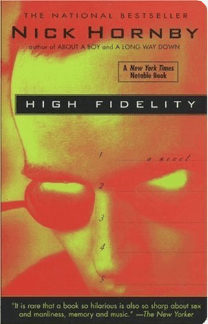
Memory and story-telling are a bit like Rob’s “autobiographical” filing method for his record collection in High Fidelity: “If I want to play, say, Blue by Joni Mitchell, I have to remember that I bought it for someone in the autumn of 1983, and thought better of giving it to her, for reasons I don’t really want to go into…”

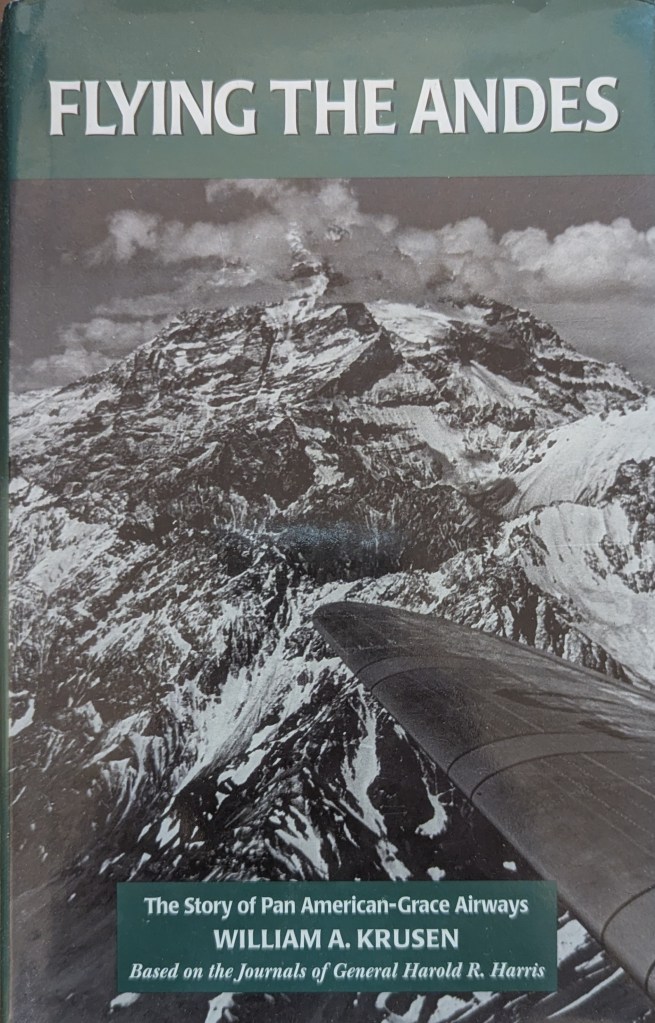
As I whittle away and reorganize the undying manuscript called Witness Tree (hope to have a final-final draft by the end of this week!), I’ve also begun working on my sixth novel, tentatively called Hours, about a pilot flying South American routes in the late 1940’s. And I’ve been thinking and writing a lot about memory.

Hours is loosely based on my grandfather’s experiences as an airline pilot based in Lima, Peru. I say loosely, because though it draws on his experiences and impressions, it is not his story. Though I hope I’m able to preserve some of the essence of him. He was a fantastic storyteller, and I’m equally hopeful that his spirit of fun, adventure and not letting facts get in the way of a good story will continue to guide and inspire me.

The opening of Hours, begins with the observation that “Memory is fluid, roiled by currents that carve deep paths, much as flowing water forges a riverbed but is thereafter constrained by it.”

The narrator, a pilot flying South American routes in the late 1940’s, is thinking back to the pinnacle moment of his career. He sees himself as though standing outside himself, a young captain, on the tarmac in Santiago, Chile, peering toward Los Andes, waiting for some sign that the “Paso de la Cumbre,” 65 miles away and still obscured, will clear. And as he conjures that earlier, younger self there on the tarmac, he finds that he’s thinking of his earliest memory of flight, when he was seven years old in West Virginia:

“If I’m to think of the pilot, I must also think of the boy, must follow the course. Because as the pilot peers toward the Andean mists, playing his game of chicken with the weather, he thinks of the boy he was. The boy’s dreams were wild, he remembers. But not this wild.”

Hours is not very far along. But I see it being told in two inter-layered parts, from two perspectives, the protagonist is the pilot in the late 1940’s, and his grandson in the present day–also a pilot–who goes through his grandfather’s log books and notes, after his own Icarus-like fall from grace. And the skies.

It will be about flying, class (rags-to-riches), and the struggle between outward success and inward peace. Like the spotty, primitive radio signals they are meant to use for navigation, the novel asks, what are you to do when the thing that’s meant to guide you may be deadly wrong? It will be through memory, and its associations, that at least one of them will find a kind of redemption.

# # #

James McCrone is the author of the Imogen Trager political suspense-thrillers Faithless ElectorDark Network and Emergency Powers–noir tales about a stolen presidency, a conspiracy, and a nation on edge. Bastard Verdict, his fourth novel, is about a conspiracy surrounding a second Scottish Independence referendum. His novel-in-progress is called Witness Tree, a (pinot) noir tale of murder and corruption set in Oregon’s wine country.

All books are available on BookShop.org, IndyBound.org, Barnes & Noble, your local bookshop, and Amazon. eBooks are available in multiple formats including Apple, Kobo, Nook and Kindle.

James is a member of Mystery Writers of America, Int’l Assoc. of Crime Writers, and he’s the current president of the Delaware Valley chapter of Sisters in Crime. He lives in Philadelphia. James has an MFA from the University of Washington in Seattle.

For a full list of appearances and readings, make sure to check out his Events/About page. And follow this blog!

You can also keep up with James and his work on social media:

Mastodon: @JMcCrone
Bluesky: @jmccrone.bsky.social
Facebook: James McCrone author (@FaithlessElector)
and Instagram/Threads “@james.mccrone”
The Whisper Legacy, by Tj O’Connor – Review

“Curran’s enemies thought he was dead. They were wrong.
He thought his past was left on the Voula Beach Road. He was wrong. Now, that nightmare is drawing his enemies out”

Whisper Legacy is a brilliant, powerful and well written cyber warfare “take” on the familiar noir tale of criminals needing to keep their stolen records hidden. But with some intriguing twists. Beset by PTSD, lingering injuries and creeping old age, (Mar)Lowe Curran makes a living “on both sides of the ethics line” as what’s left of the former black ops spy he once was. Now a security expert, an unregistered PI and a fixer for the powerful, enigmatic TAE–“Tommy” to his friends–Curran inadvertently stumbles into a much more sinister plot involving the highest levels of government.

When Curran steals back the records and files that the hacker “Piper” stole from TAE’s company, he inadvertently downloads the records of a shadowy influence-peddling group’s blackmail operations, known as Whisper. Worse, for Curran, the Whisper group has already tried to kill him. Twice.

Whisper Legacy takes us through slimy operators, to the rich and powerful, right up to the highest levels of politics, where everything is personal. Not least, for Curran. He lives not only with the aches, pains and nightmares of his past work, but also with deep regret. This is about to get ugly. And dangerous. Powerful people with shady friends need the duffel bag to remain hidden. To stay alive and expose Whisper will take all of Curran’s experience, guile and grit. The police are the least of our hero’s problems.

Lowe Curran is an engaging narrator and guide. The story moves along confidently and quickly, spinning its seemingly disparate strands in a way that feels fresh, all while leading us, and Curran, inexorably on. I liked that our hero was human, hobbled by old wounds in very real ways. He’s forced to use his wiles more than his fists or a gun (though he certainly knows how to use them both when called upon). The scene that opens the book is a wonderfully chaotic masterclass in improvised spy craft. Levels of madness misdirect from the darker purpose and set an assured tone for the story to come.

Highly recommended!

Whisper Legacy is available on Bookshop.org, Amz, Barnes & Noble and through Bookbub

# # #

James McCrone is the author of the Imogen Trager political suspense-thrillers Faithless ElectorDark Network and Emergency Powers–noir tales about a stolen presidency, a conspiracy, and a nation on edge. Bastard Verdict, his fourth novel, is about a conspiracy surrounding a second Scottish Independence referendum. His novel-in-progress is called Witness Tree, a (pinot) noir tale of murder and corruption set in Oregon’s wine country.

All books are available on BookShop.org, IndyBound.org, Barnes & Noble, your local bookshop, and Amazon. eBooks are available in multiple formats including Apple, Kobo, Nook and Kindle.

James is a member of Mystery Writers of America, Int’l Assoc. of Crime Writers, and he’s the current president of the Delaware Valley chapter of Sisters in Crime. He lives in Philadelphia. James has an MFA from the University of Washington in Seattle.

For a full list of appearances and readings, make sure to check out his Events/About page. And follow this blog!

You can also keep up with James and his work on social media:
Mastodon: @JMcCrone
Bluesky: @jmccrone.bsky.social
AND MORE, on the links page