Ship of Theseus

“When is ‘am’?” The persistence of identity and Witness Tree

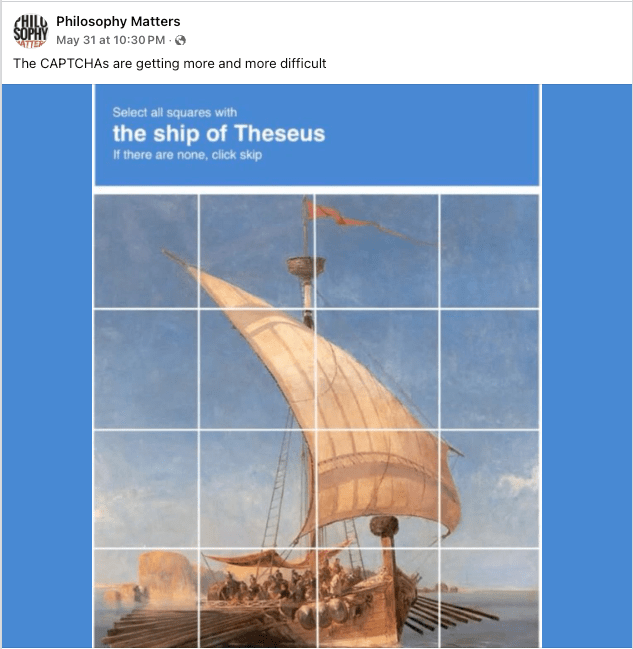
The Ship of Theseus looms large as a metaphor for ideas about identity and change in my novel-in-progress, Witness Tree, a suspense-thriller about a leadership battle for (white) supremacy in a rural Oregon county that erupts into the open when newly sober, ex-con David Paterson is the sole witness to a brutal execution meant to tie off the last loose thread.

David is trying to make a fresh start in sobriety, but he carries the weight of the past with him, along with questions about how much he may (or may not) have changed during his eight years in prison. When he reports the murder to the police, as a now-solid citizen should, it’s the deputy who put him away eight years earlier who takes his testimony. The deputy makes it clear that if a body is ever found, David will be the prime suspect. “People don’t just change overnight, Paterson,” he says.

[from Wikipedia]: “In its original formulation, the ‘Ship of Theseus’ paradox concerns a debate over whether or not a ship that has had all of its components replaced one by one would remain the same ship.” For David, the notion that you can never step into the same river twice; that “Upon those who step into the same rivers, different and again different waters flow,” looms large.

So, as to identity–which is it? Which you is “who”? The person you are today? Five years ago? Who will you be in fifty years? And when is “am”? This week? Today? And which facet of you is “I”? I’m writing a suspense-thriller, so I don’t belabor the point or get in the way of the story, but David can’t be sure who he is, or what he wants, and he can’t know how others perceive him.

The story becomes David’s race to find out who was killed, why, and by whom, before the police can hang it all on him. As he investigates, with the help of two high school friends who still stand by him, he finds that what the murder was meant to cover up runs deeper and wider than David could have imagined. Worse, the murder and officials’ seeming complicity in it, feels eerily like the murder of his friend in prison, to which he was also a witness. In prison, the Aryan Brotherhood left him alive–and damaged–as a warning to others.

The photo of the pine tree on the hillside that you see is the Witness Tree that inspired the book. It’s near my parents’ farm, a Yamhill County, Oregon, survey marker, delineating plots of land. It’s probably 80 years old. Or more. And it is illegal to cut it down. “Witness to corner,” the badge on the tree reads. My mother, now passed on, had always liked the tree. The term witness tree had been pregnant with meaning for us, and I decided to start a short story that involved it.
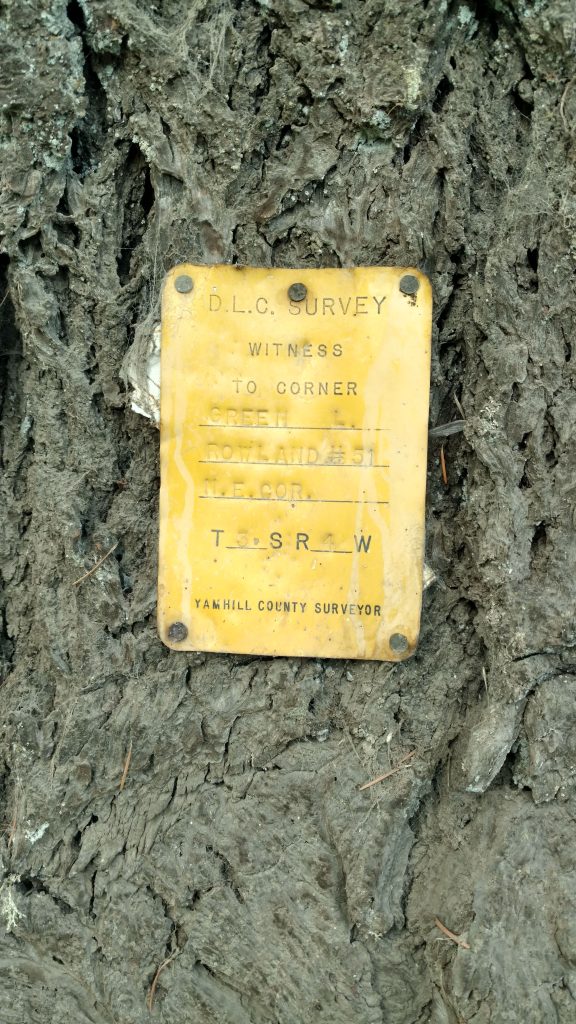
I began thinking about a short story titled Witness Tree, with the premise, “someone sees something they shouldn’t.”

I thought, “okay, good.” But then looked at the bare hillside and there seemed no way to see something without also being seen…seeing it. Which kind of threw a wrench in the gears. Until the following day, when I noticed that someone had dropped one of those green porta-potties near it for the grape harvesters to use.

And so the opening scene was born. David shelters from a deluge–common at that time of year–inside a porta-potty near a witness tree late one night. There is (fictionally) a large warehouse-like structure nearby, and the murder takes place in its gravel parking lot. The assassins are backlit by the lights on the building, but David, some forty yards away, is in total darkness. They are shadows in the murky, watery night. They can’t see him, and he can’t identify them. And yet, there’s something familiar about the dead man…
Try as I might, I could not get the story to stay a short story. I wrote the first ten pages or so and thought that it read like like an opening chapter. So I kept going. It’s been an exciting, satisfying and frustrating process. Dealing as it does with addiction, it is my most personal story to date, too.

And I have written it in first-person, which is new for me. Many of the plot points and reveals, however, could not happen as I originally conceived them. I couldn’t shift POV to the bad guys as I would do in the Faithless Elector series books, and I ended up writing (and then deleting) multiple scenes.

So, the notion of whether this is anything like the book I (sort of) conceived of two years ago also embraces Theseus’s ship. What began as a short story called “Witness Tree” became a novel of the same name, in the writing of which, I ran off the rails in a number of key ways, but have worked hard to bring it back into trim focus. Not only is it my most personal work, the number of holes I’ve plugged, scenes I have had to rewrite, is breathtaking.

But it floats, and I’m hopeful it will be seaworthy soon.

# # #

James McCrone is the author of the Imogen Trager political suspense-thrillers Faithless ElectorDark Network and Emergency Powers–noir tales about a stolen presidency, a conspiracy, and a nation on edge. Bastard Verdict, his fourth novel, is about a conspiracy surrounding a second Scottish Independence referendum. His novel-in-progress is called Witness Tree, a (pinot) noir tale of murder and corruption set in Oregon’s wine country.

All books are available on BookShop.org, IndyBound.org, Barnes & Noble, your local bookshop, and Amazon.

eBooks are available in multiple formats including Apple, Kobo, Nook and Kindle.

James is a member of Mystery Writers of America, Int’l Assoc. of Crime Writers, and he’s the current president of the Delaware Valley chapter of Sisters in Crime. He lives in Philadelphia. James has an MFA from the University of Washington in Seattle.

For a full list of appearances and readings, make sure to check out his Events/About page. And follow this blog!

You can also keep up with James and his work on social media:
Bluesky: @jmccrone.bsky.social
Facebook: James McCrone author (@FaithlessElector)
and Instagram/Threads “@james.mccrone”
“Scotland is a country, not a county” – 10th Anniversary of IndyRef vote

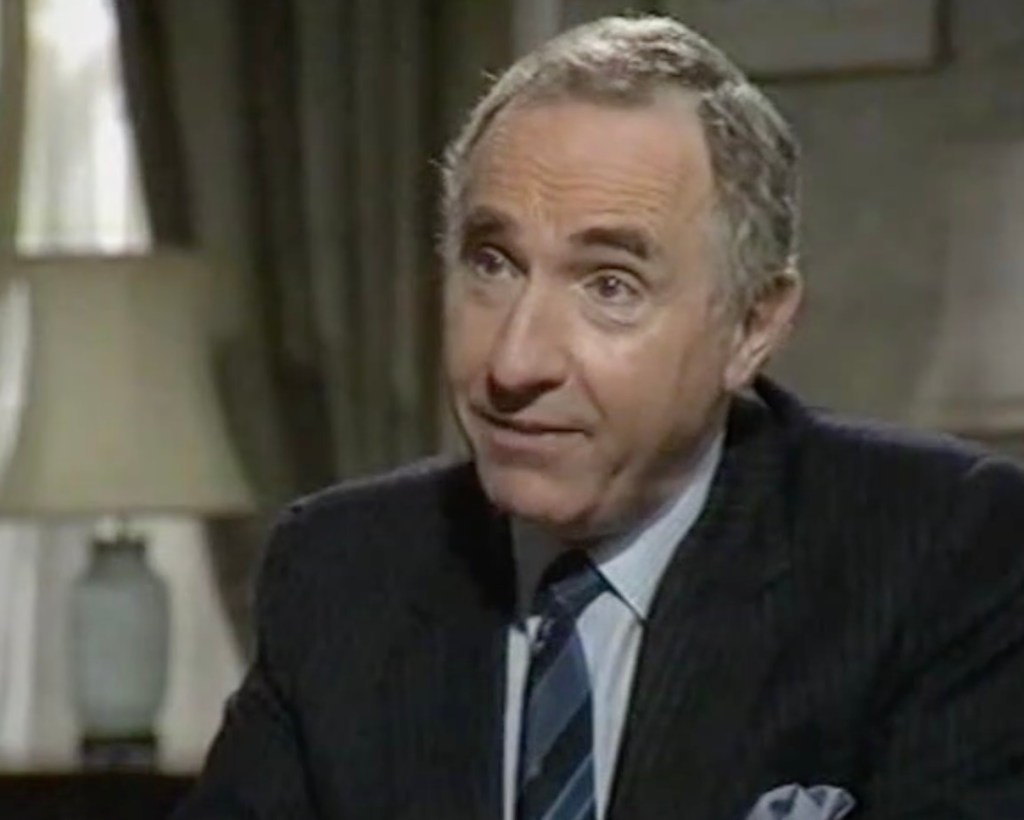
“Plays criticising the government make the second most boring evenings ever invented,” says Sir Humphrey Appleby to his minister in the delicious (and still, all-too-relevant) Yes, Minister series – “The Patron of the Arts” – (sea.2/ep.6).

The minister pauses, then asks him: “What are the most boring?”
Sir Humphrey responds: “Those praising the government.”

To write political thrillers as I do is delicate. Readers seeking partisan, anger-porn that affirms their view one way or the other have ample fodder elsewhere, and I want my stories to be something else. As I’ve written before, stories are about questions, not answers.

In my work, I’m drawn to what lies behind the official explanations and stories we’re told. What is the flip side of the answer the powerful would like us to accept? What (if anything) is being concealed? Who would be involved? What is their story, what are the consequences of their choices?

I write stories because it’s how I understand the world and the questions I have about it. My work, as much as it’s about characters in action, is animated by politics, by threats to the sovereignty of people to determine their own future and, through the ballot, to hold those in power accountable. But it isn’t meant to be partisan. Unless you regard democracy itself as partisan.

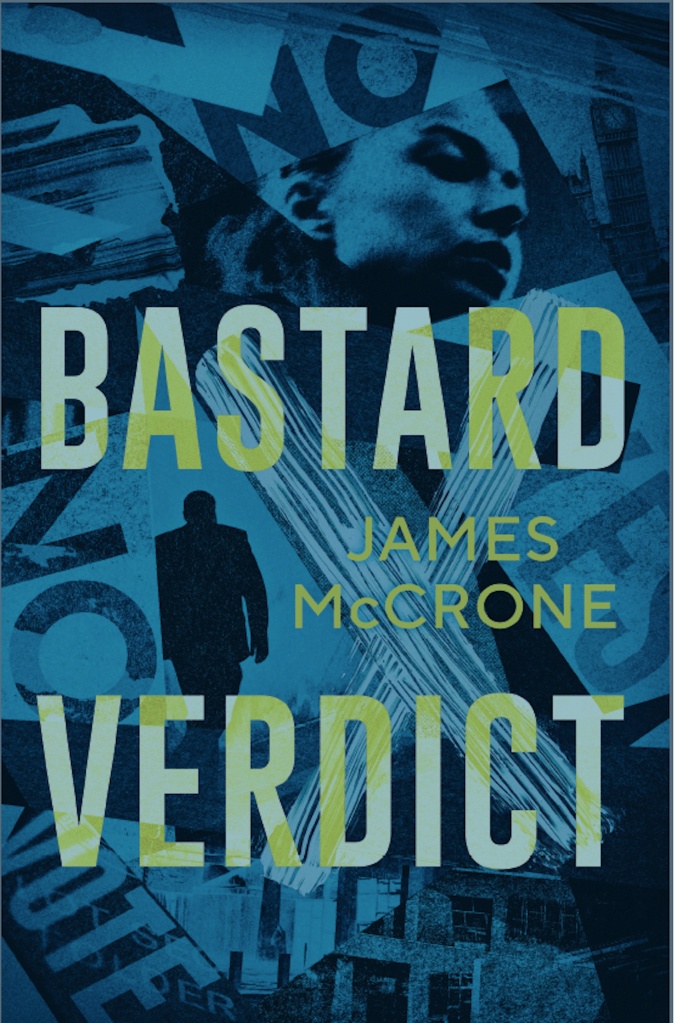
Bastard Verdict.
September 18 marked the 10 year anniversary of the 2014 Referendum on Scottish Independence, in which voters were asked, “Should Scotland be an independent country?” It failed. 55% voted ‘No,’ to independence, while 45% voted ‘Yes.’ The dismay over this sad anniversary grew starker earlier this month, when, on October 12 we learned of the death of Alex Salmon, former First Minister of Scotland, and the most visible architect of that referendum. The quote that titles this post comes from him.

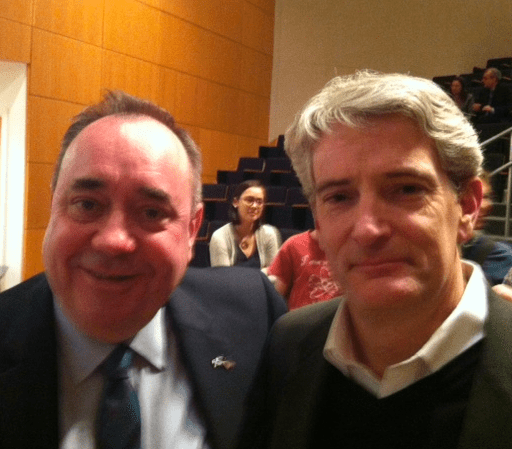
With Alex Salmond in Princeton, 2013

I got to meet Salmond when he gave a talk at Princeton in 2013. He was a fantastic speaker. The focus of his talk was Adam Smith’s Theory of Moral Sentiments, which forced me to reread Smith, and it gave me the epigram for my second novel, Dark Network – “Virtue is to be feared more than vice, because its excesses are not subject to the regulation of conscience.”

I lived in Scotland as a boy, but I had to watch the referendum from the sidelines here in the US. Nevertheless, I felt the failure of the vote keenly, and I wanted to understand it. My knowledge of the Scottish National Party (SNP)–and hopes for its success–began in 1974, when we lived in Edinburgh. My father, a US political scientist, had come to study the politics of independence during a sabbatical year at Strathclyde University.

As I began gathering notes for a new thriller about the referendum, the process led me to a different story and question: What if there had been irregularities in the referendum? What if, as a second (fictional) referendum was gathering strength, those who had interfered in 2014 felt that they needed to make sure their involvement stayed hidden? What would the conspirators do? Further, what if those who perpetrated the election interference weren’t in government at the time but had gained their places at the table through their plot?

I had not initially envisioned it as a story involving my character, the FBI Agent, Imogen Trager, but she insisted on being a part of it. (After all that has happened to her in the first books, she takes a year off to do some research at the University of Glasgow, to keep her head down and consider her next steps–only, like Michael Corleone, to get pulled back in!)

Ten years ago, hope for the future shined brightly amidst the fear-mongering and mendacity (and that hope endures, albeit somewhat dulled). At the time, retirees were told that their pensions would be at risk in a Scotland independent from the UK. The predictable media suspects treated the run-up to the referendum with derision and condescension. The queen weighed in four days before the vote, saying that Scotland should “think very carefully about the future,” an unsubtle hint. Pro-European Union voters were told that leaving the UK would mean Scotland couldn’t participate in the EU. Neither the pension scare nor the EU ouster was true of course (except later, in 2016, when the UK voted in favor of Brexit–even though voters in Scotland voted 62% in favor of remaining in the EU) It wasn’t enough of a counterweight, and England dragged its “partners” out of the EU).

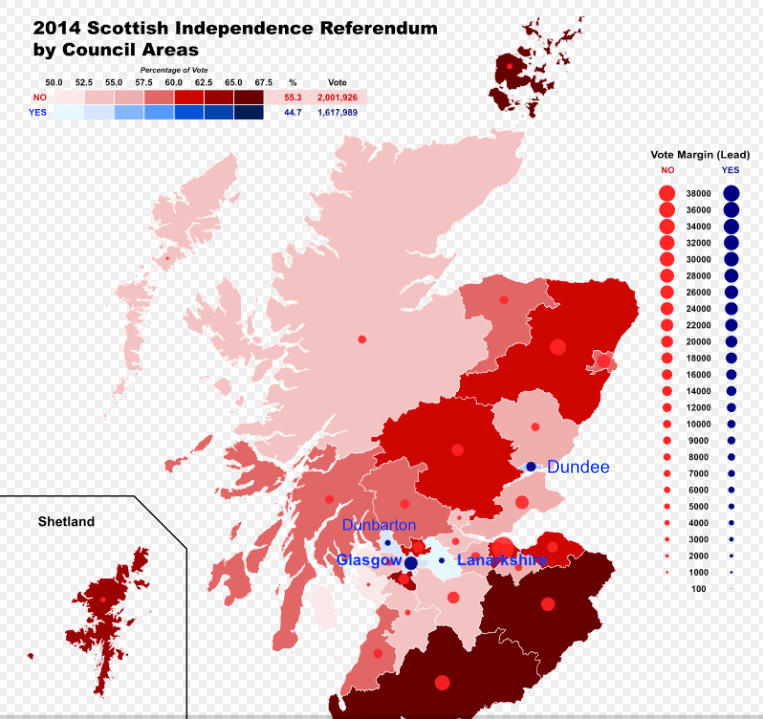
Three of the four highest returns for Yes were in Strathclyde – Glasgow City, West Dunbartonshire and North Lanarkshire. The fourth was Dundee City Council. While the map looks very red, 20 per cent of the population lives within those four blue districts. Roughly 2 million voted No, and 1.6 million voted Yes.

As aghast as I am about the above political maneuvering, it’s of a type that’s depressingly common during an election cycle. But as I watched the ham-fisted way the Tory party managed Brexit (if managed is the word for it), I began to wonder how Westminster would have reacted to a successful referendum, and what kind of legal and extra-judicial mischief they might get up to. At stake are markets, airfields, a nuclear submarine base, and the energy wealth of the North Sea. And of course Britain’s standing in the world.

As I wrote the story, traveling back and forth to Scotland on two occasions and corresponding with academics about certain aspects of the book, I struggled with my partisan feelings over the referendum, and I think that tension helped the book. Two of the principle characters did not favor independence, but they are both aghast that there may have been irregularities. Oddly, a petty criminal character becomes something like the moral center of the story.

For the story, I focused on Glasgow and Dundee, and I brought back Imogen Trager (an FBI elections specialist) into service. I felt that a novel told from the perspective of an American in Scotland–my own point of view–would be more authentic. That novel became Bastard Verdict, named for the “not proven” verdict in Scottish Law. The tension I wrestled with, between telling a good story on the one hand and venting my anger and disappointment on the other, gave the novel an energy and clarity I doubt I would have managed if I given in to the disappointment.

# # #

James McCrone is the author of the Imogen Trager political suspense-thrillers Faithless ElectorDark Network and Emergency Powers–noir tales about a stolen presidency, a conspiracy, and a nation on edge. Bastard Verdict, his fourth novel, is about a conspiracy surrounding a second Scottish Independence referendum. His novel-in-progress is called Witness Tree, about a conspiracy set in Oregon’s wine coutry, a (pinot) noir tale of murder and corruption.

All books are available on BookShop.org, IndyBound.org, Barnes & Noble, your local bookshop, and Amazon. eBooks are available in multiple formats including Apple, Kobo, Nook and Kindle.

He’s a member of Mystery Writers of America, Int’l Assoc. of Crime Writers, and he’s the current president of the Delaware Valley chapter of Sisters in Crime. He lives in Philadelphia. James has an MFA from the University of Washington in Seattle.

For a full list of appearances and readings, make sure to check out his Events/About page. And follow this blog!

Alyth and Hiding in Plain Sight

I’ve had a lot of fun revisiting the places where I set scenes in Bastard Verdict, examining the ways in which setting drives narrative; and I have blogged about them here: U of GlasgowKelvingrove Park (Glasgow) – Glasgow and spare groundDundee . I wrote about a lovely (if wet) day and a half I passed in Alyth in Blairgowrie during my most recent trip to Scotland, and I was invited to contribute to the The Alyth Voice. So today, I’ll let the Alyth Voice do the talking!

The NOT spectral clock of Alyth!

<<I set a portion of my new thriller, Bastard Verdict, in Alyth, along David Street. While I’m not keen to admit it, I had not visited Alyth before that wet Sunday afternoon in mid-September. Writing the novel during Covid, I had been forced to rely on Google Streetview for some of my insights. But I had come back to Scotland for the Bloody Scotland crime writers’ conference in Stirling, my third such visit, resolved to see Alyth with my own eyes…>> Link to further reading on the Alyth Voice (p.21).

The best part of the trip there was running into the volunteers at the Alyth Family History Project, and particularly Irene Robertson, who has continued her correspondence with me and been an extravagant, valuable source of information.

One of the occasions for my visit was to look for, or at least references to, the poet James Young Geddes (“lover and lasher of Dundee”), and his poem “The Spectre Clock of Alyth.” It was because I wandered up to the church featured in the poem, that I happily ran into the Family History Project.

The poem is reprinted here, below, in its entirety, though not in the Voice piece. Apparently, starlings nested within its workings and fouled (fowled?) the mechanism…

THE SPECTRE CLOCK OF ALYTH
by James Young Geddes, 1885

Surveying fair and fertile lands,
‘Neath the shadowing hills the Old Church stands –
Calmly, holily, looking down
On the quiet streets of the country town –
With a far away look which seems to say,
“I belong to the things of yesterday.”

Founded and built on a broader base
Than the structures of our degenerate days,
It hath with its walls of old red stone,
And its tower, with the steeple raised thereon
Far into the blue of the bending sky,
A quaint sacerdotal dignity.

And the legend runs (whether false or true
I cannot vouch) that they once could view,
Just where the tower and steeple meet,
A clock, with dials and hands complete,
Which its pious builders with kindly thought
Into the edifice interwrought.

But the unregarding fowls of air
Came in their legions and roosted there;
The rains of heaven upon it beat,
It was cracked by frost and scorched by heat,
And time itself at its doom connived,
Though for time alone it worked and lived.

Till in the conflict bleached and worn,
Aged, bird-defiled, and tempest-worn,
With drooping hands and fading powers,
And the memory only of golden hours –
The clock, reduced to such a pass,
Became but the ghost of what it was.

But they say at times you may still descry,
Should you upward turn an inquiring eye,
On the tower and steeple obelisk,
Presenting four-square a gilded disk –
A spectre clock in spectral ways
Fulfilling the functions of former days;

When the vanished hours come trooping back
And station themselves by the beaten track,
Where the labourers twain unequally yoked,
From the mists of the shadowy past revoked,
Re-plod their path o’er the phantom face,
And strive in a “hare and tortoise” race;

When a subtle influence sets astir
The rust-worn wheels with a ghostly whir,
And a sound is heard which attracts, repels,
Like the tremulous tinkling of fairy bells,
Echoed back from the hollows of the hills
In faint and far mysterious trills;

And the lowly dwellers on the ground
Listen in awe to the gruesome sound,
For they feel in a measure that adverse fate,
By means and methods intricate,
Hath placed them beneath the influence
Of the symbols and shades of the things of sense.

For the power which retribution brings
To wait in the wake of neglected things,
And of murderous deeds, hath it ordered so
That it casts a blight on all below;
And they who listen this changeling’s chimes
Are for ever and aye behind the times.

Their eyes are dulled, their ears are clogged,
They know not they how time hath jogged,
And though in them there may seem to be
The symptoms and signs of vitality,
‘Tis but a delusion and a snare –
They, too, belong to the things that were.

For the power that the phantom hath is this –
To benumb with the clock paralysis;
And the minds which its spell hath barred complete
Are a-simmer with ideas obsolete;
They move in a phantasmagoric way
The gibbering ghosts of yesterday.

And the curse shall be lifted? Only when
There shall rise from among the sons of men –
He, the gifted One, who shall fully know
The cause of the blight on the folks below,
Who shall read the riddle and then unlock
The secret and strength of the spectre clock;

Who shall sweep and scatter the dirt and dust,
And rid the wheels of their blood-red rust;
Who shall smooth the wrinkles from Time’s old face,
And his withered hands in strength replace,
To set them agog with motion brisk
Anew on each renovated disk.

Then only then shall the stagnant blood
Pulsate and flow in a fuller flood
Through flaccid veins; and men shall wake,
Yawn, start, and off their stupor shake,
To look around and astonished cry –
“’Tis the end of the nineteenth century.”

Ah me! But the wheels have never whirred,
And the life in the village lies yet unstirred.
Alas and alack! He cometh not –
The Conqueror we long have sought;
The magic spell is yet unbroken;
It reigns supreme – the Spectre Clock.

# # #

James McCrone is the author of the Imogen Trager political suspense-thrillers Faithless ElectorDark Network and Emergency Powers–noir tales about a stolen presidency, a conspiracy, and a nation on edge. Bastard Verdict, his fourth novel, is about a conspiracy surrounding a second Scottish Independence referendum. To get the details right for the new thriller, he drew on his boyhood in Scotland and scouted locations for scenes in the book while attending the Bloody Scotland crime writers conference in Stirling.

All books are available on BookShop.org, IndyBound.org, Barnes & Noble, your local bookshop, and Amazon. eBooks are available in multiple formats including Apple, Kobo, Nook and Kindle.

He’s a member of Mystery Writers of America, Int’l Assoc. of Crime Writers, and he’s the new president of the Delaware Valley chapter of Sisters in Crime. He lives in Philadelphia. James has an MFA from the University of Washington in Seattle. His current, work-in-progress is a mystery-thriller set in Oregon’s wine country…A (pinot) Noir, called Witness Tree.

For a full list of appearances and readings, make sure to check out his Events/About page. And follow this blog!

You can also keep up with James and his work on social media:
Mastodon: @JMcCrone
Bluesky: @jmccrone.bsky.social
Facebook: James McCrone author (@FaithlessElector)
and Instagram/Threads “@james.mccrone”
Scenes from #BastardVerdict, part 4 – Dundee

The photo above is from Dundee Law, a hill that is the highest point in Dundee. The iconic Tay Rail Bridge is in the middle of the photo, its predecessor immortalized (if that’s the word for it) by William McGonagall in his epically bad Tay Bridge Disaster.

Among other clinking stanzas, we get:

“…Boreas he did loud and angry bray,
And shook the central girders of the Bridge of Tay
On the last Sabbath day of 1879,
Which will be remember’d for a very long time.”

Though I’d never been to Dundee until 2019, a close friend, Father Frank, grew up in nearby Monifieth, and through him I was already conversant in McGonagall from past Burns Nights where we interspersed Burns poetry with that of Dundee’s idjit poet laureate. The Sunderland Calamity was a particular favorite, and it’s particularly eye-watering. It begins:

’Twas in the town of Sunderland, and in the year of 1883,
That about 200 children were launch’d into eternity…

So, I came to Dundee knowing very little about the place except some of the works of its worst poet, and that its claim to fame was the “three J’s”: jam, jute and journalism. As a marmalade addict, I was eager to avail myself of what Dundee had to offer!

I came because Dundee, along with Glasgow, had been anomalies during the referendum on Scottish independence in 2014, which is the inciting event from which everything in the Bastard Verdict issues. In both cities, preference for independence was very high. Indeed, there had been a twenty percent increase in voter turnout for the referendum all across Scotland–except in the two places that early polling said would have both the highest turnout and the highest preference for Yes, for Independence.

As well as researching and studying the actual method of counting the ballots, I sought input from UK friends who had been tellers (‘poll watchers’ in the US), and those who supervised actual vote counts. But I needed places for these things to happen, and I needed them to seem real.

I stayed in a lovely B&B along Perth Road, west of the University of Dundee. Because I had been around the neigborhood so often (or out of laziness) I had Imogen stay in the same (unnamed) B&B I had used as my base. It had a lovely, commanding view of the rail bridge.

I was able to have Imogen eat at a pub near the university…

And up the hill along nearby Hyndford Road, seemed just posh enough for the character, the ARO, Donald Alban.

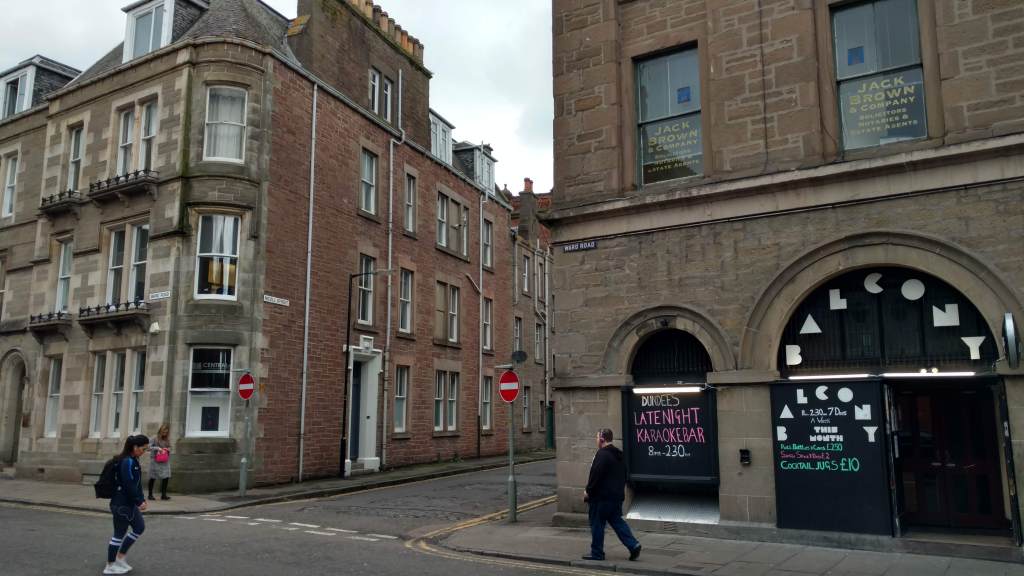
I found the courthouse, where I decided the attorney, Ewan Johnston, plied his trade, and I was pleased to find that there were a number of law offices nearby, along Ward Road. Once again, I didn’t use any of the nearby offices, but locating the fictional office along Ward Road had verisimilitude.

And a little bit along Ward Road, is The Howff, a cemetery, which the council maintains beautifully. The Howff and Ward Road would be the scene of…well, I should let you read that for yourself.

# # #

Bastard Verdict is available now in paperback, and eReader!

YOU DON’T NEED TO WIN, JUST DON’T LOSE
In politics, people cheat to win, or because they’re afraid to lose. The difference can be deadly.

Imogen will risk what’s left of her standing, her career–and maybe her life–to get at the truth.

James McCrone is the author of the Imogen Trager political suspense-thrillers Faithless ElectorDark Network and Emergency Powers–noir tales about a stolen presidency, a conspiracy, and a nation on edge. Bastard Verdict, his fourth novel, is about a conspiracy surrounding a second Scottish Independence referendum. To get the details right for the new thriller, he drew on his boyhood in Scotland and scouted locations for scenes in the book while attending Bloody Scotland.

All books are available on BookShop.org, IndyBound.org, Barnes & Noble, your local bookshop, and Amazon. eBooks are available in multiple formats including Apple, Kobo, Nook and Kindle.

He’s a member of MWA, Int’l Assoc. of Crime Writers, and he’s the new president of the Delaware Valley Sisters in Crime chapter. He lives in Philadelphia. James has an MFA from the University of Washington in Seattle. His current, work-in-progress is a mystery-thriller set in Oregon’s wine country…A (pinot) Noir, called Witness Tree.

For a full list of appearances and readings, make sure to check out his Events/About page. And follow this blog!

His most recent short fiction is below. The first is available for online reading.

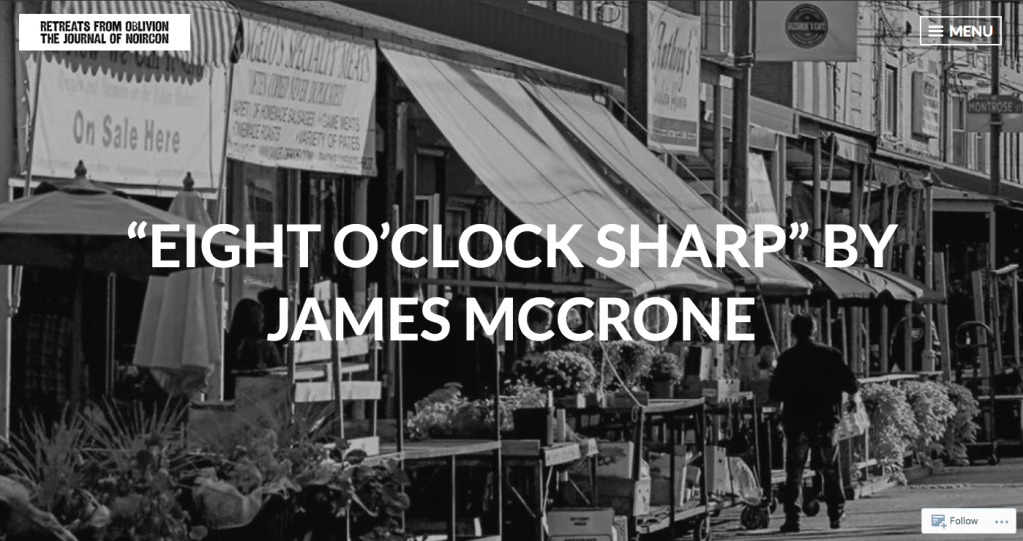
Eight O’Clock Sharp” in Retreats from Oblivion: the Journal of NoirCon. (free online)
Set in Philadelphia’s 9th Street Market, Thomas is a man outside of time, forgotten, but trying to do the right thing while contending with avaricious forces.

“Ultimatum Games” in Rock and Hard Place magazine issue #7
A rare book heist, bad decisions. The narrator and his partner-in-crime clash over evolving bourgeois norms.

“Nostalgia” in Low Down Dirty Vote, vol. 3
An armed group tries to resurrect a past that never was as they struggle with change.