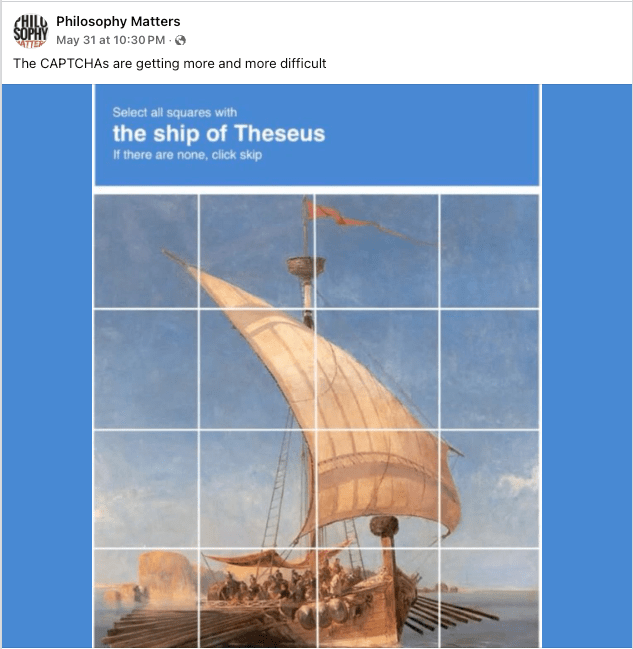
Ship of Theseus

“When is ‘am’?” The persistence of identity and Witness Tree

The Ship of Theseus looms large as a metaphor for ideas about identity and change in my novel-in-progress, Witness Tree, a suspense-thriller about a leadership battle for (white) supremacy in a rural Oregon county that erupts into the open when newly sober, ex-con David Paterson is the sole witness to a brutal execution meant to tie off the last loose thread.

David is trying to make a fresh start in sobriety, but he carries the weight of the past with him, along with questions about how much he may (or may not) have changed during his eight years in prison. When he reports the murder to the police, as a now-solid citizen should, it’s the deputy who put him away eight years earlier who takes his testimony. The deputy makes it clear that if a body is ever found, David will be the prime suspect. “People don’t just change overnight, Paterson,” he says.

[from Wikipedia]: “In its original formulation, the ‘Ship of Theseus’ paradox concerns a debate over whether or not a ship that has had all of its components replaced one by one would remain the same ship.” For David, the notion that you can never step into the same river twice; that “Upon those who step into the same rivers, different and again different waters flow,” looms large.

So, as to identity–which is it? Which you is “who”? The person you are today? Five years ago? Who will you be in fifty years? And when is “am”? This week? Today? And which facet of you is “I”? I’m writing a suspense-thriller, so I don’t belabor the point or get in the way of the story, but David can’t be sure who he is, or what he wants, and he can’t know how others perceive him.

The story becomes David’s race to find out who was killed, why, and by whom, before the police can hang it all on him. As he investigates, with the help of two high school friends who still stand by him, he finds that what the murder was meant to cover up runs deeper and wider than David could have imagined. Worse, the murder and officials’ seeming complicity in it, feels eerily like the murder of his friend in prison, to which he was also a witness. In prison, the Aryan Brotherhood left him alive–and damaged–as a warning to others.

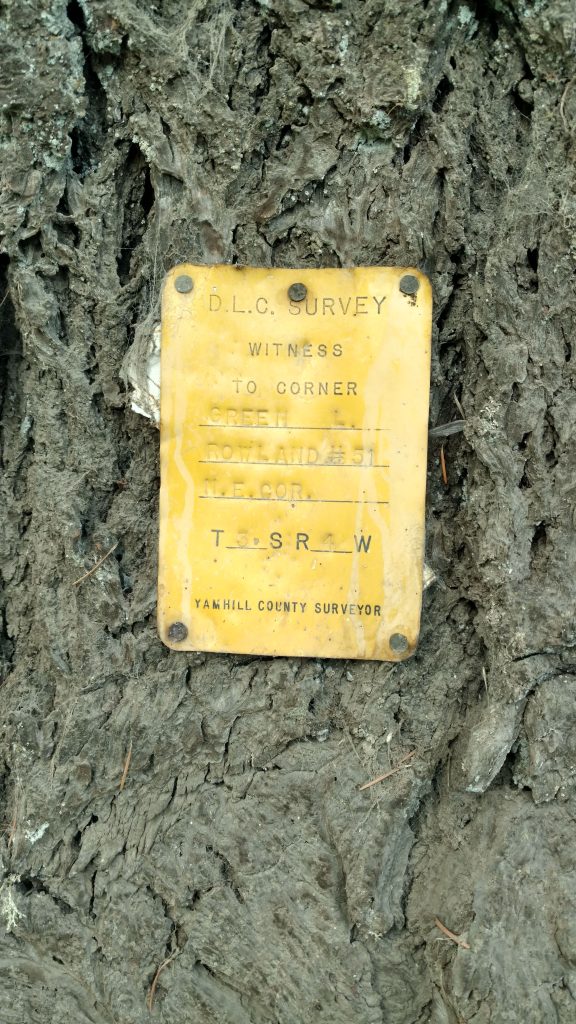
The photo of the pine tree on the hillside that you see is the Witness Tree that inspired the book. It’s near my parents’ farm, a Yamhill County, Oregon, survey marker, delineating plots of land. It’s probably 80 years old. Or more. And it is illegal to cut it down. “Witness to corner,” the badge on the tree reads. My mother, now passed on, had always liked the tree. The term witness tree had been pregnant with meaning for us, and I decided to start a short story that involved it.

I began thinking about a short story titled Witness Tree, with the premise, “someone sees something they shouldn’t.”

I thought, “okay, good.” But then looked at the bare hillside and there seemed no way to see something without also being seen…seeing it. Which kind of threw a wrench in the gears. Until the following day, when I noticed that someone had dropped one of those green porta-potties near it for the grape harvesters to use.

And so the opening scene was born. David shelters from a deluge–common at that time of year–inside a porta-potty near a witness tree late one night. There is (fictionally) a large warehouse-like structure nearby, and the murder takes place in its gravel parking lot. The assassins are backlit by the lights on the building, but David, some forty yards away, is in total darkness. They are shadows in the murky, watery night. They can’t see him, and he can’t identify them. And yet, there’s something familiar about the dead man…

Try as I might, I could not get the story to stay a short story. I wrote the first ten pages or so and thought that it read like like an opening chapter. So I kept going. It’s been an exciting, satisfying and frustrating process. Dealing as it does with addiction, it is my most personal story to date, too.

And I have written it in first-person, which is new for me. Many of the plot points and reveals, however, could not happen as I originally conceived them. I couldn’t shift POV to the bad guys as I would do in the Faithless Elector series books, and I ended up writing (and then deleting) multiple scenes.

So, the notion of whether this is anything like the book I (sort of) conceived of two years ago also embraces Theseus’s ship. What began as a short story called “Witness Tree” became a novel of the same name, in the writing of which, I ran off the rails in a number of key ways, but have worked hard to bring it back into trim focus. Not only is it my most personal work, the number of holes I’ve plugged, scenes I have had to rewrite, is breathtaking.

But it floats, and I’m hopeful it will be seaworthy soon.

# # #

James McCrone is the author of the Imogen Trager political suspense-thrillers Faithless ElectorDark Network and Emergency Powers–noir tales about a stolen presidency, a conspiracy, and a nation on edge. Bastard Verdict, his fourth novel, is about a conspiracy surrounding a second Scottish Independence referendum. His novel-in-progress is called Witness Tree, a (pinot) noir tale of murder and corruption set in Oregon’s wine country.

All books are available on BookShop.org, IndyBound.org, Barnes & Noble, your local bookshop, and Amazon.

eBooks are available in multiple formats including Apple, Kobo, Nook and Kindle.

James is a member of Mystery Writers of America, Int’l Assoc. of Crime Writers, and he’s the current president of the Delaware Valley chapter of Sisters in Crime. He lives in Philadelphia. James has an MFA from the University of Washington in Seattle.

For a full list of appearances and readings, make sure to check out his Events/About page. And follow this blog!

You can also keep up with James and his work on social media:
Bluesky: @jmccrone.bsky.social
Facebook: James McCrone author (@FaithlessElector)
and Instagram/Threads “@james.mccrone”

The Autofac

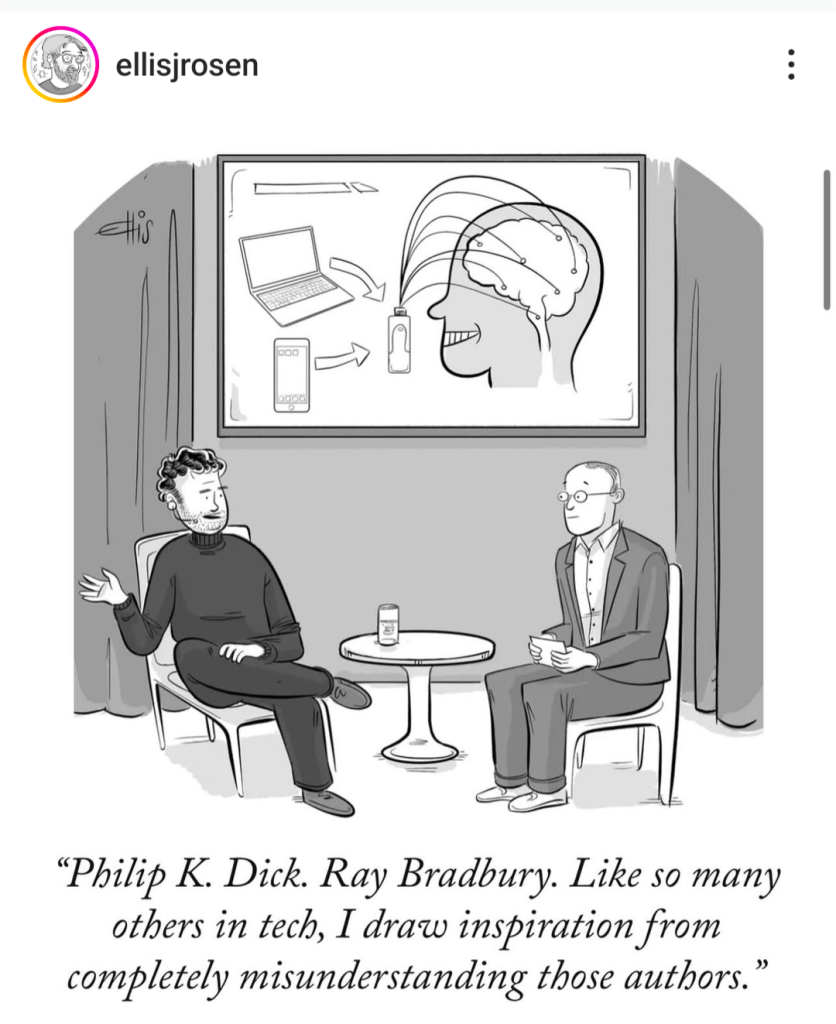
Robots Are About to Outnumber Humans At Amazon Warehouses: “They’re one step closer to that realization of the full integration of robotics,” Futurism reports, perhaps bringing us one step closer to the Autofac of Philip K. Dick’s fevered nightmares. In which “nuclear war survivors in a small community struggle to make contact with an automated factory that has consumed most of their natural resources.”

I first encountered the story in the limited series Philip K. Dick’s Electric Dreams. The bots, like AI, are not conscious, yet they have a purpose. In the story, the Autofac is so automated that it’s (re)producing the robots who work there.

The bots only want what’s best for humanity, and their only mission is to sell and deliver… everything. Even though there’s almost no one left to buy.

Originally published in 1955, the tale is sad and unnerving. In the television program, the survivors gain access to the Autofac in the only way accessible to them–by faking a complaint form.

Spoiler: it doesn’t work.

# # #

James McCrone is the author of the Imogen Trager political suspense-thrillers Faithless ElectorDark Network and Emergency Powers–noir tales about a stolen presidency, a conspiracy, and a nation on edge. Bastard Verdict, his fourth novel, is about a conspiracy surrounding a second Scottish Independence referendum. His novel-in-progress is called Witness Tree, a (pinot) noir tale of murder and corruption set in Oregon’s wine country.

All books are available on BookShop.org, IndyBound.org, Barnes & Noble, your local bookshop, and Amazon.

eBooks are available in multiple formats including Apple, Kobo, Nook and Kindle.

James is a member of Mystery Writers of America, Int’l Assoc. of Crime Writers, and he’s the current president of the Delaware Valley chapter of Sisters in Crime. He lives in Philadelphia. James has an MFA from the University of Washington in Seattle.

For a full list of appearances and readings, make sure to check out his Events/About page. And follow this blog!

You can also keep up with James and his work on social media:
Bluesky: @jmccrone.bsky.social
Facebook: James McCrone author (@FaithlessElector)
and Instagram/Threads “@james.mccrone”

Fluidity of Memory and Guilt by Association

We are the sum total of the memories and experiences we have forgotten. Or, as William Faulkner put it, in Light in August, “Memory believes before knowing remembers. Believes longer than recollects, longer than knowing even wonders…” Memory is also associative, grouped with other memories, sometimes seemingly at random.

Memory and story-telling are a bit like Rob’s “autobiographical” filing method for his record collection in High Fidelity: “If I want to play, say, Blue by Joni Mitchell, I have to remember that I bought it for someone in the autumn of 1983, and thought better of giving it to her, for reasons I don’t really want to go into…”

As I whittle away and reorganize the undying manuscript called Witness Tree (hope to have a final-final draft by the end of this week!), I’ve also begun working on my sixth novel, tentatively called Hours, about a pilot flying South American routes in the late 1940’s. And I’ve been thinking and writing a lot about memory.

Hours is loosely based on my grandfather’s experiences as an airline pilot based in Lima, Peru. I say loosely, because though it draws on his experiences and impressions, it is not his story. Though I hope I’m able to preserve some of the essence of him. He was a fantastic storyteller, and I’m equally hopeful that his spirit of fun, adventure and not letting facts get in the way of a good story will continue to guide and inspire me.

The opening of Hours, begins with the observation that “Memory is fluid, roiled by currents that carve deep paths, much as flowing water forges a riverbed but is thereafter constrained by it.”

The narrator, a pilot flying South American routes in the late 1940’s, is thinking back to the pinnacle moment of his career. He sees himself as though standing outside himself, a young captain, on the tarmac in Santiago, Chile, peering toward Los Andes, waiting for some sign that the “Paso de la Cumbre,” 65 miles away and still obscured, will clear. And as he conjures that earlier, younger self there on the tarmac, he finds that he’s thinking of his earliest memory of flight, when he was seven years old in West Virginia:

“If I’m to think of the pilot, I must also think of the boy, must follow the course. Because as the pilot peers toward the Andean mists, playing his game of chicken with the weather, he thinks of the boy he was. The boy’s dreams were wild, he remembers. But not this wild.”

Hours is not very far along. But I see it being told in two inter-layered parts, from two perspectives, the protagonist is the pilot in the late 1940’s, and his grandson in the present day–also a pilot–who goes through his grandfather’s log books and notes, after his own Icarus-like fall from grace. And the skies.

It will be about flying, class (rags-to-riches), and the struggle between outward success and inward peace. Like the spotty, primitive radio signals they are meant to use for navigation, the novel asks, what are you to do when the thing that’s meant to guide you may be deadly wrong? It will be through memory, and its associations, that at least one of them will find a kind of redemption.

# # #

James McCrone is the author of the Imogen Trager political suspense-thrillers Faithless ElectorDark Network and Emergency Powers–noir tales about a stolen presidency, a conspiracy, and a nation on edge. Bastard Verdict, his fourth novel, is about a conspiracy surrounding a second Scottish Independence referendum. His novel-in-progress is called Witness Tree, a (pinot) noir tale of murder and corruption set in Oregon’s wine country.

All books are available on BookShop.org, IndyBound.org, Barnes & Noble, your local bookshop, and Amazon. eBooks are available in multiple formats including Apple, Kobo, Nook and Kindle.

James is a member of Mystery Writers of America, Int’l Assoc. of Crime Writers, and he’s the current president of the Delaware Valley chapter of Sisters in Crime. He lives in Philadelphia. James has an MFA from the University of Washington in Seattle.

For a full list of appearances and readings, make sure to check out his Events/About page. And follow this blog!

You can also keep up with James and his work on social media:

Mastodon: @JMcCrone
Bluesky: @jmccrone.bsky.social
Facebook: James McCrone author (@FaithlessElector)
and Instagram/Threads “@james.mccrone”
The Whisper Legacy, by Tj O’Connor – Review

“Curran’s enemies thought he was dead. They were wrong.
He thought his past was left on the Voula Beach Road. He was wrong. Now, that nightmare is drawing his enemies out”

Whisper Legacy is a brilliant, powerful and well written cyber warfare “take” on the familiar noir tale of criminals needing to keep their stolen records hidden. But with some intriguing twists. Beset by PTSD, lingering injuries and creeping old age, (Mar)Lowe Curran makes a living “on both sides of the ethics line” as what’s left of the former black ops spy he once was. Now a security expert, an unregistered PI and a fixer for the powerful, enigmatic TAE–“Tommy” to his friends–Curran inadvertently stumbles into a much more sinister plot involving the highest levels of government.

When Curran steals back the records and files that the hacker “Piper” stole from TAE’s company, he inadvertently downloads the records of a shadowy influence-peddling group’s blackmail operations, known as Whisper. Worse, for Curran, the Whisper group has already tried to kill him. Twice.

Whisper Legacy takes us through slimy operators, to the rich and powerful, right up to the highest levels of politics, where everything is personal. Not least, for Curran. He lives not only with the aches, pains and nightmares of his past work, but also with deep regret. This is about to get ugly. And dangerous. Powerful people with shady friends need the duffel bag to remain hidden. To stay alive and expose Whisper will take all of Curran’s experience, guile and grit. The police are the least of our hero’s problems.

Lowe Curran is an engaging narrator and guide. The story moves along confidently and quickly, spinning its seemingly disparate strands in a way that feels fresh, all while leading us, and Curran, inexorably on. I liked that our hero was human, hobbled by old wounds in very real ways. He’s forced to use his wiles more than his fists or a gun (though he certainly knows how to use them both when called upon). The scene that opens the book is a wonderfully chaotic masterclass in improvised spy craft. Levels of madness misdirect from the darker purpose and set an assured tone for the story to come.

Highly recommended!

Whisper Legacy is available on Bookshop.org, Amz, Barnes & Noble and through Bookbub

# # #

James McCrone is the author of the Imogen Trager political suspense-thrillers Faithless ElectorDark Network and Emergency Powers–noir tales about a stolen presidency, a conspiracy, and a nation on edge. Bastard Verdict, his fourth novel, is about a conspiracy surrounding a second Scottish Independence referendum. His novel-in-progress is called Witness Tree, a (pinot) noir tale of murder and corruption set in Oregon’s wine country.

All books are available on BookShop.org, IndyBound.org, Barnes & Noble, your local bookshop, and Amazon. eBooks are available in multiple formats including Apple, Kobo, Nook and Kindle.

James is a member of Mystery Writers of America, Int’l Assoc. of Crime Writers, and he’s the current president of the Delaware Valley chapter of Sisters in Crime. He lives in Philadelphia. James has an MFA from the University of Washington in Seattle.

For a full list of appearances and readings, make sure to check out his Events/About page. And follow this blog!

You can also keep up with James and his work on social media:
Mastodon: @JMcCrone
Bluesky: @jmccrone.bsky.social
AND MORE, on the links page