Recently, I related a story about my penchant for (and the dangers of) going on too long, and the vaudeville hook. So, I’ll try to keep this brief!
In early drafts, I tend to over-write. Brevity for its own sake is not the goal of good prose, but over-writing, as I do, projects a lack of confidence, the inability to let the work stand on its own. When I edit my drafts, the first thing I go after are the superfluous words and the sentences and scenes that may go on too long. The goal is to keep the reader engaged, after all.
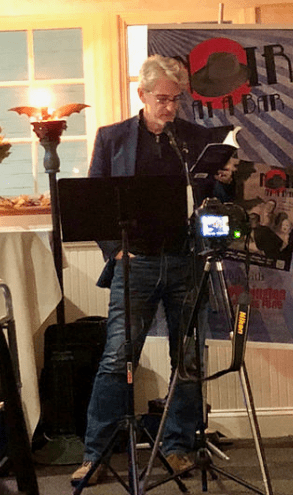
I will be reading at Oxford Bar in Oxford, PA, on November 7th. Readings are delightful for many reasons–meeting readers, other writers, and testing out material. They are very useful for new material.
I have found that doing a public reading of a work-in-progress that has been through a few self-edits can be an excellent means of identifying things I was blind to. Keeping an eye on the audience while reading, you can get a sense of what’s working, or that something goes on too long. The audience starts to shift, or–stab to the heart!–someone glances at their watch. You feel the long hook begin to encircle you.
To the vaudeville hook, I’d like to add the “Chuck-bin.” Charles R. Johnson (author of Oxherding Tale and Middle Passage–for which he won the National Book Award in 1990), was chair of the creative writing department at the University of Washington where I got my MFA, and I took every class he offered. One of the things he told us that has stuck with me, when talking about the need for the story to hold attention, was that we should imagine that the reader is standing over a garbage can while reading our work, and we mustn’t give them any reason to drop it in the trash.
I’ve taken this image so much to heart that as I do my readings, when I sense that the audience might be losing interest, I can hear the pages falling with a clunk into the wastebasket. It’s a high wire act 🙂 After the reading, I often sit with the passage I worked on and begin cutting.
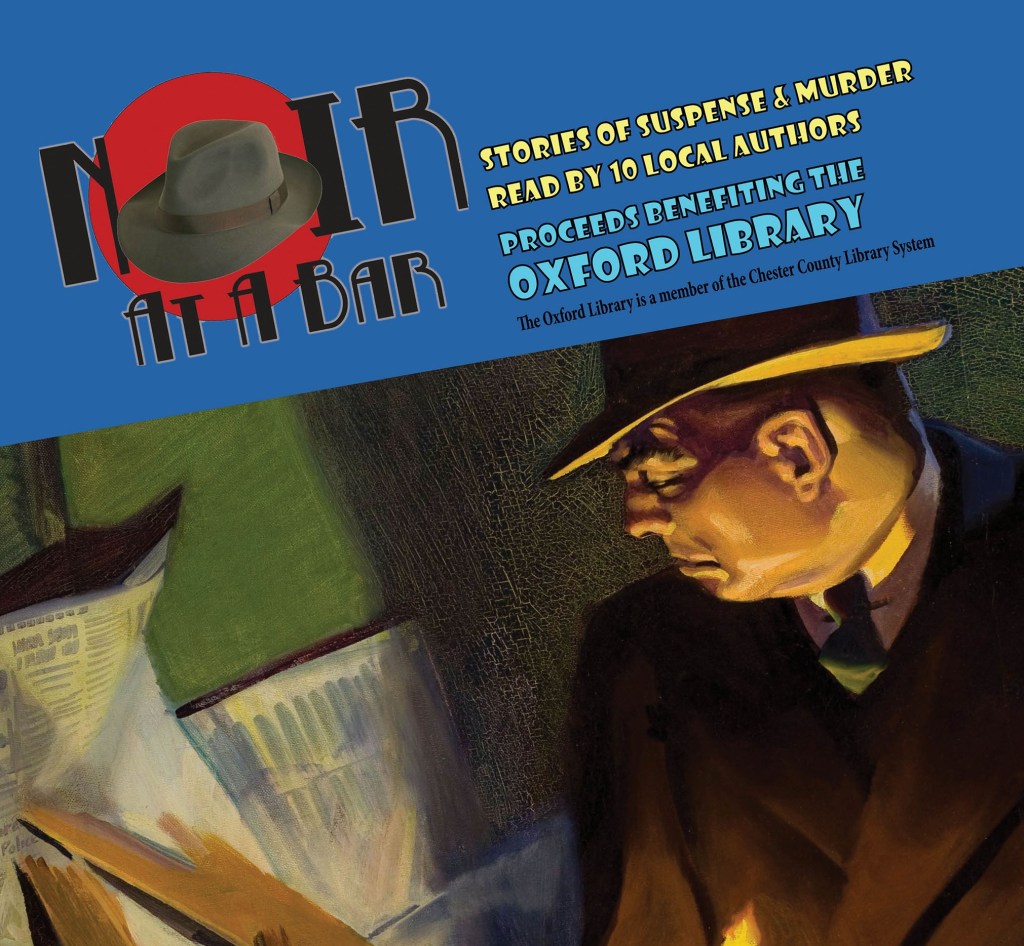
Come see me and twelve other authors on Thurs., November 7th in Oxford, PA for Noir at a Bar. The festivities begin at 6:30. Proceeds benefit the Oxford Public Library Tickets are $25, includes a buffet dinner!
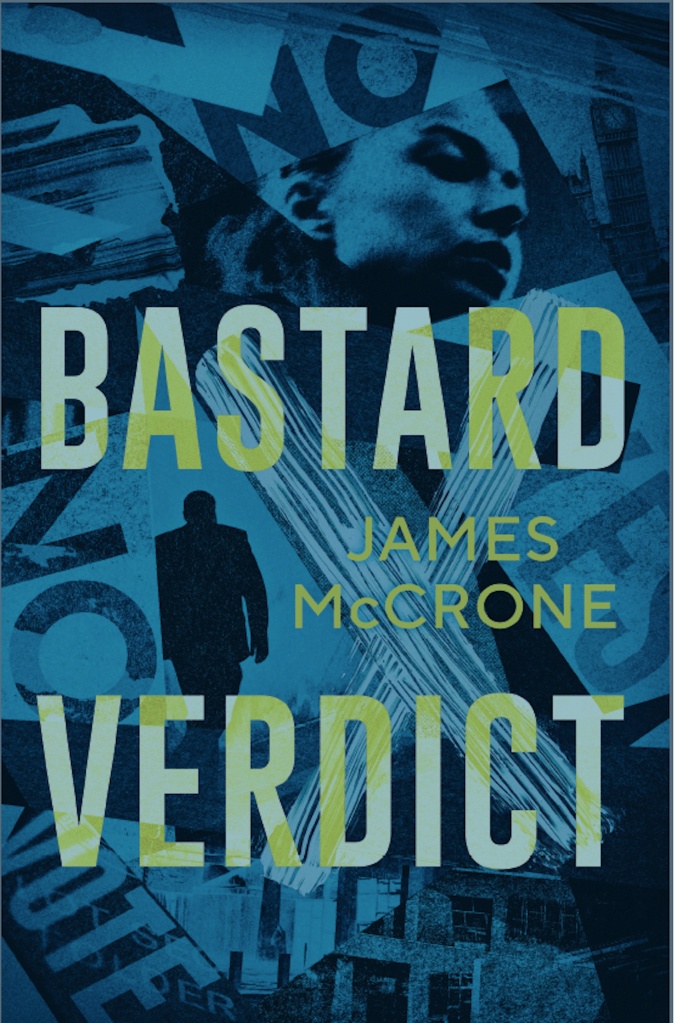
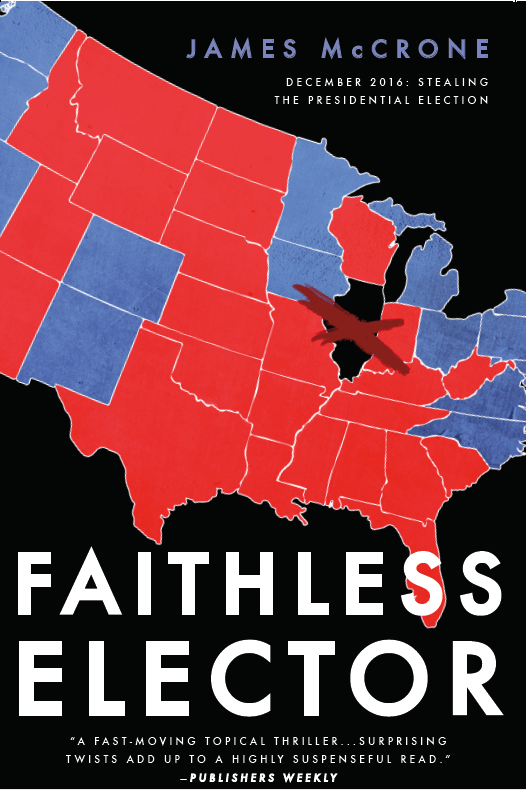
James McCrone is the author of the Imogen Trager political suspense-thrillers Faithless Elector, Dark Network , and Emergency Powers–noir tales about a stolen presidency, a conspiracy, and a nation on edge. Bastard Verdict, his fourth novel, is about a conspiracy surrounding a second Scottish Independence referendum. His novel-in-progress is called Witness Tree, about a conspiracy set in Oregon’s wine country, a (pinot) noir tale of murder and corruption.
Allbooks are available on BookShop.org, IndyBound.org, Barnes & Noble, your local bookshop, and Amazon. eBooks are available in multiple formats including Apple, Kobo, Nook and Kindle.
“Plays criticising the government make the second most boring evenings ever invented,” says Sir Humphrey Appleby to his minister in the delicious (and still, all-too-relevant) Yes, Minister series – “The Patron of the Arts” – (sea.2/ep.6).
The minister pauses, then asks him: “What are the most boring?” Sir Humphrey responds: “Those praising the government.”
To write political thrillers as I do is delicate. Readers seeking partisan, anger-porn that affirms their view one way or the other have ample fodder elsewhere, and I want my stories to be something else. As I’ve written before, stories are about questions, not answers.
In my work, I’m drawn to what lies behind the official explanations and stories we’re told. What is the flip side of the answer the powerful would like us to accept? What (if anything) is being concealed? Who would be involved? What is their story, what are the consequences of their choices?
I write stories because it’s how I understand the world and the questions I have about it. My work, as much as it’s about characters in action, is animated by politics, by threats to the sovereignty of people to determine their own future and, through the ballot, to hold those in power accountable. But it isn’t meant to be partisan. Unless you regard democracy itself as partisan.
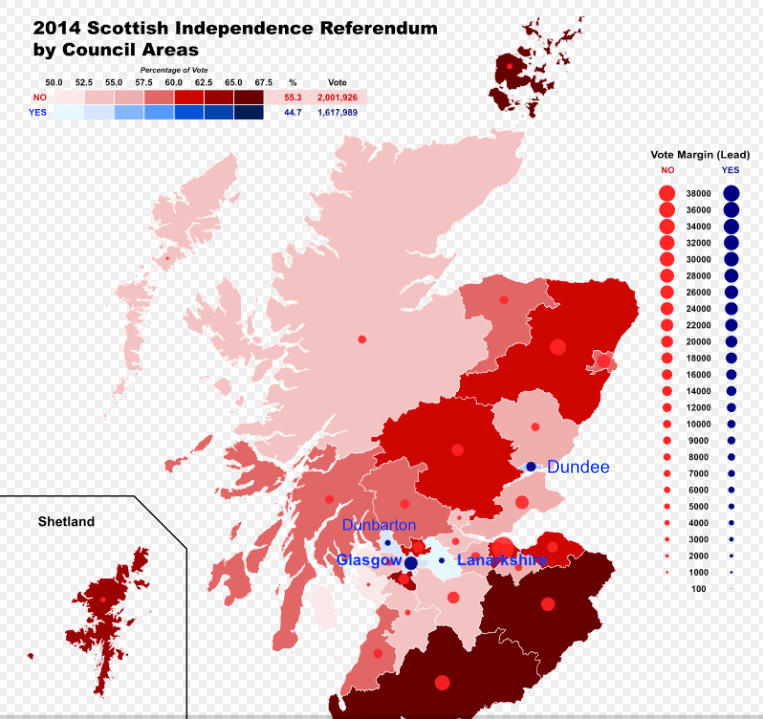
Bastard Verdict. September 18 marked the 10 year anniversary of the 2014 Referendum on Scottish Independence, in which voters were asked, “Should Scotland be an independent country?” It failed. 55% voted ‘No,’ to independence, while 45% voted ‘Yes.’ The dismay over this sad anniversary grew starker earlier this month, when, on October 12 we learned of the death of Alex Salmon, former First Minister of Scotland, and the most visible architect of that referendum. The quote that titles this post comes from him.
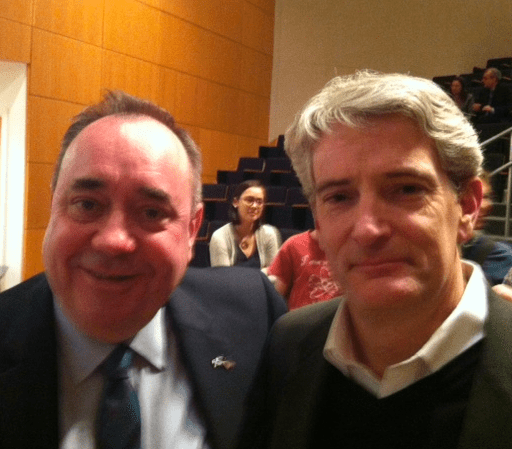
With Alex Salmond in Princeton, 2013
I got to meet Salmond when he gave a talk at Princeton in 2013. He was a fantastic speaker. The focus of his talk was Adam Smith’s Theory of Moral Sentiments, which forced me to reread Smith, and it gave me the epigram for my second novel, Dark Network – “Virtue is to be feared more than vice, because its excesses are not subject to the regulation of conscience.”
I lived in Scotland as a boy, but I had to watch the referendum from the sidelines here in the US. Nevertheless, I felt the failure of the vote keenly, and I wanted to understand it. My knowledge of the Scottish National Party (SNP)–and hopes for its success–began in 1974, when we lived in Edinburgh. My father, a US political scientist, had come to study the politics of independence during a sabbatical year at Strathclyde University.
As I began gathering notes for a new thriller about the referendum, the process led me to a different story and question: What if there had been irregularities in the referendum? What if, as a second (fictional) referendum was gathering strength, those who had interfered in 2014 felt that they needed to make sure their involvement stayed hidden? What would the conspirators do? Further, what if those who perpetrated the election interference weren’t in government at the time but had gained their places at the table through their plot?
I had not initially envisioned it as a story involving my character, the FBI Agent, Imogen Trager, but she insisted on being a part of it. (After all that has happened to her in the first books, she takes a year off to do some research at the University of Glasgow, to keep her head down and consider her next steps–only, like Michael Corleone, to get pulled back in!)
Ten years ago, hope for the future shined brightly amidst the fear-mongering and mendacity (and that hope endures, albeit somewhat dulled). At the time, retirees were told that their pensions would be at risk in a Scotland independent from the UK. The predictable media suspects treated the run-up to the referendum with derision and condescension. The queen weighed in four days before the vote, saying that Scotland should “think very carefully about the future,” an unsubtle hint. Pro-European Union voters were told that leaving the UK would mean Scotland couldn’t participate in the EU. Neither the pension scare nor the EU ouster was true of course (except later, in 2016, when the UK voted in favor of Brexit–even though voters in Scotland voted 62% in favor of remaining in the EU) It wasn’t enough of a counterweight, and England dragged its “partners” out of the EU).
Three of the four highest returns for Yes were in Strathclyde – Glasgow City, West Dunbartonshire and North Lanarkshire. The fourth was Dundee City Council. While the map looks very red, 20 per cent of the population lives within those four blue districts. Roughly 2 million voted No, and 1.6 million voted Yes.
As aghast as I am about the above political maneuvering, it’s of a type that’s depressingly common during an election cycle. But as I watched the ham-fisted way the Tory party managed Brexit (if managed is the word for it), I began to wonder how Westminster would have reacted to a successful referendum, and what kind of legal and extra-judicial mischief they might get up to. At stake are markets, airfields, a nuclear submarine base, and the energy wealth of the North Sea. And of course Britain’s standing in the world.
As I wrote the story, traveling back and forth to Scotland on two occasions and corresponding with academics about certain aspects of the book, I struggled with my partisan feelings over the referendum, and I think that tension helped the book. Two of the principle characters did not favor independence, but they are both aghast that there may have been irregularities. Oddly, a petty criminal character becomes something like the moral center of the story.
For the story, I focused on Glasgow and Dundee, and I brought back Imogen Trager (an FBI elections specialist) into service. I felt that a novel told from the perspective of an American in Scotland–my own point of view–would be more authentic. That novel became Bastard Verdict, named for the “not proven” verdict in Scottish Law. The tension I wrestled with, between telling a good story on the one hand and venting my anger and disappointment on the other, gave the novel an energy and clarity I doubt I would have managed if I given in to the disappointment.
# # #
James McCrone is the author of the Imogen Trager political suspense-thrillers Faithless Elector, Dark Network , and Emergency Powers–noir tales about a stolen presidency, a conspiracy, and a nation on edge. Bastard Verdict, his fourth novel, is about a conspiracy surrounding a second Scottish Independence referendum. His novel-in-progress is called Witness Tree, about a conspiracy set in Oregon’s wine coutry, a (pinot) noir tale of murder and corruption.
Allbooks are available on BookShop.org, IndyBound.org, Barnes & Noble, your local bookshop, and Amazon. eBooks are available in multiple formats including Apple, Kobo, Nook and Kindle.
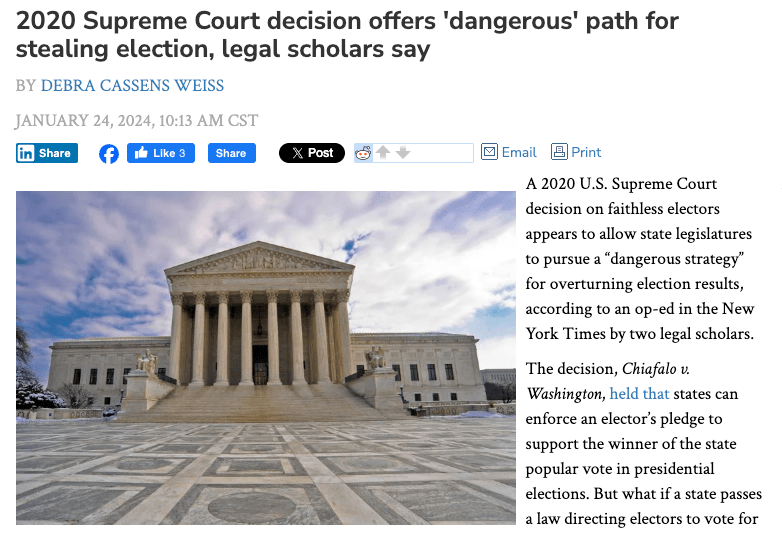
Today we need to discuss the Chiafalo v. Washington, 591 U.S. _ (2020) ruling, and its (potential) unintended consequences. The ABA Journal (link above) notes earlier this year that “A 2020 U.S. Supreme Court decision on faithless electors appears to allow state legislatures to pursue a dangerous strategy for overturning election results…”
Those who read my posts–and my thrillers–know that I have long regarded the Electoral College as an outmoded, arcane system for electing a president; and one that is ripe for mischief from bad actors that only amplifies the anti-democratic underpinnings of our system. Those who claim to defend the Electoral College often say that they are upholding the Founders’ vision, when in fact they are working to exploit its loopholes and undermine faith in its legitimacy for their own ends.
Chiafalo v Washington was a unanimous Supreme Court decision “that states have the ability to enforce an elector’s pledge in presidential elections.” It is the suit that arose from the Faithless Electors lawsuit after the 2016 presidential election. The ABA article quotes a NY Times op-ed by Lawrence Lessig, a professor at Harvard Law School, and Matthew A. Seligman, a fellow at the Constitutional Law Center at Stanford Law School.
In their op-ed, Lessig and Seligman’s describe an all-too possible scenario: “Charges of fraud cloud a recount. Leaders in the state legislature challenge the presumptive result. In response to those challenges, the legislature votes to direct its electors to cast their ballots for the candidate who presumptively lost but whom the legislature prefers. Any elector voting contrary to the legislature’s rule would be removed and replaced with an elector who complied. This is a critical innovation in the science of stealing a presidential election.” [Emphasis mine]
Lessig and Seligman go on to say: “Congress could amend the federal law governing electoral votes by declaring that any post-election change of the results by a state legislature would not count as votes ‘regularly given,’” they wrote. “States could cement the requirement that electors are to follow the people’s will. Neither path is assured, but we are certain of this: It is a rocky road ahead.” As currently constituted, only the Senate would be likely to take this up. The House has a Trump-controlled majority.(And it is Trump-controlled. As we saw in the failure of the bipartisan Immigration Reform Bill after Trump torpedoed it. Brookings has an explainer “for the perplexed,” though in the end, it’s not hard to figure out.)
My first novel, Faithless Elector came out in early 2016 and presaged some of the insanity surrounding the election. But the third book, Emergency Powers may prove to be more on point (which does not make me feel good, somehow).
Voting is our chance to participate and to hold our elected officials to some sort of accountability. Is it perfect? Hardly, but we may get a lesson in just how bad the alternative is if we don’t vote–all of us. Because the last three years or more have seen a coordinated effort to undercut that chance to make outrvoices heard through bad faith laws, official skullduggery and lawsuits. So much so, that the GOP candidate, Donald Trump, can say, as he did on July 28 of this year, that we “won’t have to vote anymore…”
The election is roughly 3 months from now. The forces that seek to steal our votes have been busy for years. Perhaps knowing that a majority does not support their policies, the GOP has undertaken to shrink the number of eligible voters and (potentially) to usurp the role of Electors.
I’ll talk more about the lawsuits and gerrymandering that’s still going on–and the Supreme Court’s role in it–in a follow-up post.
# # #
James McCrone is the author of the Imogen Trager political suspense-thrillers Faithless Elector, Dark Network , and Emergency Powers–noir tales about a stolen presidency, a conspiracy, and a nation on edge. Bastard Verdict, his fourth novel, is about a conspiracy surrounding a second Scottish Independence referendum.
Allbooks are available on BookShop.org, IndyBound.org, Barnes & Noble, your local bookshop, and Amazon. eBooks are available in multiple formats including Apple, Kobo, Nook and Kindle.
He’s a member of Mystery Writers of America, Int’l Assoc. of Crime Writers, and he’s the current president of the Delaware Valley chapter of Sisters in Crime. He lives in Philadelphia. James has an MFA from the University of Washington in Seattle. His current, work-in-progress is a mystery-thriller set in Oregon’s wine country…A (pinot) Noir, called Witness Tree.
For a full list of appearances and readings, make sure to check out his Events/About page. And follow this blog!
Fiction is not a letter to the editor, not an essay or a position paper, nor even a puff piece reifying one view over another. It’s stories–about character(s) in conflict, and a question–what will happen next? will the character succeed, fail, or live to fight another day?
But that isn’t quite all of it. I’m indebted to Maria Popova’s newsletter The Marginalian for helping me articulate something I felt to be true but couldn’t quite make clear.
Popova’s August 2021 newsletter “How (Not) to Be a Writer” quotes Anton Chekhov: “the task of the writer is not to solve the problem, but to state the problem correctly.” James Baldwin said something similar when he noted that the writer’s task is to “drive to the heart of every answer and expose the question the answer hides.”
Chekhov goes on to say: “Anyone who says that the artist’s sphere leaves no room for questions, but deals exclusively with answers, has never done any writing or done anything with imagery. The artist observes, selects, guesses, and arranges; every one of these operations presupposes a question at its outset. If he has not asked himself a question at the start, he has nothing to guess and nothing to select.”
So, is it that “Happy families are all alike; but every unhappy family is unhappy in its own way,” as Tolstoy asserts at the beginning of Anna Karenina? We may decide for ourselves. George Eliot’s preoccupation and recurring question was, “What to do with one’s life, how to use one’s gifts for the benefit of oneself and the world?” Or, as she asks in one of my favorite novels, Middlemarch, is it true “that things are not so ill with you and me as they might have been…owing to the number who lived faithfully a hidden life, and rest in unvisited tombs”?
I have said that I write political thrillers that aren’t political. By that, I mean that the work has no axe to grind, no point to prove. Sometimes the label “political” is lobbed around by readers or critics who are uncomfortable with a book’s subject matter, or the characters involved, and those inclusions in the story are what such people label (and dismiss) as “political.” Which is decidedly not what I’m talking about. In my work, I’m drawn to what lies behind the official explanations and stories we’re told. What is the flip side of the answer the powerful would like us to accept? What (if anything) is being concealed?
For example, a switched vote by a “faithless elector” has never altered the supposed result of a presidential election. But what if it did, what would it take? Who might orchestrate such a thing? How would they go about it? Those questions animated my first thriller, Faithless Elector, and new questions arose that drove me through the two following novels in the series, Dark Network and Emergency Powers. Early agent- and editor rejections for Faithless would praise the story, the characters (while nevertheless declining to pursue publication), but in two instances an agent wrote back, saying that “No one knows anything or cares about the Electoral College.”
I think they do now.
This isn’t too much of a spoiler, but readers are often surprised to find that neither of the parties is behind the conspiracy. Did I do it because I wanted not to offend anyone? No, when I asked the question, ‘who would do it?’ the story (and verisimilitude) dictated that it be an outside force, albeit one that is parasitic on a particular party. As a beginning, the novels I have written thus far ask, “What if?” and then go deeper:
In Faithless Elector, it was, What if a group of conspirators tried to steal the presidency by manipulating the Electoral College? In Dark Network, it was, How far might such people really go, and what happens when there is no law, only power? And in Emergency Powers, the questions was, Would Imogen have the stamina to sustain the investigation when everyone else wants to move on? (And why are those others so eager to move on?)
For my latest thriller, Bastard Verdict, I wondered, What if the first Referendum on Scottish Independence had been interfered with? How might it have been achieved? Would the conspirators be anxious to keep the lid on what they had done?
You can also read two of my recent short stories online. In “What’s Hidden,” the question is, “what do we owe to the dying and the dead?” In “Eight O’clock Sharp,” the question is, “is there freedom when the past doesn’t remember you?”
To write about one’s own time is to risk being dismissed as “political,” but to write about the here and now is always political. The beauty and substance comes from the questions we ask.
# # #
James McCrone is the author of the Imogen Trager political suspense-thrillers Faithless Elector, Dark Network , and Emergency Powers–noir tales about a stolen presidency, a conspiracy, and a nation on edge. All books are available on BookShop.org, IndyBound.org, Barnes & Noble, your local bookshop, and Amazon. eBooks are available in multiple formats including Apple, Kobo, Nook and Kindle.
His latest book Bastard Verdict(18-May-2023), is a noir political thriller set in Scotland. His current, work-in-progress is a mystery-thriller set in Oregon’s wine country…A (pinot) Noir, called Witness Tree.
A Seattle native (mostly), James now lives in South Philadelphia with his wife and three children. He’s a member of the The Mystery Writers of America, Int’l Assoc. of Crime Writers, Int’l Thriller Writers, Philadelphia Dramatists Center and is the current president of the Delaware Valley chapter of the Sisters in Crime network. James has an MFA from the University of Washington in Seattle.
For a full list of appearances and readings, make sure to check out his Events/About page. And follow this blog!



 Chosen Words - James McCrone