As American as Baseball: A Modest Proposal

New plurality rules for baseball!
The extra-innings format rule in Major League Baseball has inspired me to dust off a format change I’d blogged about years ago, but which so far hasn’t garnered the changes I envisioned. Be assured, I have forwarded this “innings-ovation” proposal to Baseball Commissioner Rob Manfred. Incredibly, then-commissioner Bud Selig did not respond to my original proposal.

The Electoral College is as American as baseball—venerably, willfully idiosyncratic, hidebound and capricious. (Which is part of the fun, right?)!

Why does the similarity stop there?

The enduring use of the Electoral College should inspire those of us who love the game–as we love the Republic–to greater depths.  If winner-take-all is indeed our national spirit, why must “America’s game” cling to its outmoded scoring?

Total number of runs over nine innings is clearly too simple-minded a way of determining a winner. And likely to stir up passions.

Therefore, in order to address the unfair, and frankly un-American scoring discrepancy that baseball presents, I would like to modestly propose a new set of plurality rules for scoring a baseball game:

  • The team who scores the most runs in a particular inning will be awarded ALL of the runs scored in that inning by either team. 

To illustrate: let us say, in the first inning Team ‘A’ scored 3 runs and Team ‘B’ scored 2. Under electoral scoring, Team ‘A’ having received more runs that ‘B’ would receive all 5 runs scored in that inning.

Then, (to continue the scenario) if in the following second inning, ‘B’ scored 3 runs and ‘A’ none, the running score would be ‘A’-5 vs. ‘B’- 3, each having won an inning and been awarded all the points that inning carried. Then, in the 9th inning, the innings-won total would be calculated to determine the winner.

I’m sure we can all agree that this makes much more sense. And to those who say it would unfairly award wins and even the championship to a lesser team, I can only say that it wouldn’t happen any more frequently than the Electoral College winner loses the popular vote (5, but who’s counting?).

Indeed, a survey of the last two World Series contests shows that while the scoring would have been different, the result would have been the same. And more just.
But I hear you say, there could still be a tie.

Of course. In the new innings plurality rules, the teams would play a 10th inning. But, as the new player-in-scoring-position-to begin extra innings makes clear, to continue playing past that is pointless. If, at the end of the 10th inning, there is still a tie, the decision as to who has won the contest would be remanded to a responsible body, one with knowledge of the teams, players and their capabilities. 

There could be no better group than living members of the Baseball Hall of Fame to weigh, consider and decide which team should win, a College of Baseball Elders. Like the electoral college, there could be some simple safeguards in place, such as a restriction on not voting for a team on which an Elder had previously played.

What could be more American? 

Follow this blog for more insights.

# # #

For a primer of past blog posts on the issues surrounding the Electoral College, click the links below: everything from the issues surrounding popular vote winners losing in the Electoral College, to Faithless Electors, to the democratic deficit inherent in the apportioning of EC votes.
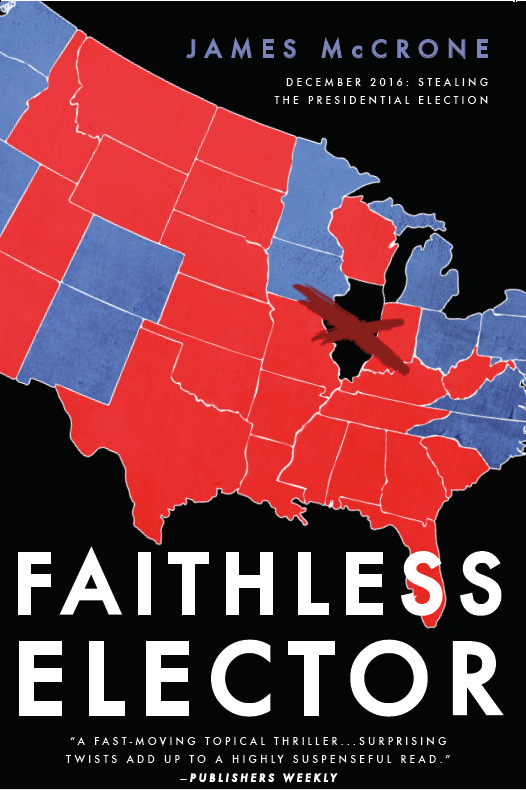
And for a thrilling read, check out the whole series, beginning with Faithless Elector.

Alexander Hamilton and the first contested election

Power of Small State Voting

Chaos Theory, Electoral College Style

Faithless Electors could have tipped 5 previous elections
Structural Flaws
James McCrone

James McCrone is the author of the Imogen Trager political suspense-thrillers Faithless Elector , Dark Network , and Emergency Powers–noir tales about a stolen presidency, a conspiracy, and a nation on edge. All books are available on BookShop.org, IndyBound.org, Barnes & Noble, and Amazon. eBooks are available in multiple formats including Apple, Kobo, Nook and Kindle.

His work, “Numbers Don’t Lie” also recently appeared in the 2020 short-story anthology Low Down Dirty Vote, vol. 2, and his short story “Ultimatum Games” will appear in Rock and a Hard Place this fall. His next book, w/t Bastard Verdict, is a noir political thriller set in Scotland.


A Seattle native (mostly), James now lives in South Philadelphia with his wife and three children. He’s a member of the The Mystery Writers of America, Int’l Assoc. of Crime Writers, Int’l Thriller Writers, Philadelphia Dramatists Center and is the newly elected vice-president of the Delaware Valley chapter of the Sisters in Crime network. James has an MFA from the University of Washington in Seattle.

Power of the small states in the *Electoral College

Power of the Small States in the Electoral College

[previously posted on a former blog, now defunct – April, 2016]

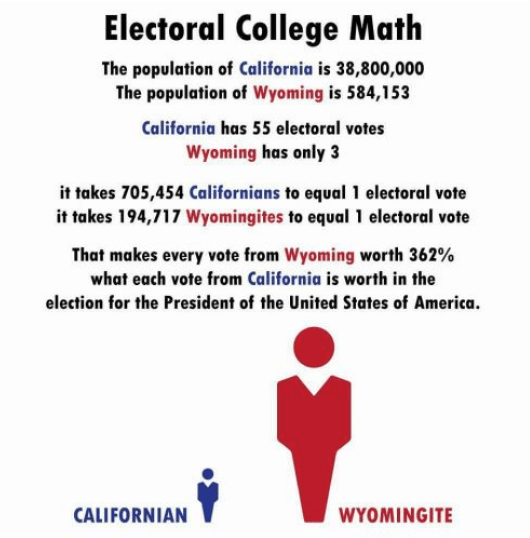
The Electoral College process favors people living in small states. We all know that each state has the same number of electoral votes as it does members of Congress. Since congressional apportionment in the Senate favors the small states, the electoral college therefore favors small states, first by giving them the malapportioned Senate votes, and second by amplifying the voting power of those votes.

For instance, California has 38,800,000 residents, and it has 55 electoral votes, or about 705,000 people per elector; and Wyoming, with 550,000 people, has three electoral votes, or about 183,000 people per elector. Which means that a Wyoming resident has 3.8 times the voting power of a California resident. Sixty-five Wyomings could fit in California, meaning that if California were scaled in such a way it would contribute 195 votes to the electoral college.

The winner-take-all (except ME and NE) further amplifies this scenario. (For further reading, you can check out papers from Columbia Univ. and MIT.)

Many respond that ours is a Constitutional Republic, that the Electoral College and the Senate protect us from “tyranny of the majority” and/or “mobocracy.” This misses a key point:

Where and when are we prepared to say that the loser gets to win, to dictate policy? Under what circumstances?

And whereas California has 38,800,000 residents, and it has 55 electoral votes, or about 705,000 people per elector; and Wyoming, with 550,000 people, has three electoral votes, or about 183,000 people per elector. This discrepancy means that a Wyoming resident has 3.8 times the voting power of a California resident.

Sixty-five Wyomings could fit in California, meaning that if California were scaled in the same way, California would contribute 195 votes to the electoral college. The winner-take-all nature of the contest (except ME and NE) further amplifies this unbalanced scenario.

One further latent anti-democratic issue in the Electoral College is the prospect of a three-way race where no one wins a clear majority (270).

When no candidate wins 270 electoral votes, the Constitution provides that the House of Representatives elects the president in such a case. If it were the full House voting, and since, ideally, the House’s membership reflects the nation’s population, this election would be relatively fair. However, this process provides that each state receives only one vote, further diluting and diminishing the power of large states, and utterly disenfranchising the people of the United States.

Given the undemocratic nature of the EC, if an elector switched his or her vote so that the EC vote matched the popular vote, would this be a good thing?

#   #   #

James McCrone

James McCrone is the author of the Imogen Trager political suspense-thrillers Faithless Elector , Dark Network , and Emergency Powers–noir tales about a stolen presidency, a conspiracy, and a nation on edge. All books are available on BookShop.org, IndyBound.org, Barnes & Noble, and Amazon. eBooks are available in multiple formats including Apple, Kobo, Nook and Kindle.

His work, “Numbers Don’t Lie” also recently appeared in the 2020 short-story anthology Low Down Dirty Vote, vol. 2, and his short story “Ultimatum Games” will appear in Rock and a Hard Place this fall. His next book, w/t Bastard Verdict, is a noir political thriller set in Scotland.


A Seattle native (mostly), James now lives in South Philadelphia with his wife and three children. He’s a member of the The Mystery Writers of America, Int’l Assoc. of Crime Writers, Int’l Thriller Writers, Philadelphia Dramatists Center and is the newly elected vice-president of the Delaware Valley chapter of the Sisters in Crime network. James has an MFA from the University of Washington in Seattle.
This blogpost was previously posted on a former blog, now defunct – April, 2016

Alexander Hamilton and the first contested election

[previously posted on a now defunct blog – 30 August, 2016]

The compromise rules governing the Electoral College could not even stand up to the first contested election in 1800. The original writing had the candidate with the most Electoral College ballots becoming president; the second place candidate would be vice-president. Those at the Philadelphia Constitutional Convention had not even conceived of there being political parties.

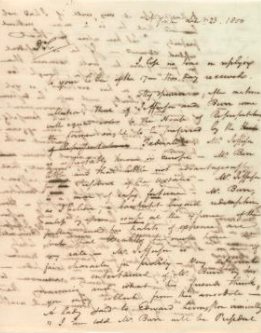
Hamilton Letter

In 1800, there was a tie between Jefferson and Burr; and even had there not been, two candidates from different parties would have been president and vice-president. The deadlock in the House in 1800 was broken on the 36th ballot (!), but only after Federalist Party leader Alexander Hamilton made known his preference for Jefferson, in words that ring eerily salient today: “In a choice of Evils let them take the least – Jefferson is in every view less dangerous than Burr.”

EXCERPT of the letter:
“Mr. Jefferson, though too revolutionary in his notions, is yet a lover of liberty and will be desirous of something like orderly Government – Mr. Burr loves nothing but himself – thinks of nothing but his own aggrandizement – and will be content with nothing short of permanent power in his own hands – No compact, that he should make with any other passion in his own breast except his Ambition, could be relied upon by himself – How then should we be able to rely upon any agreement with him? Mr. Jefferson, I suspect will not dare much; Mr. Burr will dare every thing in the sanguine hope of effecting every thing.”
[Letter to Harrison Gray Otis, a Massachusetts Congressman, from Alexander Hamilton]

Responding to the problems from those first elections, the Congress proposed the Twelfth Amendment in 1803—prescribing that electors cast separate ballots for president and vice president, and replacing the system outlined in Article II, Section 1, Clause 3. By June 1804, the states had ratified the amendment in time for the 1804 election. However, should there ever be a tie, or if no candidate receives the requisite majority of Electoral Votes, the vote for president will go to the House and Senate, who will vote separately on president and vice-president.

Initially, the Electoral College provisions conceived a set of knowledgeable persons, gentlemanly statesman of the political class who would put nation above self-interest. We have only to look at the 1800 election, where it is clear those involved were motivated more by what would be better for their state and their party than with the concerns of the nation to see how hollow that conception was.

I’m not casting aspersions on those Representatives. The 1800 election was a political struggle, with the clamor and rancor we would recognize today between contending visions of what is best for the nation. But it was hardly statesman-like.

When people defend the Electoral College as a way of putting country over the self-interest of the popular will, they are hearkening to a pre-political time that never existed, or more cynically, they are defending and advocating the ability of a small group to impose their self-interest on the majority. For all the criticism political parties routinely get, they are the only way non-political people (the majority) can have influence. The enduring recession has exposed how easily moneyed interests can manipulate rules at the heart of the Constitution itself.

The novel, Faithless Elector, shines light on the weakness of the system as well as the opportunity for narrow, special interests to exploit that weakness and thwart the will of the majority.

#   #   #

James McCrone

James McCrone is the author of the Imogen Trager political suspense-thrillers Faithless Elector , Dark Network , and Emergency Powers–noir tales about a stolen presidency, a conspiracy, and a nation on edge. All books are available on BookShop.org, IndyBound.org, Barnes & Noble, and Amazon. eBooks are available in multiple formats including Apple, Kobo, Nook and Kindle.

His work, “Numbers Don’t Lie” also recently appeared in the 2020 short-story anthology Low Down Dirty Vote, vol. 2, and his short story “Ultimatum Games” will appear in Rock and a Hard Place this fall. His next book, w/t Bastard Verdict, is a noir political thriller set in Scotland.


A Seattle native (mostly), James now lives in South Philadelphia with his wife and three children. He’s a member of the The Mystery Writers of America, Int’l Assoc. of Crime Writers, Int’l Thriller Writers, Philadelphia Dramatists Center and is the newly elected vice-president of the Delaware Valley chapter of the Sisters in Crime network. James has an MFA from the University of Washington in Seattle.
This post is from a previous (now defunct) blog, originally published 30 August, 2016

Blunt Tools

If you’ve followed my posts at all you know that my first novel, Faithless Elector is a thriller about stealing the presidency by manipulating the Electoral College—something that seemed crazily far-fetched to most of the agents I pitched it to years ago. Faithless Elector asks, “what if a group of conspirators wanted to steal a close election by getting a small number Electors to switch their votes—to vote as Faithless Electors—and overturn the result?” What would it take? How might it be done?

What doesn’t get as much attention (what middle child ever does?) is the second book in the Imogen Trager trilogy, Dark Network, which focuses on sub rosa politicking (and murder!) in the lead-up to certifying the votes, and a subsequent Contingency Election.

These thrillers, which include this year’s Emergency Powers, aren’t screeds for or against one party, but unblinking examinations of what could go wrong, about how the systems we the people rely upon to protect the process can also be the very thing that gets exploited–and what a fearless, driven group of investigators might have to do to protect the rule of law.

Today (Dec. 14) is the “the first Monday after the second Wednesday in December,” the day provided for in the Constitution, when the Electors meet for the real presidential election. No one expects there to be the kind of faithless voting that took place four years ago when ten (10!) Electors cast their ballots as Faithless Electors. But it’s the second book, Dark Network, that may prove more prophetic because it deals with the aftermath of Electoral voting: Electoral votes must be certified by Congress.

If enough votes are challenged and rejected, and neither candidate has an Electoral College majority (270 or better), the vote for president goes to the House, where each state has but one vote. The Senate votes separately for VP.

The separate Senate and House votes could even mean that the president and vice president are of different parties. But what Dark Network examines, underneath its thriller veneer, is the lengths a group of bad actors might go to in order to undermine faith in the process, to undermine the legitimacy of the vote.

Voting, and faith in its legitimacy, is the blunt tool by which we hold our government accountable. “Without law, there’s only power,” is the tagline from Dark Network. But what about when law protects the powerful?

As this Lawyers, Guns and Money blogpost makes clear, as does my earlier Murder is Everywhere post about the patchwork nature of Electoral rules, each stop on the way to certification and inauguration adds layer upon layer of uncertainty—and potential for mischief—to the process. And while the Supreme Court, hoping to avoid the kind of chaos that would indeed undermine faith in the process, ruled in July that states may make laws binding Electors to their pledge, the ruling only permits those laws. 32 states have no such law.

House members are already agitating to challenge various states’ Electoral votes when Congress meets on January 6. Will they be able to throw out enough Electoral votes to change the anticipated outcome? Probably not. A Senator would have to sign on to the challenge(s), and a majority of both houses would then have to vote in favor of the challenge (throwing out the votes!).

But overturning the result at this stage may not be the goal.

#   #   #

James McCrone

James McCrone is the author of the Imogen Trager political suspense-thrillers Faithless Elector and Dark Network , about a stolen presidency, a conspiracy, and a nation on edge.
The third book, Emergency Powers, is available NOW!
All books are available on BookShop.org, IndyBound.org, Barnes & Noble, and Amazon. eBooks are available in multiple formats including Apple, Kobo, Nook and Kindle.

He’s at work on a fourth thriller, set in Scotland.
A Seattle native (mostly), he now lives in South Philadelphia with his wife and three children.
James is a member of the The Mystery Writers of America, Int’l Assoc. of Crime Writers, Int’l Thriller Writers, Philadelphia Dramatists Center and the Sisters in Crime network. James has an MFA from the University of Washington in Seattle.