Without law, there is only power

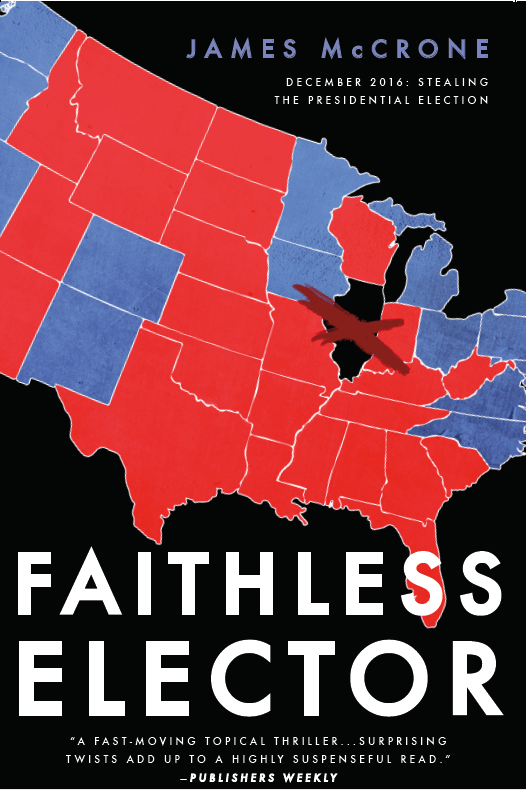
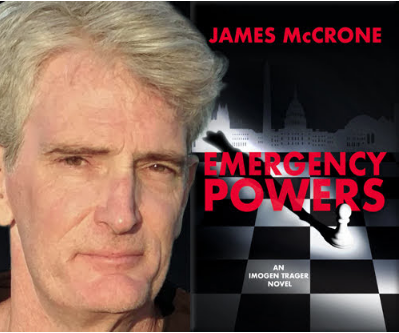
“Without law, there is only power,” is the tagline for the second book in the Faithless Elector series, Dark Network.

The books have been prescient about where we find ourselves today, attacks on the Electoral College, attacks on voting; naked power grabs by people from outside the parties who are nevertheless parasitic upon them (and who, like parasites, take over and destroy their hosts). There is a prison murder made to look like suicide, false flag attacks–and all written years before such events took center stage.

But I have to admit to a little naivety.

As the tagline above suggests, I had stupidly believed that the law might be a check on power. I had no inkling that the Dept. of Justice and the courts could be neutered (or weaponized) to the extent that we’re seeing today. The courts may indeed turn out to be a bulwark against the worst excesses of the current Trump administration, but I am not optimistic.

If I were writing Dark Network today I might use the tagline “when power is the law, there is no justice.”

Laws are not self-enforcing. We learned today, that DOJ lawyers are “being forced to choose between the president’s agenda and their ethical obligations as attorneys” (NYT, see link above).

With a supine congress, content to cede power to the presidency, there is little chance the administration will follow rulings that are contrary to its will. When the Supreme Court continues to abdicate its prerogatives, too, it’s unlikely that the administration will be compelled to do anything or uphold anything it doesn’t want to.

Voting is the crux of all three novels in the Faithless Elector series. It’s what the conspirators try to undermine and nullify. So, while I may have missed some of the viciousness and vindictiveness of the current administration in my novel, their real-world undermining of voting rights remains salient.

My alter-ego, and protagonist in all three books, FBI Agent Imogen Trager, is driven by her rage to oppose those who would take away or mitigate the right to vote. To do so, she has to navigate compromised and outright corrupt colleagues, a shadow paramilitary group and more to unmask who is pulling the strings and bring him to justice.

The “law” that Imogen fights desperately to preserve is that of the people to determine their own destiny. And in the real world, it’s also under daily threat.

Democracy Docket is fighting anti-voting legislation across the country, and it will be voting that brings some semblance of order and justice to the nation. “We are not powerless, and we must not act like we are,” writes Marc Elias.

I might add that they wouldn’t fight so hard to take away your vote if it wasn’t so important…and worrisome to them.

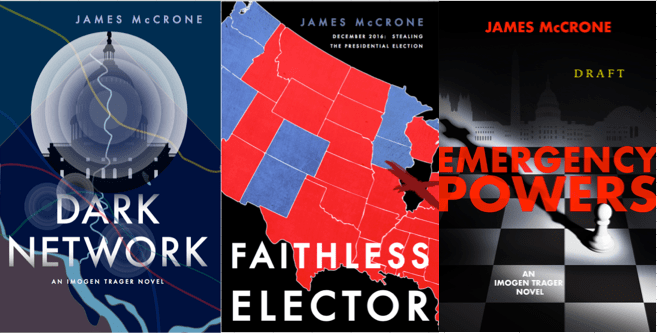
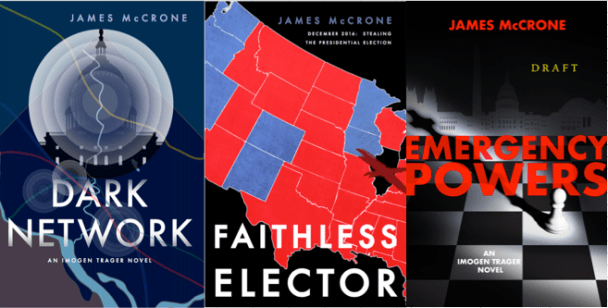
The Imogen Trager #FaithlessElector Thrillers at a glance:
trilogy-draft

Faithless Elector – Everyone thinks the election is over, but six weeks is a long time in politics. An idealistic, young researcher stumbles onto a plot to steal the presidency, with deadly consequences.

Dark Network – Without law, there’s only power. FBI Agent Imogen Trager is alone and in grave danger from a conspiracy she failed to destroy. She’ll have to fight against time, a sinister network, and even her own colleagues to defeat it.

Emergency Powers – No battle plan survives contact with the enemy. The investigation that was FBI Agent Imogen Trager’s undoing may be the key to stopping a brutal, false flag terrorist attack meant to tighten a puppet president’s grip on power.

# # #

James McCrone is the author of the Imogen Trager political suspense-thrillers Faithless ElectorDark Network and Emergency Powers–noir tales about a stolen presidency, a conspiracy, and a nation on edge. Bastard Verdict, his fourth novel, is about a conspiracy surrounding a second Scottish Independence referendum. His novel-in-progress is called Witness Tree, a (pinot) noir tale of murder and corruption set in Oregon’s wine country.

All books are available on BookShop.org, IndyBound.org, Barnes & Noble, your local bookshop, and Amazon.

eBooks are available in multiple formats including Apple, Kobo, Nook and Kindle.

James is a member of Mystery Writers of America, Int’l Assoc. of Crime Writers, and he’s the current president of the Delaware Valley chapter of Sisters in Crime. He lives in Philadelphia. James has an MFA from the University of Washington in Seattle.

For a full list of appearances and readings, make sure to check out his Events/About page. And follow this blog!

You can also keep up with James and his work on social media:
Mastodon: @JMcCrone
Bluesky: @jmccrone.bsky.social
Facebook: James McCrone author (@FaithlessElector)
and Instagram/Threads “@james.mccrone”
Questions and guessing, when the political is not political

Fiction is not a letter to the editor, not an essay or a position paper, nor even a puff piece reifying one view over another. It’s stories–about character(s) in conflict, and a question–what will happen next? will the character succeed, fail, or live to fight another day?

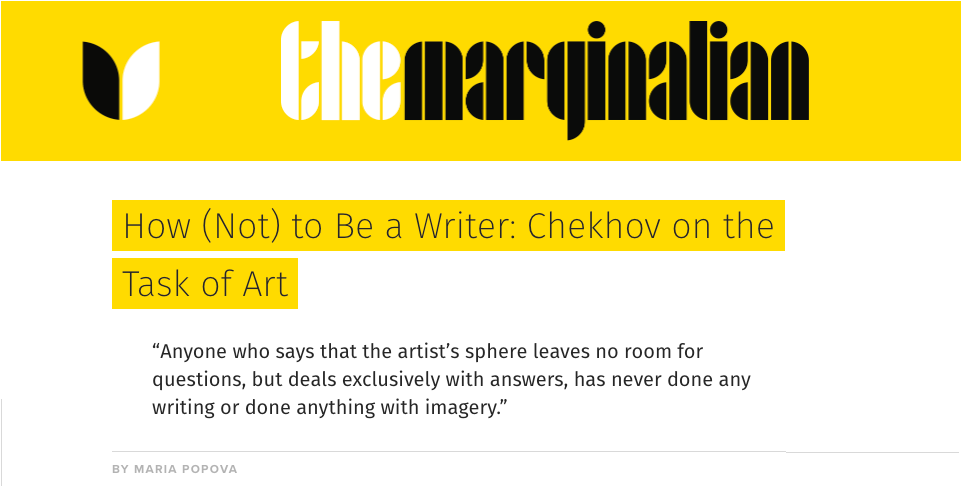
But that isn’t quite all of it. I’m indebted to Maria Popova’s newsletter The Marginalian for helping me articulate something I felt to be true but couldn’t quite make clear.

Popova’s August 2021 newsletter “How (Not) to Be a Writer” quotes Anton Chekhov: “the task of the writer is not to solve the problem, but to state the problem correctly.” James Baldwin said something similar when he noted that the writer’s task is to “drive to the heart of every answer and expose the question the answer hides.”

Chekhov goes on to say: “Anyone who says that the artist’s sphere leaves no room for questions, but deals exclusively with answers, has never done any writing or done anything with imagery. The artist observes, selects, guesses, and arranges; every one of these operations presupposes a question at its outset. If he has not asked himself a question at the start, he has nothing to guess and nothing to select.”

So, is it that “Happy families are all alike; but every unhappy family is unhappy in its own way,” as Tolstoy asserts at the beginning of Anna Karenina? We may decide for ourselves. George Eliot’s preoccupation and recurring question was, “What to do with one’s life, how to use one’s gifts for the benefit of oneself and the world?” Or, as she asks in one of my favorite novels, Middlemarch, is it true “that things are not so ill with you and me as they might have been…owing to the number who lived faithfully a hidden life, and rest in unvisited tombs”?

I have said that I write political thrillers that aren’t political. By that, I mean that the work has no axe to grind, no point to prove. Sometimes the label “political” is lobbed around by readers or critics who are uncomfortable with a book’s subject matter, or the characters involved, and those inclusions in the story are what such people label (and dismiss) as “political.” Which is decidedly not what I’m talking about. In my work, I’m drawn to what lies behind the official explanations and stories we’re told. What is the flip side of the answer the powerful would like us to accept? What (if anything) is being concealed?

For example, a switched vote by a “faithless elector” has never altered the supposed result of a presidential election. But what if it did, what would it take? Who might orchestrate such a thing? How would they go about it? Those questions animated my first thriller, Faithless Elector, and new questions arose that drove me through the two following novels in the series, Dark Network and Emergency Powers. Early agent- and editor rejections for Faithless would praise the story, the characters (while nevertheless declining to pursue publication), but in two instances an agent wrote back, saying that “No one knows anything or cares about the Electoral College.”

I think they do now.

This isn’t too much of a spoiler, but readers are often surprised to find that neither of the parties is behind the conspiracy. Did I do it because I wanted not to offend anyone? No, when I asked the question, ‘who would do it?’ the story (and verisimilitude) dictated that it be an outside force, albeit one that is parasitic on a particular party. As a beginning, the novels I have written thus far ask, “What if?” and then go deeper:

In Faithless Elector, it was, What if a group of conspirators tried to steal the presidency by manipulating the Electoral College? In Dark Network, it was, How far might such people really go, and what happens when there is no law, only power? And in Emergency Powers, the questions was, Would Imogen have the stamina to sustain the investigation when everyone else wants to move on? (And why are those others so eager to move on?)

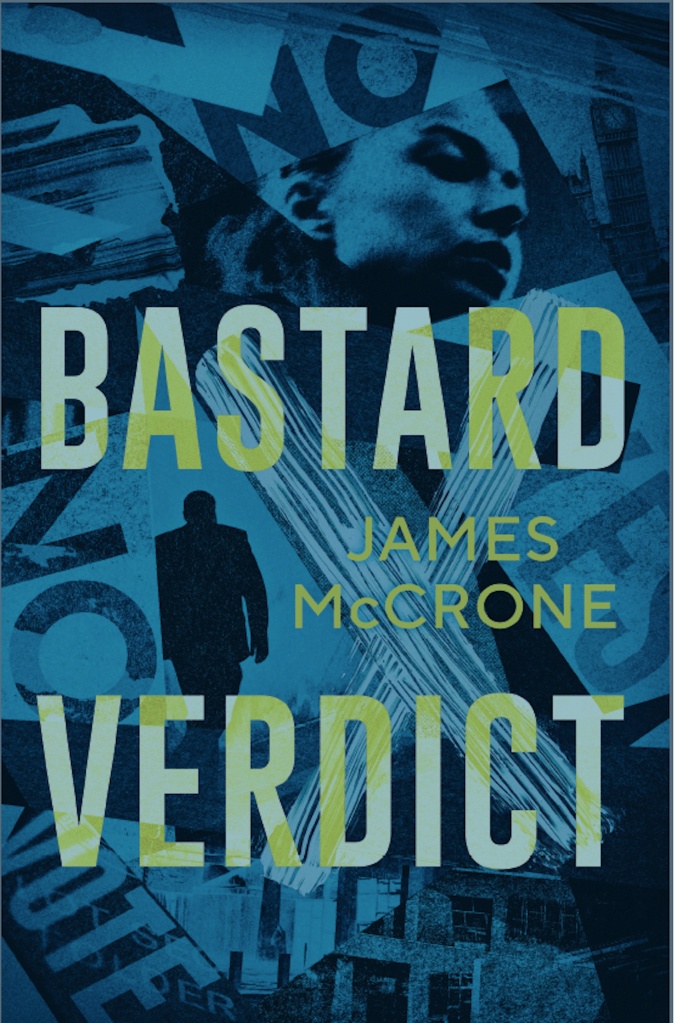
For my latest thriller, Bastard Verdict, I wondered, What if the first Referendum on Scottish Independence had been interfered with? How might it have been achieved? Would the conspirators be anxious to keep the lid on what they had done?

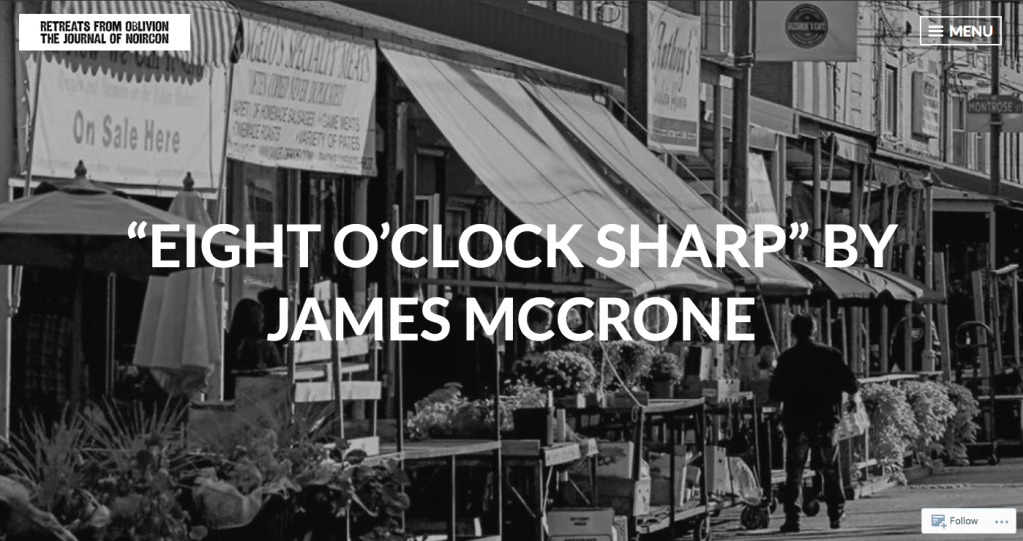
You can also read two of my recent short stories online. In “What’s Hidden,” the question is, “what do we owe to the dying and the dead?” In “Eight O’clock Sharp,” the question is, “is there freedom when the past doesn’t remember you?”

To write about one’s own time is to risk being dismissed as “political,” but to write about the here and now is always political. The beauty and substance comes from the questions we ask.

# # #

James McCrone is the author of the Imogen Trager political suspense-thrillers Faithless ElectorDark Network and Emergency Powers–noir tales about a stolen presidency, a conspiracy, and a nation on edge. All books are available on BookShop.org, IndyBound.org, Barnes & Noble, your local bookshop, and Amazon. eBooks are available in multiple formats including Apple, Kobo, Nook and Kindle.

His latest book Bastard Verdict (18-May-2023), is a noir political thriller set in Scotland. His current, work-in-progress is a mystery-thriller set in Oregon’s wine country…A (pinot) Noir, called Witness Tree.

A Seattle native (mostly), James now lives in South Philadelphia with his wife and three children. He’s a member of the The Mystery Writers of America, Int’l Assoc. of Crime Writers, Int’l Thriller Writers, Philadelphia Dramatists Center and is the current president of the Delaware Valley chapter of the Sisters in Crime network. James has an MFA from the University of Washington in Seattle.

For a full list of appearances and readings, make sure to check out his Events/About page. And follow this blog!

Secondary characters

I used to daydream about writing for Law and Order back when it was still running*, not for its propulsive, plot-driven narratives, and certainly not its copaganda, but for the occasional, random, richly drawn secondary or even tertiary character(s); some random person who helps the plot along, but whom you probably won’t see again. True, there are a lot of stock interactions and tropes in Law and Order, like the one comedian John Mulaney has satirized as “guy who while being questioned by homicide detectives will not stop stocking crates…”, a kind of expository action-within-inaction reminiscent of the Sorkin walk, or any of HBO’s “sexposition” scenes.  

But occasionally, and the reason I wanted to write for Dick Wolf, the episodes will also give time to brief encounters with memorable criminals. Yes, I want to know whodunnit, but the cream in my coffee, the a la mode on my pie, are the people, the characters. I’m not talking about dramatic flashbacks, but about artful, iceberg-like, less-is-more character moments. One that sticks with me was a brief interchange between Briscoe and a heroin addict being held for questioning.

The heroin addict has been detained for hours, and he needs his fix—badly—and he’d very much like to leave, now that he’s told the police everything he knows. Briscoe makes some wisecrack about how much money the addict is spending on heroin, and the addict launches into a brief, surprisingly cogent, economic disquisition on how well heroin has held its value in the marketplace. “Pot, cocaine,” he says disdainfully, “the price per gram has doubled over the past few years, but heroin’s still right where it always was. Gram-for-gram, ounce-for-ounce, heroin’s still your best value.” Not even Briscoe had a comeback for this sage advice.

Why do I love those exchanges? Because in a world of formulaic television, strange, vivid, serendipitous encounters are the stuff of life. I’ve written elsewhere about how I try to remain alive to possibilities, and I write down moments and exchanges I’ve been party to or eavesdropped upon. I hold onto them because even though they’re real and therefore could mean anything (or nothing), they feel like more than what they are—and maybe someday I’ll have a place to use them.

I’ve been pleased, in Bastard Verdict, that the character of Alan Wilson, a young, up-and-coming, petty criminal in an organized crime gang, has caught on. I needed someone with underworld ties to make the story work, but I needed him to be more than a conduit for the plot. To put flesh on his bones (so to speak), I created a backstory for him (one I know but don’t go into great detail about), and introducing him, I ripped off an exchange from my long-past drug days, and a deal I made in a pub bathroom.

I’d gone into the bathroom to wait for my dealer. When he came in, he was aghast that I was just standing there. “At least pretend you’re taking a piss,” he said to me all those years ago.

But how and why do some secondary characters strike a chord with readers where others don’t?

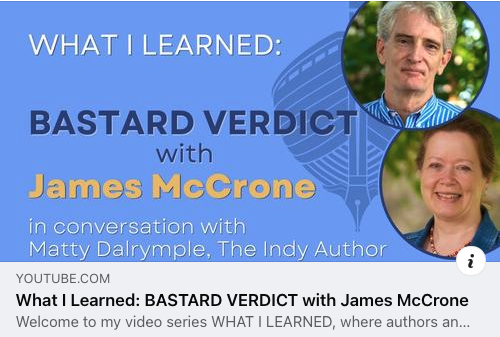
I’ve been pleased that some of my secondary characters have resonated with readers. Though I as I noted in the WHAT I LEARNED interview with the Indy Author/Matty Dalrymple, I had hoped the lawyer, Ewan Johnston would have garnered a bit more attention.

I remember an early reading of Faithless Elector in Oxford, where a young woman from the audience that day came up to me afterwards, wondering if I was going to give the cab driver more “stage time” in a future book. “I’m sure he’ll be back!” she said. I was glad the cabby had “landed” but sad that Mr. Fitzwilliam, the super in Professor Calder’s building had not. I wanted Fitzwilliam to resonate as the kind of good, everyday person whom we might all hope would (collectively) be the bulwark against the kind of conspiracy that’s unfolding. I even gave him a kind of heartwarming joke but no one mentioned him in reviews.

Special Agent in Charge Amanda Vega in Dark Network gets good reviews, but I’d also hoped that the courier, Jimmy May, would have engendered similar affection. While no one disparaged him, no one said, “will he be back?” He was, in Emergency Powers, as was Vega. In Emergency Powers, I brought back the cabby, but I had really hoped that Kirsten, the waitress at a tiny, Midwest airport would gain more traction than she did. Again, I wanted to juxtapose her ordinary, everyday-ness with the dire things going on in the conspiracy.  Strangely, the bad guy, Frank Reed, even received some plaudits. I had one reader write to me to say how odd it was to be rooting for him.

I’m not sure why some secondary characters break through and others remain in the background, I’m pleased that the young criminal Alan Wilson, who becomes a kind of moral center in Bastard Verdict, seems to have become a favorite, with two reviewers expressing the hope that he’ll be back in a further installment.

I’ll see what I can do! 🙂

*Wait, L&O is back on the air?

# # #

James McCrone is the author of the Imogen Trager political suspense-thrillers Faithless ElectorDark Network and Emergency Powers–noir tales about a stolen presidency, a conspiracy, and a nation on edge. All books are available on BookShop.org, IndyBound.org, Barnes & Noble, your local bookshop, and Amazon. eBooks are available in multiple formats including Apple, Kobo, Nook and Kindle.

His current book, Bastard Verdict, debuted on May 18th. A noir political thriller set in Scotland, it’s available through the link above, or wherever you buy your books. His current, work-in-progress is a mystery-thriller set in Oregon’s wine country…A (pinot) Noir, called Witness Tree.

A Seattle native (mostly), James now lives in South Philadelphia with his wife and three children. He’s a member of the The Mystery Writers of America, Int’l Assoc. of Crime Writers, Int’l Thriller Writers, Philadelphia Dramatists Center and is the vice-president of the Delaware Valley chapter of the Sisters in Crime network. James has an MFA from the University of Washington in Seattle.

For a full list of appearances and readings, make sure to check out his Events/About page. And follow this blog!

His most recent short fiction is below. The first is available for online reading.

Eight O’Clock Sharp” in Retreats from Oblivion: the Journal of NoirCon. (free online)
Set in Philadelphia’s 9th Street Market, Thomas is a man outside of time, forgotten, but trying to do the right thing while contending with avaricious forces.

“Ultimatum Games” in Rock and Hard Place magazine issue #7
A rare book heist, bad decisions. The narrator and his partner-in-crime clash over evolving bourgeois norms.


“Nostalgia” in Low Down Dirty Vote, vol. 3
An armed group tries to resurrect a past that never was as they struggle with change.

Strong Characters

I write about politics and institutions a great deal on this blog. I worry that my posts have made it seem that the Faithless Elector books are only political treatises. To be sure they are well researched and offer a chilling, insider take on Washington and our dismayingly enduring democratic deficit.

But they’re thillers.

As thrillers, they’re about characters in action. And a good many readers and reviewers have found the characters compelling and intriguing (see a sampling, below). My protagonist, FBI Agent Imogen Trager is a complex, driven character, a by-the-numbers (if rarely by-the-book) investigator who leads a strong, memorable cast. Taken together, the books weave high stakes, low politics, intricate motives and tense emotions into compelling, fast-paced stories that can be read individually or in order.

Imogen grew out of the first book, Faithless Elector, and during the re-writing/editing process, I realized she was a star. And like a star, she was stealing scenes and making others look bad! I deleted one character, and gave her his lines and discoveries, and switched a few other things around to make her more central. When I came to write the second book, Dark Network, I was excited because it would be wholly her book. In Emergency Powers, all the chickens come home to roost. And the whole cast—Imogen in particular—must confront their choices and their allegiances. (No chickens were actually harmed in the writing of this book 🙂

Here’s some of what reviewers and readers have said about the characters in the Faithless Elector series:

“McCrone’s ability to portray a heroine who makes both good and bad decisions is well-done, providing many action-packed and unexpected moments throughout.” — DIANE DONOVAN, Sr. Reviewer, Midwest Book Review

“Three tough female characters that steal the show: FBI agents Vega, Sartain, and Trager…shoulder much of the burden in this novel and deserve a large credit for why it succeeds.” -T. LIEBERMAN, Independent Book Review

Imogen Trager “wrangles with her demotion from golden girl to the FBI’s problem child while still trying to uncover the truth…It beautifully combines the bureaucracy of a spy thriller with the tantalising chase that’s usually seen in detective novels. -HANNAH STEVENSON, Dorset Book Detective

“A dynamic mix of political intrigue and high-stakes personal drama, offering keen portraits of true patriotism—its weight, its costs, and the courage that drives it.
ART TAYLOR, Edgar Award-winning author of The Boy Detective & The Summer of ’74

“Couldn’t put it down. The tension just builds and builds. The book just sucked me in….and now I’m looking forward to the next!” radiostax (Amazon)

“Wonderful characters! But the key to the book is Imogen Trager – a dedicated FBI agent who’s willing to risk whatever it takes to save the country. You’ll love her. Highly recommended!” R. G. Belsky (Amazon)

Links to all the books are available in the bio below.

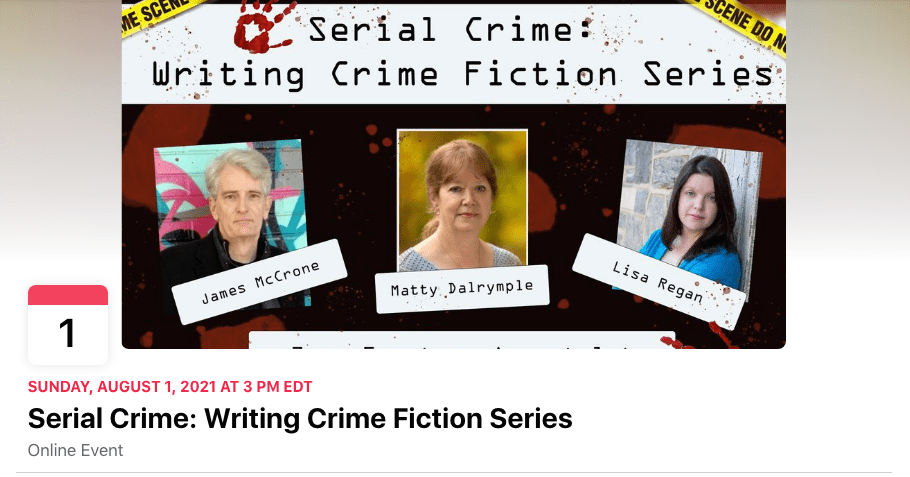
You can catch me online this Sunday, Aug. 1 at 3pm in conversation with Matty Dalrymple and Lisa Regan, hosted by the Mechanicsburg Mystery Bookshop;

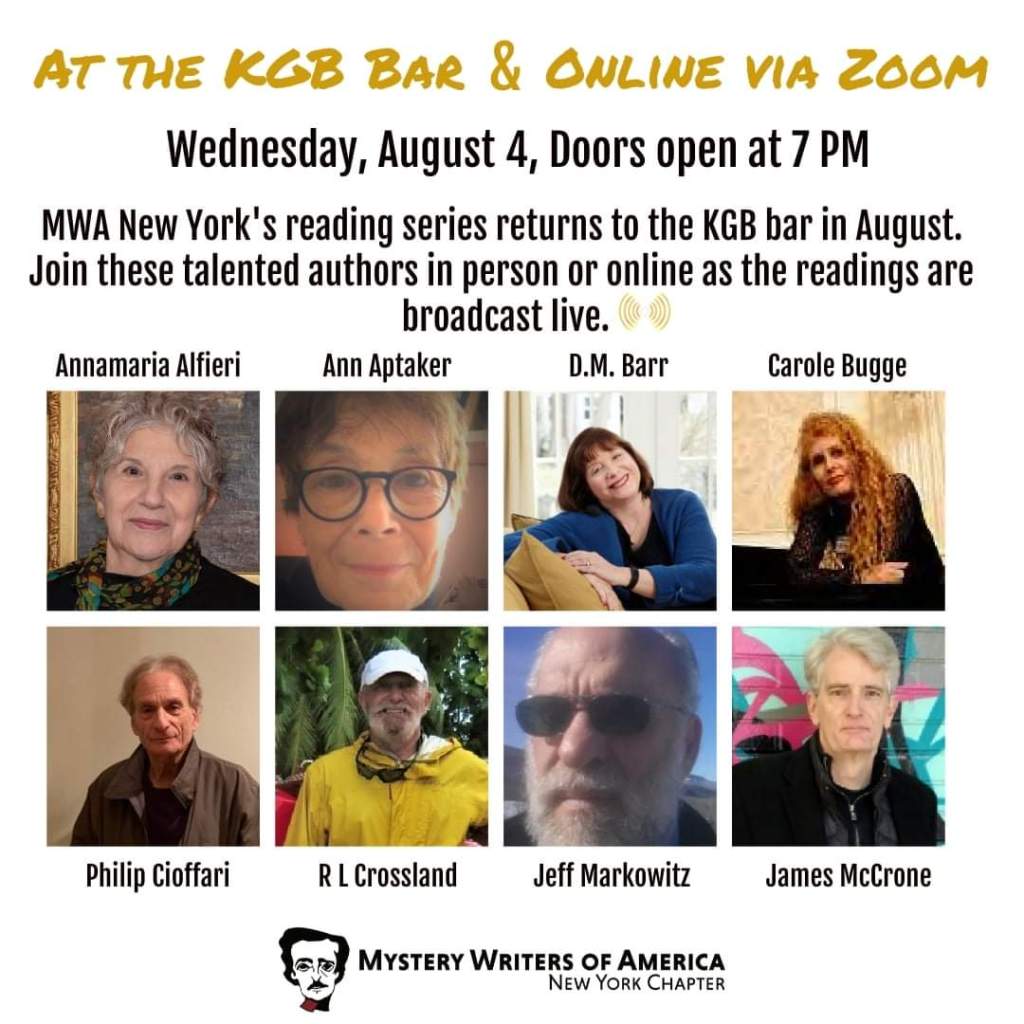
AND I’ll be in New York City on Wednesday, Aug. 4, at KGB Bar (85 E 4th St) IN-PERSON and online for the MWA Reading Series, beginning at 7pm.

For a full list of appearances and readings, make sure to check out my Events/About page.

# # #

James McCrone is the author of the Imogen Trager political suspense-thrillers Faithless Elector , Dark Network and Emergency Powers–noir tales about a stolen presidency, a conspiracy, and a nation on edge. All books are available on BookShop.org, IndyBound.org, Barnes & Noble, and Amazon. eBooks are available in multiple formats including Apple, Kobo, Nook and Kindle.

His work, “Numbers Don’t Lie” also recently appeared in the 2020 short-story anthology Low Down Dirty Vote, vol. 2, and his short story “Ultimatum Games” will appear in Rock and a Hard Place in issue #7 this fall. His next book, w/t Bastard Verdict, is a noir political thriller set in Scotland.


A Seattle native (mostly), James now lives in South Philadelphia with his wife and three children. He’s a member of the The Mystery Writers of America, Int’l Assoc. of Crime Writers, Int’l Thriller Writers, Philadelphia Dramatists Center and is the newly elected vice-president of the Delaware Valley chapter of the Sisters in Crime network. James has an MFA from the University of Washington in Seattle.