
 The Supreme Court of the United States will hear arguments on May 13 about the constitutionality of Faithless Elector laws established by the states, and it will deliver an opinion this summer.
At stake is whether Electors are independent actors, or are bound by the laws of their respective states.
Until very recently, most scholars seemed to agree that if the question came before the Court, the Court would rule that Electors were free to choose according to their individual consciences, which is what the Electoral College was intended for. Indeed, the schism between what has come to seem customary and how things actually work was the dramatic–and dire!–premise of my 2016 thriller, Faithless Elector. Now it seems less clear. And even when viewed through a so-called States Rights lens (which this court might tend to favor), the potential gains are actually muddled.
Those who seek to preserve the Electoral College–in which the people of the United States do not vote directly for the president or vice-president–want to preserve an institution that has twice since the turn of the century delivered Republican candidates who lost in the popular vote–Bush in 2000 and Trump in 2016. But such people should be careful what they wish for.
If the states prevail and the Court finds that Electors may be bound, the National Popular Vote Interstate Compact (NPV) will have more teeth in it. The core of the NPV is that states can direct their Electors to vote for whomever the national vote winner is, irrespective of the result in the state. States could also argue, as the plaintiffs before the Court do, that states would also be free to direct Electors not to vote for anyone who had, say, failed to provide his tax returns. Or not for one who was divorced, or an adulterer. We’re talking about state legislatures making these rules, after all.
The high court has never weighed in before because until the 2016 election no Elector had been penalized for voting against his/her pledge. No one had “standing” to bring a claim. Now they do. The Court is taking this case ahead of the upcoming election because adjudicating it in the heat of an election (or after the fact!) would be disastrous for the nation.
As I’ve pointed out on this blog elsewhere, the Electoral College was a compromise, one that most assumed would be ironed out in the fullness of time.
I fear that the Court’s decision won’t provide clarity, but will solidify an archaic system and add to the bitter acrimony already festering.
The Faithless Elector Argument Preview, posted on the SCOTUS-Blog is informative, and not over-burdened with legalese.
# # #
The Imogen Trager #NoirPolitik Thrillers at a glance:
Faithless Elector – Everyone thinks the election is over, but six weeks is a long time in politics. An idealistic, young researcher stumbles onto a plot to steal the presidency, with deadly consequences.
Dark Network – Without law, there’s only power. FBI Agent Imogen Trager is alone and in grave danger from a conspiracy she failed to destroy. She’ll have to fight against time, a sinister network, and even her own colleagues to defeat it.
Emergency Powers (Oct. 1) – No battle plan survives contact with the enemy. The investigation that was FBI Agent Imogen Trager’s undoing may be the key to stopping a brutal, false flag terrorist attack meant to tighten a puppet president’s grip on power.
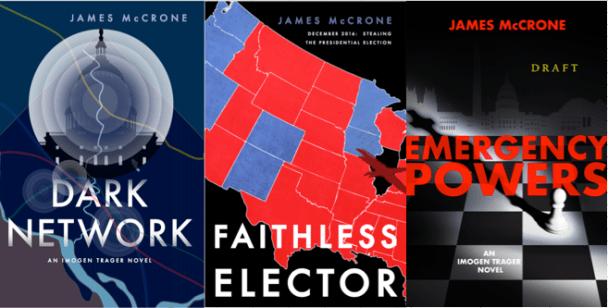
James McCrone is the author of the Imogen Trager political suspense-thrillers Faithless Elector and Dark Network , about a stolen presidency, a conspiracy, and a nation on edge.

The third book, Emergency Powers, is coming October 1st, and he’s at work on a fourth book called Bastard Verdict (w/t) . You can check out Emergency Powers for free on NetGalley.

Find them all through BookShop.org. They are also available at Amazon, Barnes & Noble, and Powell’s Books.
Link to REVIEWS
 On October 14 the NY Times reported
 Two weeks later, Charles Lane, writing in the Washington Post, posited
 Worse, as my thrillers point out, the Electoral College is ripe for mischief. A very close election, like the 2000 Bush-Gore election (where only 5 Electoral votes–271-266–separated the two candidates) could be disastrous for the nation. And, there was a Faithless Elector in that election, too–
 The recent

 What would an accidental president need to do to solidify his grip on power? That’s the question I set myself for the new thriller, Emergency Powers, with chillingly real implications. I find my stories
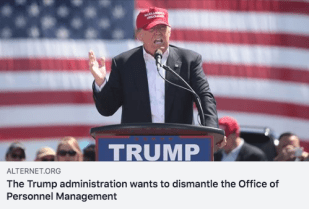 I had all this in the first draft of Emergency Powers, which I finished in October of 2018. That same month (unbeknownst to me at the time), Jeff Tien Han Pon was asked to resign as Director of OPM. As of this writing, there is still only an acting Director, Margaret Weichart, who is also the Deputy Director of OMB. Pon’s resignation came as the Trump administration began work to dismantle the Office of Personnel Management and to bring it under the ambit of White House administration, which folds the daily business of the Federal government into one run by political appointees: patronage politics, or a return to the “spoils system.”

 “Publishers are doing what everyone else in the news media has done for the past two years. Trump’s ability to sow constant chaos and shift attention toward himself is unparalleled…

