Shining light on conscious stupidity

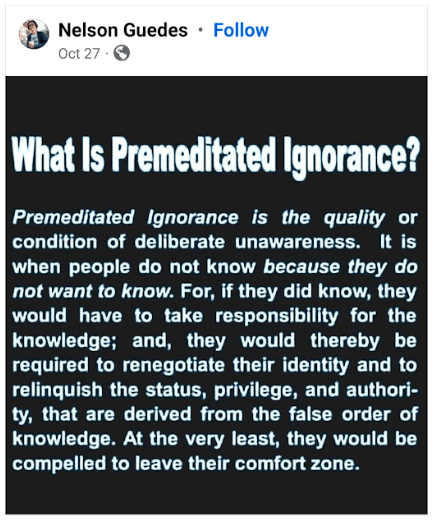
A meme has been making the rounds, credited (as I saw it) to a Nelson Guedes, regarding “premeditated ignorance.” It is the quality or condition of deliberate unawareness, and I am grateful to Nelson Guedes for putting it about.

Sadly, it sounds all-too similar to the Ingsoc principle (from George Orwell’s 1984) called “crimestop.” Crimestop describes the mental gymnastics–the insanity–required for self-preservation in an authoritarian regime. It means “the faculty of stopping short, as though by instinct, at the threshold of any dangerous thought. It includes the power of not grasping analogies, failing to perceive logical errors, of misundertanding the simplest arguments if the are inimical to Ingsoc, and being bored or repelled by any train of thought which is capable of leading in a heretical direction.”

As I read the passage above (from the “Goldstein Book” section of 1984), I can’t keep Tucker Carlson’s quisling Labrador face out of my mind. But, loathsome as he is, he’s hardly original, and we’ve seen it before, with the know-nothings of the 1850’s, a lurid brand of Nativists, the McCarthy era, etc. It is conscious, premeditated stupidity. Or as I would term it – willful ignorance. And it is most dangerous when weaponized, together with Aggressive Stupidity.

Ignorance and knowledge exist on a spectrum, bearing the physical-religious qualities of light (and also darkness). I used to joke about it, but events of the last decade have strangled the funny.

At one end of the spectrum lies ignorance. No judgment (necessarily), it merely describes the absence of information.

Ignorance –> Stupidity –> Willful Ignorance –> Aggressive Stupidity

Red – Orange – Yellow – Green – Blue – Indigo – Violet
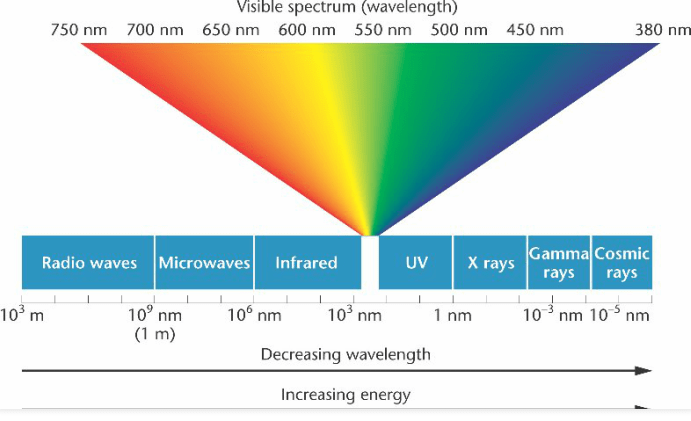
Beginning with “simple ignorance” (i.e. lack of information), ignorance is judgment-neutral and merely describes a state of (un)knowledge, a kind of dark matter state, glimpsed only indirectly, defined only by what it is NOT.

Further study may reveal that simple ignorance is not dark, but like faint light from a distant galaxy or indeed quantum particles, it may be that we sense something is there; but it could be almost anything, and we can’t describe it or discuss its qualities.

Proceeding along the spectrum, we come to “stupid,” which also describes an (un)knowledgeable state of being. But in this case that state has been changed by exposure to information/knowledge NOT absorbed or acted upon–a lost or discarded (albeit exposed) photo plate, let’s say. This state would include forgetting something previously known or failure to reason inductively based on past information or experience. A kind of petulant entropy.

The third state of ignorance is “willful ignorance.” In this state, painful/inconvenient facts are actively resisted. This is where bullshit comes in, too, giving space to misunderstand–or to claim that everyone else misunderstands. In the bullshit realm, it seems, up is down, and like a black hole, its gravity is so massive and powerful that it sucks in light, even as it continues to emit vast amounts of energy.

The fourth state of ignorance is “aggressive stupidity.” It is by far the most volatile and unstable state, an epistemological supernova. In this white hot state, it’s not enough that painful or inconvenient facts and information be ignored or resisted, but that the regard must be turned outward: facts must be obliterated and shouted down in all caps. Blame must be assigned. The threat of violence is ever-present.
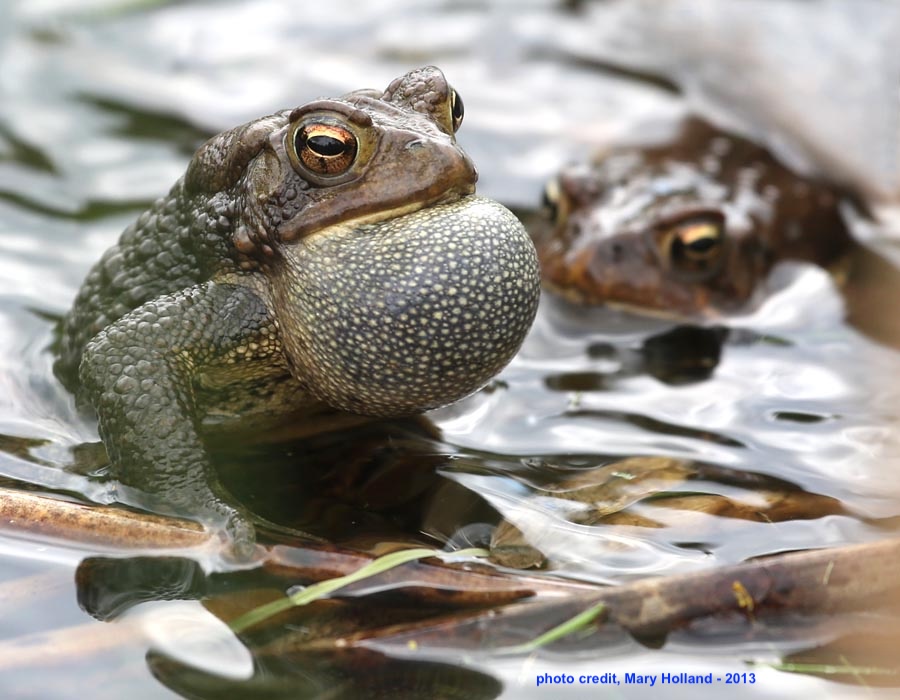
We have seen that the MAGA-hat-faithful will contort themselves with willful ignorance and aggressive stupidity, but we’ve recently found that our billionaires are all-too willing to be Toads for Trump. We might also revisit Graham Greene’s very fine (and very dark) Doctor Fischer of Geneva for a look at the lengths to which the wealthy will go to keep or increase their wealth–and the debasement they are prepared to suffer for it.

The key to sanity in the coming years will be to call out what we see, and not to slip into comfortable, willful ignorance. Because if we begin to go along to get along, to stop questioning, to stop seeing things as they are and stating them plainly, we may quickly find ourselves defending the indefensible.

# # #

James McCrone is the author of the Imogen Trager political suspense-thrillers Faithless ElectorDark Network and Emergency Powers–noir tales about a stolen presidency, a conspiracy, and a nation on edge. Bastard Verdict, his fourth novel, is about a conspiracy surrounding a second Scottish Independence referendum. His novel-in-progress is called Witness Tree, a (pinot) noir tale of murder and corruption set in Oregon’s wine country.

All books are available on BookShop.org, IndyBound.org, Barnes & Noble, your local bookshop, and Amazon. eBooks are available in multiple formats including Apple, Kobo, Nook and Kindle.

James is a member of Mystery Writers of America, Int’l Assoc. of Crime Writers, and he’s the current president of the Delaware Valley chapter of Sisters in Crime. He lives in Philadelphia. James has an MFA from the University of Washington in Seattle.

For a full list of appearances and readings, make sure to check out his Events/About page. And follow this blog!

You can also keep up with James and his work on social media:
Mastodon: @JMcCrone
Bluesky: @jmccrone.bsky.social
Facebook: James McCrone author (@FaithlessElector)
and Instagram/Threads “@james.mccrone”
“Truth Value” and B.S.

I was delighted today when an account I follow, Jonny Thomson’s Mini Philosophy, discussed Harry Frankfurt’s “Reflections on B.S,” an essay I used to teach when I was a community college instructor in the 1990’s, and one that I wrote about back in February of 2018. That post (link below), along with Corinne Purtill’s “The difference between a snafu….etc” remain among the most popular posts on this blog. I’m pleased that Frankfurt is still read and discussed.

As we stare down the barrel of another potential Trump presidency, I thought it might be helpful to revisit the Orewellian blare of that time, and the weaponized obfuscation that lies at the heart of an inability to distinguish lying and bullshit.

Link to original post

That difference, as Frankfurt notes, concerns truth value: one must believe that one knows the truth, in order to conceal it, to lie; whereas, the bullshitter has no necessary relation to truth.

The title of my original piece comes from 1984, and the appendix, Principles of Newspeak. It’s an imagined article in some future Newspeak-only newspaper, designed to show how Newspeak is designed and used to limit thought and action – ‘Oldthinkers unbellyfeel Ingsoc,’ would replace something we might understand today, as, “Those whose ideas were formed before the revolution cannot have a full emotional understanding of the principles of English Socialism.” The Newspeak version is brief but freighted.

It calls to mind Trump’s rambling word salads–it’s a stretch to call them speeches–impossible to pin down, and they’re formulated (if we can call it that) in such a way as to drop heavily weighted nouns that have specific meanings for his supporters. He sometimes, as in the example I used in the original post, contradicts himself within the same rambling, but the key nouns continue to resonate because the audience is not really listening. They hear the sound-cues they need and move on.

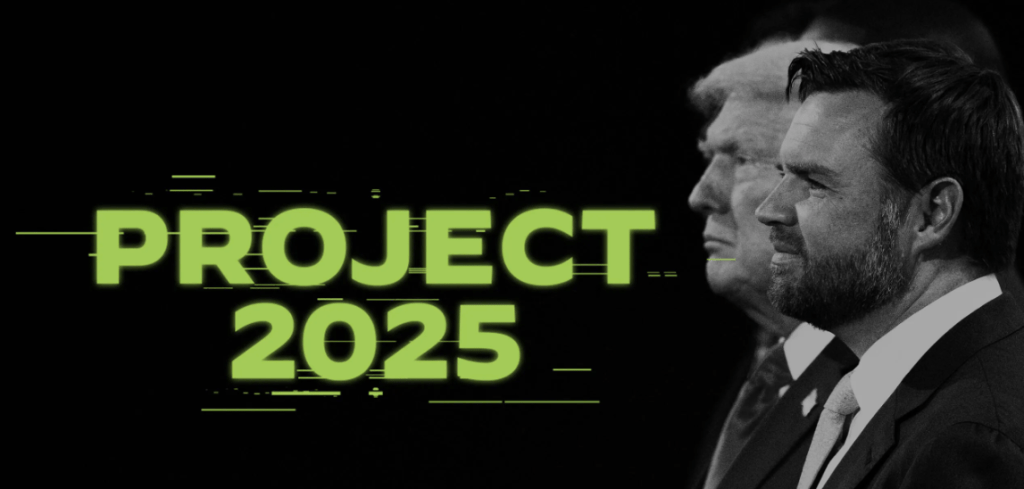
In a second Trump presidency, Project 2025 will be the scaffold for an ugly revolution, and the authors, who consulted with Trump in its creation, have made the grave mistake of being quite clear about what they will do.

Which may be why Trump is so keen to soft-peddle the Project. We need to listen, and we need to vote before it’s too late.

Here’s the Facebook post (reel) from Jonny Thomsom – https://www.facebook.com/reel/343009432203796

# # #

James McCrone is the author of the Imogen Trager political suspense-thrillers Faithless ElectorDark Network and Emergency Powers–noir tales about a stolen presidency, a conspiracy, and a nation on edge. Bastard Verdict, his fourth novel, is about a conspiracy surrounding a second Scottish Independence referendum. His novel-in-progress is called Witness Tree, a (pinot) noir tale of murder and corruption set in Oregon’s wine country.

All books are available on BookShop.org, IndyBound.org, Barnes & Noble, your local bookshop, and Amazon. eBooks are available in multiple formats including Apple, Kobo, Nook and Kindle.

James is a member of Mystery Writers of America, Int’l Assoc. of Crime Writers, and he’s the current president of the Delaware Valley chapter of Sisters in Crime. He lives in Philadelphia. James has an MFA from the University of Washington in Seattle.

For a full list of appearances and readings, make sure to check out his Events/About page. And follow this blog!

You can also keep up with James and his work on social media:
Mastodon: @JMcCrone
Bluesky: @jmccrone.bsky.social
Facebook: James McCrone author (@FaithlessElector)
and Instagram/Threads “@james.mccrone”
Check-kiting the truth

Truth and Power.
In college, I was a (late) founding member of the Univ. of Washington Shakespeare Society, together with a number of friends. I’m not sure the Society lasted much beyond our graduation, and I’ve lost touch with most of those friends, but it was great fun while it lasted, and we put on some excellent productions. Together, we put on Henry IV, part one; Macbeth, Twelfth Night and Romeo and Juliet.

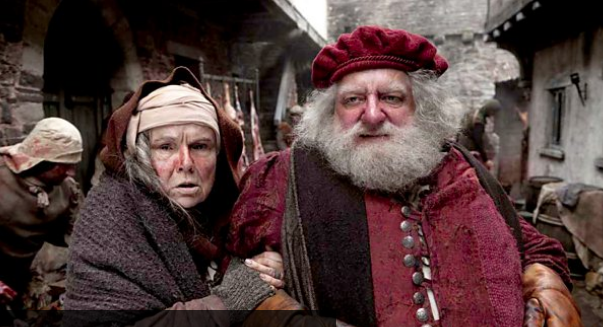
Mistress Quickly and Falstaff (BBC)

There’s a moment in our production of 1 Henry IV that stands out for me, and asserts itself in my mind more than 25 years after it happened as I look at the skirmishing remains of the “post-truth” political landscape.

In scene II.iv of the play, the sheriff comes to the Boar’s Head Inn to arrest Falstaff for a robbery committed earlier that evening. The stage was a very simple, minimalist set, with carpets hung to conceal the upper stage left and -right entrances. In rehearsal, the actor playing Falstaff suggested that it might be funny for Falstaff to poke his face in from offstage where he’s hiding, through the “arras” at stage left.

It was a funny bit, but as happens so often in Shakespeare, it did even more work. What began as a bit of a goof became something of a sinister moment, too.

In the scene, the sheriff says to Prince Hal that he has testimony that Falstaff committed a robbery earlier that night and is even now there at the Inn. In our production, Falstaff peeks out at this moment. The actor playing the Sheriff does a double take. The Prince sees Falstaff, and he sees that the Sheriff has just spotted Faltaff, but he says, walking downstage: “The man I assure you is not here…” and then he goes on to say that he has sent Falstaff on an errand.

During the performance, there’s a nice laugh as Falstaff sticks out his head and then quickly, guiltily pulls it back in like turtle who can’t be bothered; followed by a long, uncomfortable pause as Prince Hal and the Sheriff look at one another.

In rehearsal, the director had paused the action and asked the actor playing the Sheriff what (as his character) he was thinking.

“I’m thinking that Sheriff or not, I can’t go up against the Prince,” he said.

“Do you just accept it?” the director asked.

“I have to, don’t I? But I don’t like it.”

The scene isn’t over, and Prince Hal further impresses his birthright advantage. When the Sheriff bids Hal farewell with: “Good night, my noble lord,” Hal pauses, making the Sheriff stop is backward, bowing exit, to say: “I think it be good morrow, is it not?”
The Sheriff eats some more shit: “Indeed, my lord, I think it be two o’clock.”

Among other things, 1 Henry IV is about the nature of power and ruling. Prince Hal will become Henry V, scourge of the French, victor at Agincourt, the soul of honor. How, the play seems to ask, did this entitled, drunken rich kid turn into a proper king? His father worries he won’t. Falstaff and his crew worry that he will.

I’ve always found the exchange disturbing.

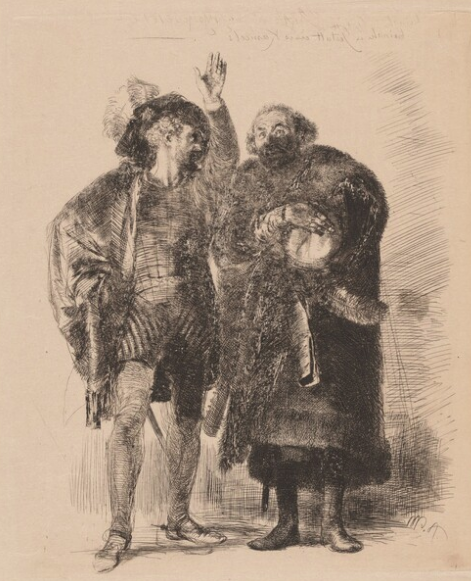
Hamlet and Polonius

One further example, also from Shakespeare, Hamlet, this time: Polonius has gone to sound out Hamlet’s mind. They gaze at the sky. When Hamlet corrects Polonius about what he sees in the shapes of the clouds, and Polonius readily agrees with everything Hamlet says, the scene is often regarded as being about how transparently craven Polonius is. And he is that, but given the absolute power of the royal family, how—and why—should he be anything different?

The reason these instances keep coming back to me is that in both of these examples the knuckling under by the non-royal characters is obvious, and is clearly about staying on the good side of those in power. There’s dramatic irony in what’s said and what’s known. We in the audience note it, as do the other characters on stage.

What is KEY though, is that the truth is known, agreed upon and shared, but not uttered or acted upon. Which is chilling.

How much worse then is our own post-truth era? When people are forced not just to accept, but to believe the lie—and worse, to make/force others believe it?

Covid deniers, anti-vaxxers, Stop the Steal thugs spring to mind–the elected officials who claim that the January 6 insurrectionists were just a tour.

This is not knuckling under because you have no choice. It’s a complicit trick of the mind to believe “correctly.” In the novel 1984, there’s one particular part that goes a long way toward describing the current overheated state of the Grand Old Party: The key to citizens’ ceding of power is the mental discipline known as Crimestop, defined as, “the faculty of stopping short, as though by instinct, at the threshold of any dangerous thought. It includes the power of not grasping analogies, of failing to perceive logical errors, of misunderstanding the simplest arguments if they are inimical to Ingsoc, and being bored or repelled by any train of thought which is capable of leading in a heretical direction.” I think about that quote every time I remember how some in Congress decried the January 6 hearings as “boring.”

I think of it whenever I see that labrador-quizzical (quizzling?) face Tucker Carlson makes when he wants NOT to understand. The unwillingness (or inability) to grasp analogies, reflects an incapacity for empathy, to be sure, but it also serves as a kind of training.

And just to make sure there’s no back-sliding, there are Telescreens everywhere tuned to Fox News channel to stoke the hatred-abasement matrix. I make my way from Shakespeare to Orwell because there is a kind of double-think/Crimestop consciousness about this unknowing, wholly different from what Elizabethans were subject to.

The “determining factor,” Orwell writes elsewhere in the Goldstein Book passage, “is the mental attitude of the ruling class.” And the level of no-nothing depravity among GOPArty leadership is breath-taking. The bone-chilling part is that they really seem to believe their apocalyptic rhetoric. And they care so little for democracy, that it doesn’t matter if their voters die.

I’m actually hopeful that we as an electorate are waking up. The next election is Nov 8th. We ought to know pretty soon thereafter where we stand on the shifting sands of truth.

# # #

You can check out McCrone’s recent short stories and novels below:

Eight O’Clock Sharp” in Retreats from Oblivion: the Journal of NoirCon. (free online)
Set in Philadelphia’s 9th Street Market, Thomas is a man outside of time, forgotten, but trying to do the right thing while contending with avaricious forces.

“Ultimatum Games” in Rock and Hard Place magazine issue #7
A rare book heist, bad decisions. The narrator and his partner-in-crime clash over evolving bourgeois norms.


“Nostalgia” in Low Down Dirty Vote, vol. 3
An armed group tries to resurrect a past that never was as they struggle with change.

James McCrone

James McCrone is the author of the Imogen Trager political suspense-thrillers Faithless ElectorDark Network and Emergency Powers–noir tales about a stolen presidency, a conspiracy, and a nation on edge. All books are available on BookShop.org, IndyBound.org, Barnes & Noble, your local bookshop, and Amazon. eBooks are available in multiple formats including Apple, Kobo, Nook and Kindle.

His next book, w/t Bastard Verdict, is a noir political thriller set in Scotland, currently under review. His work-in-progress is a mystery-thriller set in Oregon’s wine country…A (pinot) Noir, called Witness Tree.

A Seattle native (mostly), James now lives in South Philadelphia with his wife and three children. He’s a member of the The Mystery Writers of America, Int’l Assoc. of Crime Writers, Int’l Thriller Writers, Philadelphia Dramatists Center and is the vice-president of the Delaware Valley chapter of the Sisters in Crime network. James has an MFA from the University of Washington in Seattle.

For a full list of appearances and readings, make sure to check out his Events/About page. And follow this blog!