Today reminds me of the early stages of being an empty-nester (many years past, now). I’ve sent my new mystery-suspense novel, Witness Tree to a publisher, and I feel something like the uncertainty of sending a child out into the world. You think they’re equipped. Certainly, you hope you’ve done your job. But you can’t know.
Like the first days of being an empty-nester, you don’t quite know what to do with yourself. Not yet…
James McCrone is the author of the Imogen Trager political suspense-thrillers Faithless Elector, Dark Network , and Emergency Powers–noir tales about a stolen presidency, a conspiracy, and a nation on edge. Bastard Verdict, his fourth novel, is about a conspiracy surrounding a second Scottish Independence referendum. His novel-in-progress is called Witness Tree, a (pinot) noir tale of murder and corruption set in Oregon’s wine country. Coming soon!
Allbooks are available on BookShop.org, IndyBound.org, Barnes & Noble, your local bookshop, and Amazon.
In a small corner of Philadelphia, a funeral director steals a man’s car as payment on a debt.
My latest short story, “Coffin Corner” [story link] came out on Tough/Redneck Press last week. I’ve already had some feedback from readers–for which I am grateful, and even an exchange regarding where the story had come from. Check out the story (link above), and make sure to look at the other great things Redneck Press is putting out.
One reader wrote to me:
“Very enjoyable & a nice twist at the end. They say you should write what you know. Which makes me wonder what kind of world you live in – wise guys, seedy funeral homes etc.”
My “world” probably isn’t so different from anyone else’s. Imagination, openness and curiosity are the main ingredients to my writer’s life. I write stories about dirty politics, and desperate people making bad decisions; and I’m fascinated by the pettiness of the petty crime that results.
Years ago, I worked for a guy who had been a mortician. We were walking past a house, and he pointed it out, saying that the person who lived there was someone who had once “stiffed” him on funeral arrangements .
He said, “I thought about taking his car as collateral until he paid up, but what’re ya gonna do?” (He really did use the term stiffed)
A story was born in my mind.
Later, I thought to myself, “what if he’d been really hard up, and what if desperation had made him take the man’s car? And, what if seizing the car opened up a whole new can of worms?” When I finally sat down to work on it, the story came quickly. Obviously, the story has nothing to do with real people, the situation is what lodged in my mind and finally came out as “Coffin Corner.”
I made the main character old enough to remember the precarity of the mob days here in Philadelphia, and how difficult they were. I’m fascinated by the difference of opinion about what the old, mob days were like, and what they meant. Some seem willing to remember those past days as good somehow, ordered and orderly, whereas others remember only violence and the way honest people were preyed upon.
I’ve written about it before, as in my story contribution to Low Down Dirty Vote, vol. 3, “Nostalgia,” in which a young, career criminal finds himself–dismayingly–in amongst a gang playing at being mobsters. As the narrator notes: “People in the neighborhood treated Mr. Johnny like a big shot—but only because it flattered their vanity, like they were all living together in some movie where the world still made sense.”
And working in the 9th Street Market helped too. My story “Eight O’Clock Sharp,” also available for free online, is published by Retreats from Oblivion(the journal of NoirCon), and it is about a new/old predator. As I wrote about the villain that story, I found myself singing lines from “Teenage Wildlife,” by David Bowie: “Same old thing, in brand new drag, comes sweeping into view…”
I don’t consciously use short stories as a means of working out ideas or themes I explore in my longer work, but it does seem to happen. “Nostalgia” put together drug-running and corrupt politics, allowing me to examine it and return to it in my novel-in-progress, Witness Tree, about a secret power play for a white supremacist organization that erupts into the open. “Coffin Corner” allowed me to think about what the mob meant, and what it might have been like to live with the threat of Wise Guys everywhere.
A similar corrupt, thuggish coercion seems to have taken hold of the country, too. Maybe that’s my world. The source is different, but the stinking fear it creates is the same. And it’s worth exploring and writing about.
# # #
James McCrone is the author of the Imogen Trager political suspense-thrillers Faithless Elector, Dark Network , and Emergency Powers–noir tales about a stolen presidency, a conspiracy, and a nation on edge. Bastard Verdict, his fourth novel, is about a conspiracy surrounding a second Scottish Independence referendum. His novel-in-progress is called Witness Tree, a (pinot) noir tale of murder and corruption set in Oregon’s wine country. Coming soon!
Allbooks are available on BookShop.org, IndyBound.org, Barnes & Noble, your local bookshop, and Amazon.
“The ball is round, the place is Philly!” I have begun editing two days a week for the Philly Soccer Page, the “local soccer sports section you wish your newspaper had…” I have been a long-term reader, and I’m enjoying contributing. I even fill in to write a few Match Reports on an as-needed basis. My most recent effort, an away tie at Houston Dynamo, is from last night, July 19: https://phillysoccerpage.net/2025/07/20/match-report-houston-dynamo-1-1-philadelphia-union/
Working with the writers and editors on PSP has been gratifying and fun. And it has helped sharpen my writing (and editing) skills. It has sharpened the way I look at the game. Taking notes, looking for tactics, or play, or even trends that played out through the game has also helped. If I ever get up the courage to find an old guys league, it may even help my play somewhat!
The Ball is Round is not only part of PSP’s slogan, but is David Goldblatt’s definitive book about soccer, and I highly recommend it. Goldblatt’s book, as well as reading The Secret Footballer, first in the Guardian, and then the collected writings, made me feel writing about American soccer would be fun. It also showed me the kinds of things that weren’t being talked about, how the eye for detail could be interesting and meaningful, and how proper football relates to broader contexts. And Philly Soccer Page does good work doing deep dives into different aspects of the game. They also chronicle local and development leagues.
Definitely sign up for the PSP newsletter and get the best writing delivered right to your inbox.
James McCrone is the author of the Imogen Trager political suspense-thrillers Faithless Elector, Dark Network , and Emergency Powers–noir tales about a stolen presidency, a conspiracy, and a nation on edge. Bastard Verdict, his fourth novel, is about a conspiracy surrounding a second Scottish Independence referendum. His novel-in-progress is called Witness Tree, a (pinot) noir tale of murder and corruption set in Oregon’s wine country.
Allbooks are available on BookShop.org, IndyBound.org, Barnes & Noble, your local bookshop, and Amazon.
“When is ‘am’?” The persistence of identity and Witness Tree
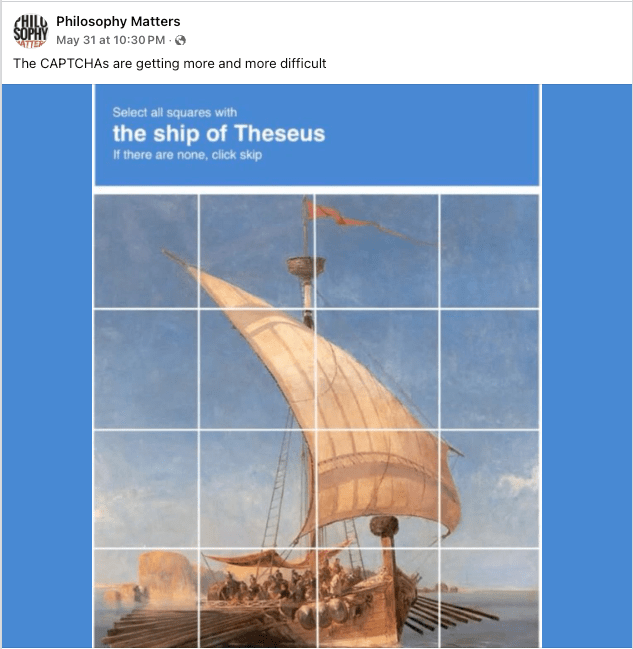
The Ship of Theseus looms large as a metaphor for ideas about identity and change in my novel-in-progress, Witness Tree, a suspense-thriller about a leadership battle for (white) supremacy in a rural Oregon county that erupts into the open when newly sober, ex-con David Paterson is the sole witness to a brutal execution meant to tie off the last loose thread.
David is trying to make a fresh start in sobriety, but he carries the weight of the past with him, along with questions about how much he may (or may not) have changed during his eight years in prison. When he reports the murder to the police, as a now-solid citizen should, it’s the deputy who put him away eight years earlier who takes his testimony. The deputy makes it clear that if a body is ever found, David will be the prime suspect. “People don’t just change overnight, Paterson,” he says.
[from Wikipedia]: “In its original formulation, the ‘Ship of Theseus’ paradox concerns a debate over whether or not a ship that has had all of its components replaced one by one would remain the same ship.” For David, the notion that you can never step into the same river twice; that “Upon those who step into the same rivers, different and again different waters flow,” looms large.
So, as to identity–which is it? Which you is “who”? The person you are today? Five years ago? Who will you be in fifty years? And when is “am”? This week? Today? And which facet of you is “I”? I’m writing a suspense-thriller, so I don’t belabor the point or get in the way of the story, but David can’t be sure who he is, or what he wants, and he can’t know how others perceive him.
The story becomes David’s race to find out who was killed, why, and by whom, before the police can hang it all on him. As he investigates, with the help of two high school friends who still stand by him, he finds that what the murder was meant to cover up runs deeper and wider than David could have imagined. Worse, the murder and officials’ seeming complicity in it, feels eerily like the murder of his friend in prison, to which he was also a witness. In prison, the Aryan Brotherhood left him alive–and damaged–as a warning to others.
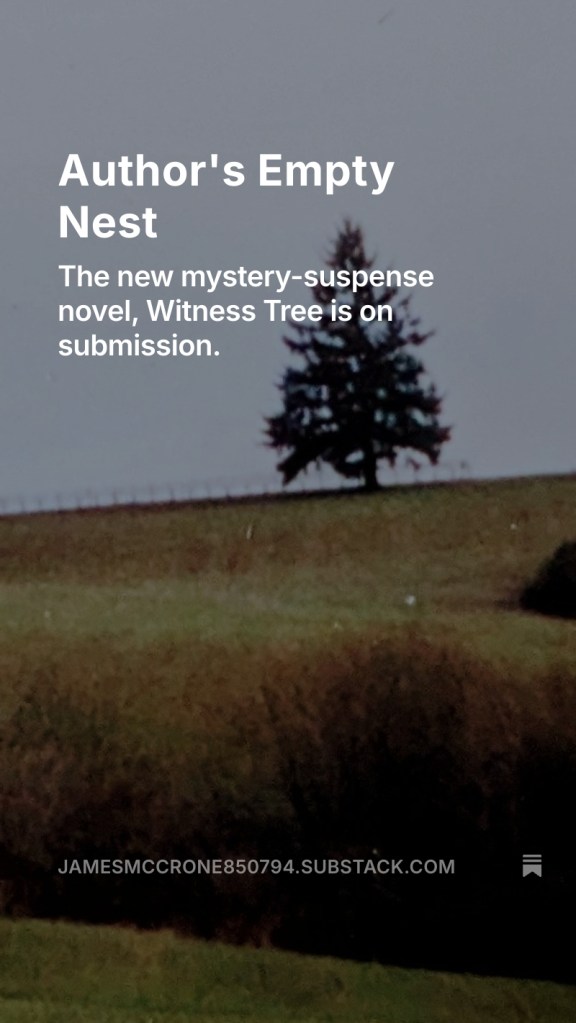
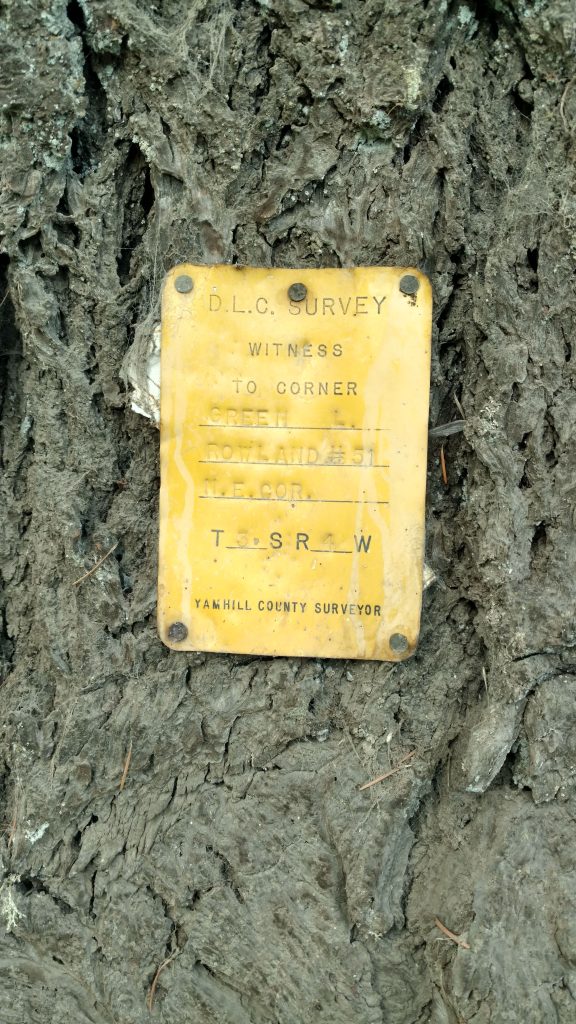
The photo of the pine tree on the hillside that you see is the Witness Tree that inspired the book. It’s near my parents’ farm, a Yamhill County, Oregon, survey marker, delineating plots of land. It’s probably 80 years old. Or more. And it is illegal to cut it down. “Witness to corner,” the badge on the tree reads. My mother, now passed on, had always liked the tree. The term witness tree had been pregnant with meaning for us, and I decided to start a short story that involved it.
I began thinking about a short story titled Witness Tree, with the premise, “someone sees something they shouldn’t.”
I thought, “okay, good.” But then looked at the bare hillside and there seemed no way to see something without also being seen…seeing it. Which kind of threw a wrench in the gears. Until the following day, when I noticed that someone had dropped one of those green porta-potties near it for the grape harvesters to use.
And so the opening scene was born. David shelters from a deluge–common at that time of year–inside a porta-potty near a witness tree late one night. There is (fictionally) a large warehouse-like structure nearby, and the murder takes place in its gravel parking lot. The assassins are backlit by the lights on the building, but David, some forty yards away, is in total darkness. They are shadows in the murky, watery night. They can’t see him, and he can’t identify them. And yet, there’s something familiar about the dead man…
Try as I might, I could not get the story to stay a short story. I wrote the first ten pages or so and thought that it read like like an opening chapter. So I kept going. It’s been an exciting, satisfying and frustrating process. Dealing as it does with addiction, it is my most personal story to date, too.
And I have written it in first-person, which is new for me. Many of the plot points and reveals, however, could not happen as I originally conceived them. I couldn’t shift POV to the bad guys as I would do in the Faithless Elector series books, and I ended up writing (and then deleting) multiple scenes.
So, the notion of whether this is anything like the book I (sort of) conceived of two years ago also embraces Theseus’s ship. What began as a short story called “Witness Tree” became a novel of the same name, in the writing of which, I ran off the rails in a number of key ways, but have worked hard to bring it back into trim focus. Not only is it my most personal work, the number of holes I’ve plugged, scenes I have had to rewrite, is breathtaking.
But it floats, and I’m hopeful it will be seaworthy soon.
# # #
James McCrone is the author of the Imogen Trager political suspense-thrillers Faithless Elector, Dark Network , and Emergency Powers–noir tales about a stolen presidency, a conspiracy, and a nation on edge. Bastard Verdict, his fourth novel, is about a conspiracy surrounding a second Scottish Independence referendum. His novel-in-progress is called Witness Tree, a (pinot) noir tale of murder and corruption set in Oregon’s wine country.
Allbooks are available on BookShop.org, IndyBound.org, Barnes & Noble, your local bookshop, and Amazon.





 Chosen Words - James McCrone