
Yes, I’m still on that kick.
The print version of Stephen Marche’s New York Times essay from earlier this month is titled “Tony Sorprano Tried to Warn Us,” (the online title is “The Four Shows that Heralded America’s Fall”).
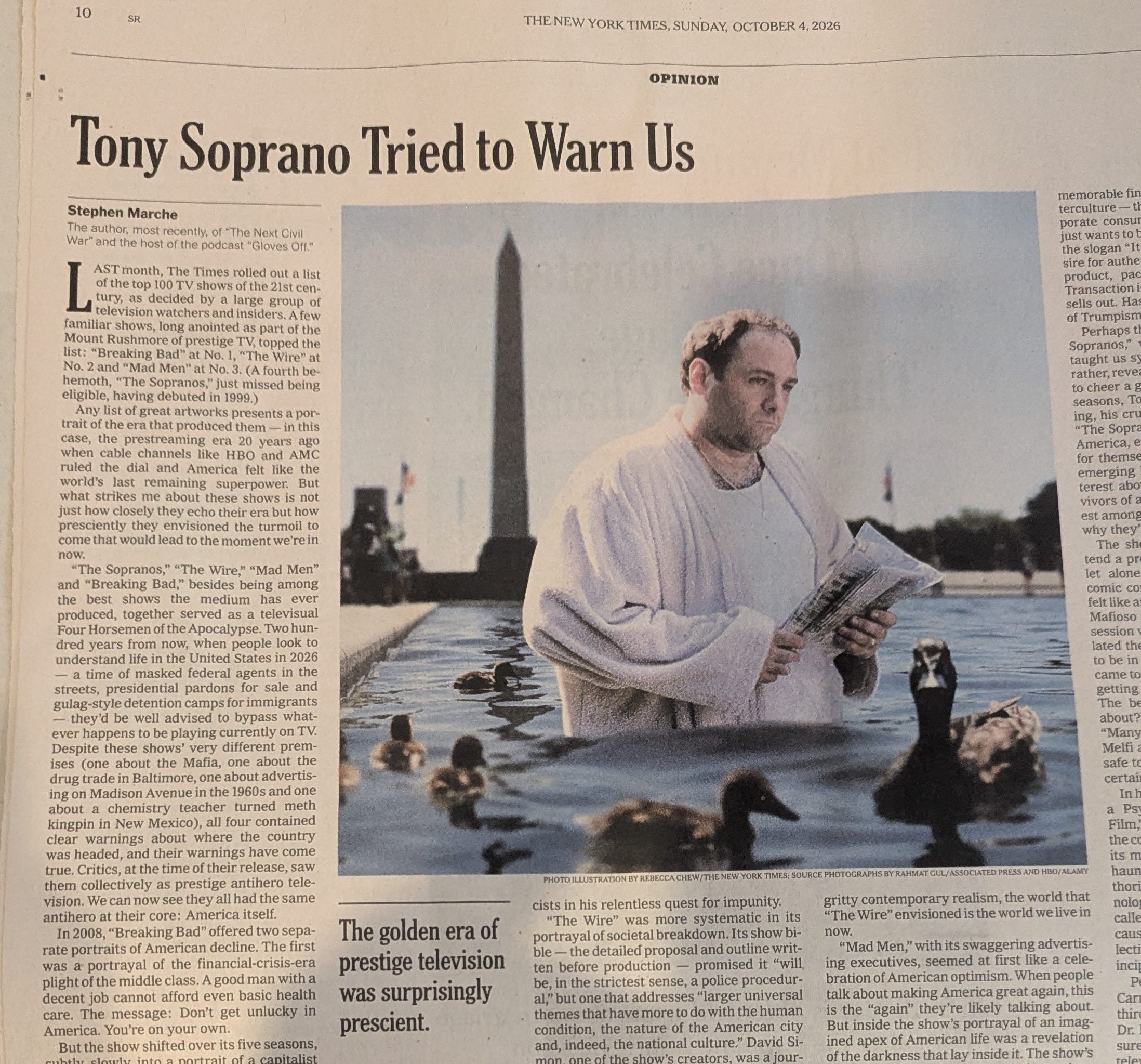
IS that what they did?
The subheading within the text is “The golden era of prestige television was surprisingly prescient.”
People can certainly see it that way…now. But were those dramas conceived as a warning? I’m doubtful that the writers of The Sopranos, Breaking Bad, The Wire or Mad Men intended to write a warning about mid-2020s America. That’s not how fiction works. They are great dramas because they offer so many facets.
And I would argue that fiction, by its nature, gets at deeper truths through the questions it asks—questions that may, in retrospect, seem prescient.
My wife (and my indefatigable publicist!) was at a Political Science conference recently, and a fellow panelist, speaking of her own work, mentioned that she studies the current intersection between economics and politics, which she terms “Neo-royalism.”
That is, in place of laissez-faire capitalism contesting for advantage in a clamorous marketplace, economic transactionalism now trades favor among flattering admirers, like a royal court.
My publicist, er, wife, mentioned my Faithless Elector trilogy to the fellow panelist. Published more than 10 years ago (and conceived years before), it centers on an oligarch who is intent on stealing the presidency; who wants to seize power and run things for his own benefit. To run the government and the economy like a medieval monarch, or like an organized crime “family.” Like a court. The co-panelist said she thought I sounded like a lovely man, but that maybe I should be locked up (!)
Was I prescient? Somewhat. The Electoral College became a battle ground later in the same year that the first book debuted (2016), and the craven men and women who circled the drain in that first administration knew little and cared less about norms and the rule of law.
Did I anticipate Trump? No. He wasn’t even his party’s candidate in March of 2016, when the book debuted.
Did I intend the book as a warning? No. I wanted to write a thriller.
But fiction can get at truths or scenarios that transcend reporting, or opinion pieces. I wanted to tell a story, and I wanted that story to have bite, but more than anything else, I wanted it to have verisimilitude. I worried that the bleak premise of the book was too harsh, the bad guys too over-the-top.
The election of George W. Bush in 2000 changed that.
First, after his narrow, disputed victory in the Electoral College, I assumed W would steer a cautious, middle course. Which he did not. The image that crystallized who the bad guys were was a photograph of W. Bush, Karl Rove, Dick Cheney and Donald Rumsfeld standing together.
I felt I could be looking at members of the Politburo reviewing the troops. The only thing missing were ushankas, those furry, Russian winter hats. The photo seared itself into my mind.
Naked power animated them.
That idea of power that was an end in itself raised the stakes for my protagonists Imogen Trager and Duncan Calder, who must figure out what’s going on and how to stop it. Before the “real” election, when Electors meet in their respective state capitals to cast their vote for president.
The story became more than just “What-if” and became, How do you stop people whose only goal is power? In the later books, it became how do you fight against something like that without becoming the thing you hate?
Later, the question was a version of Who polices the police? with the twist being, how can you trust people to follow your new rules when they have demonstrated a clear disregard for rule of law?
As I’ve argued elsewhere, and here good literature (and I include TV/film and stage under that heading) is about questions, not answers. And good literature is deep enough that it can contain multitudes, and multiple readings.
If you doubt that idea, think back to stories you’ve read in the past, and in which you found different things on subsequent readings. You “get” things you didn’t see before, or moments land differently. Because you’re different, or the world has changed in some meaningful way. And your answers to the questions the story poses may change, too.
Maybe the author saw it all coming, but maybe you’re reading into it. Which is not a bad thing.

James McCrone’s stories raise questions about the nature of power, the choices we make and the lessons we don’t learn.
He’s the author of the Imogen Trager political suspense-thrillers Faithless Elector, Dark Network and Emergency Powers–noir tales about a stolen presidency, a conspiracy, and a nation on edge. Bastard Verdict, his fourth novel, is about a conspiracy surrounding a second Scottish Independence referendum. His current novel, Witness Tree, is out on submission.
All books are available on BookShop.org, IndyBound.org, Barnes & Noble, your local bookshop, and Amazon. eBooks are available in multiple formats including Apple, Kobo, Nook and Kindle.
James is a member of Mystery Writers of America, Int’l Assoc. of Crime Writers, and he’s the current president of the Delaware Valley chapter of Sisters in Crime. He has an MFA from the University of Washington in Seattle, and he now lives and writes in Philadelphia, PA.
For a full list of appearances and readings, make sure to check out his Events/About page. And follow him on here, or on Substack!

