Strategic Mischief in the Electoral College

Despite our familiarity with the Electoral College, it bears repeating that the citizens of the United States do not vote for the president but rather for Electors, chosen by the various political parties state-by-state, who promise, that is “pledge,” to vote for their candidate. “There are so many curving byways and nooks and crannies in the Electoral College that there are opportunities for a lot of strategic mischief,” Rep. Jamie Raskin (D-MD) noted in a 2022 interview.

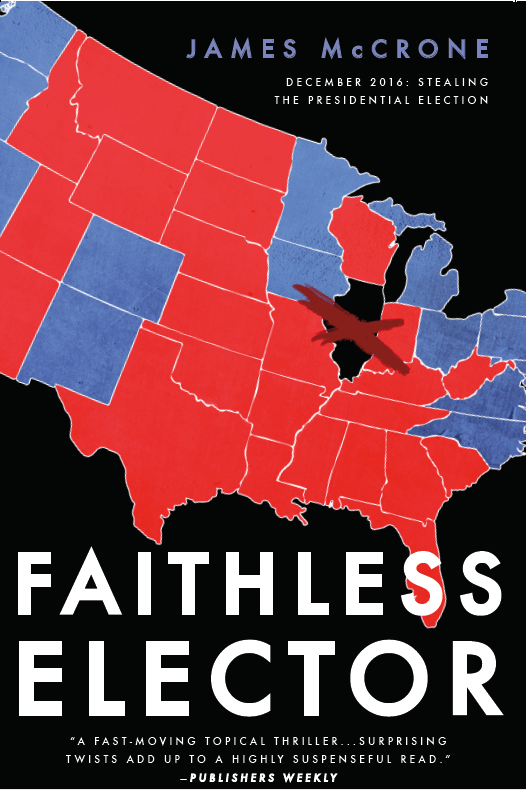
If you follow this blog, you know that my first novel was a thriller called Faithless Elector, in which a shadowy group seeks to steal the presidency by manipulating the Electoral College. My novel is a work a fiction, and I didn’t get everything right. But it’s dismaying to watch so much of its plot play out in the real world.

Faithless Elector debuted in March of 2016, well before the party conventions had selected their respective candidates, so it’s not about Clinton and Trump, but is animated by the question, “What if?” What if a shadow group wanted to steal the presidency by manipulating the Electoral College? The book’s staying power lies in the fact that it’s about a real, latent weakness in the process, prone, as Rep. Raskin points out, to “a lot of strategic mischief.”

And it’s about writers’ questions: Who are the bad guys? What do they want? What are the stakes? How would they go about it? Because first and foremost, for a good story, the protagonist(s) need a strong antagonist. If your “bad guys” are dummies, or the stakes don’t seem compelling, it doesn’t make for much of a story. As a reader, you want to feel the importance of the stakes and the very real possibility that the protagonist might not succeed.

The story is driven by move and counter-move. Verisimilitude (“like truth”) has been my guide, and I had to construct a plausible, mischievous threat. So, to begin with, I looked at the story not as the hero’s journey, but as the conspirators’ plot. I looked at how they might plausibly pervert rules and institutions, what groundwork they would have to create. I zeroed in on the weakest link, the actual Electors, and I made the conspirators resilient, having built into their model an ability to take advantage of serendipitous (for them) unforeseen events.

In the novel, the assumed EC vote tally is separated by only four votes. If three Electors could be persuaded to switch their votes, then the presumed loser would win. When I wrote the book, only a few states had anti-Faithless Elector laws on the books, and no one knew whether those statutes would stand if brought before the Supreme Court (there is much scholarship suggesting that Electors were intended to be decision makers, and despite their pledge were free to vote as they saw fit; but of course, no switched vote had ever changed the assumed outcome). Since the ’16 election a number of states and the District of Columbia (38 in total now) have instituted some sort of anti-Faithless Elector law, leaving twelve states without any such laws, and of the 38, fully half have no enforcement mechanism for their laws.

In the novel, an idealistic young graduate student, Matthew Yamashita, happens to be polling Electors for his dissertation research when he finds a suspicious number of deaths among them–all of them occurring between the general election and the real presidential election, when the Electors meet in their respective state capitols. This year it will be December 17, 2024. Matthew must get the information out to someone who will believe him–and who can do something to stop it. Later, Matthew and his allies realize that though they’ve got most of the facts right, they’ve missed a key point, which has cost them time.

In the novel, the conspirators need to give the Faithless Electors cover for switching their pledged vote, so they set about creating what looks like voter fraud in Illinois. It is the key to their strategy because it sows doubt and causes confusion. Meanwhile, in the real world, the Trump campaign covers all bets–it sows doubt about the validity of voting, and their operatives work to disenfranchise as many voters as possible. We have even seen ballot collection boxes set on fire in and around the Portland, OR, area, putting hundreds of ballots in jeopardy.

Not only is the Electoral College an archaic remnant that has never operated as designed, but since the first fully contested election (after Washington declined to run a third term), the rise of political parties has caused it to grow worse and more convoluted. Worst, far from giving a voice to small state voters, it disenfranchises rural and city dwellers alike. Adding the malapportioned Senate numbers (two per state regardless of population), further distorts the will of the people. The candidates, as has been true for some time now, focus on “swing states,” like my home state of Pennsylvania.

Meanwhile, there have now been five (5) presidential elections where the loser of the popular vote nevertheless became president – 1824, 1876, 1888, 2000 and 2016. Will it happen again in ’24? Will it be worse?

# # #

James McCrone is the author of the Imogen Trager political suspense-thrillers Faithless ElectorDark Network and Emergency Powers–noir tales about a stolen presidency, a conspiracy, and a nation on edge. Bastard Verdict, his fourth novel, is about a conspiracy surrounding a second Scottish Independence referendum. His novel-in-progress is called Witness Tree, a (pinot) noir tale of murder and corruption set in Oregon’s wine country.

All books are available on BookShop.org, IndyBound.org, Barnes & Noble, your local bookshop, and Amazon. eBooks are available in multiple formats including Apple, Kobo, Nook and Kindle.

James is a member of Mystery Writers of America, Int’l Assoc. of Crime Writers, and he’s the current president of the Delaware Valley chapter of Sisters in Crime. He lives in Philadelphia. James has an MFA from the University of Washington in Seattle.

For a full list of appearances and readings, make sure to check out his Events/About page. And follow this blog!

You can also keep up with James and his work on social media:
Mastodon: @JMcCrone
Bluesky: @jmccrone.bsky.social
Facebook: James McCrone author (@FaithlessElector)
and Instagram/Threads “@james.mccrone”
“Truth Value” and B.S.

I was delighted today when an account I follow, Jonny Thomson’s Mini Philosophy, discussed Harry Frankfurt’s “Reflections on B.S,” an essay I used to teach when I was a community college instructor in the 1990’s, and one that I wrote about back in February of 2018. That post (link below), along with Corinne Purtill’s “The difference between a snafu….etc” remain among the most popular posts on this blog. I’m pleased that Frankfurt is still read and discussed.

As we stare down the barrel of another potential Trump presidency, I thought it might be helpful to revisit the Orewellian blare of that time, and the weaponized obfuscation that lies at the heart of an inability to distinguish lying and bullshit.

Link to original post

That difference, as Frankfurt notes, concerns truth value: one must believe that one knows the truth, in order to conceal it, to lie; whereas, the bullshitter has no necessary relation to truth.

The title of my original piece comes from 1984, and the appendix, Principles of Newspeak. It’s an imagined article in some future Newspeak-only newspaper, designed to show how Newspeak is designed and used to limit thought and action – ‘Oldthinkers unbellyfeel Ingsoc,’ would replace something we might understand today, as, “Those whose ideas were formed before the revolution cannot have a full emotional understanding of the principles of English Socialism.” The Newspeak version is brief but freighted.

It calls to mind Trump’s rambling word salads–it’s a stretch to call them speeches–impossible to pin down, and they’re formulated (if we can call it that) in such a way as to drop heavily weighted nouns that have specific meanings for his supporters. He sometimes, as in the example I used in the original post, contradicts himself within the same rambling, but the key nouns continue to resonate because the audience is not really listening. They hear the sound-cues they need and move on.

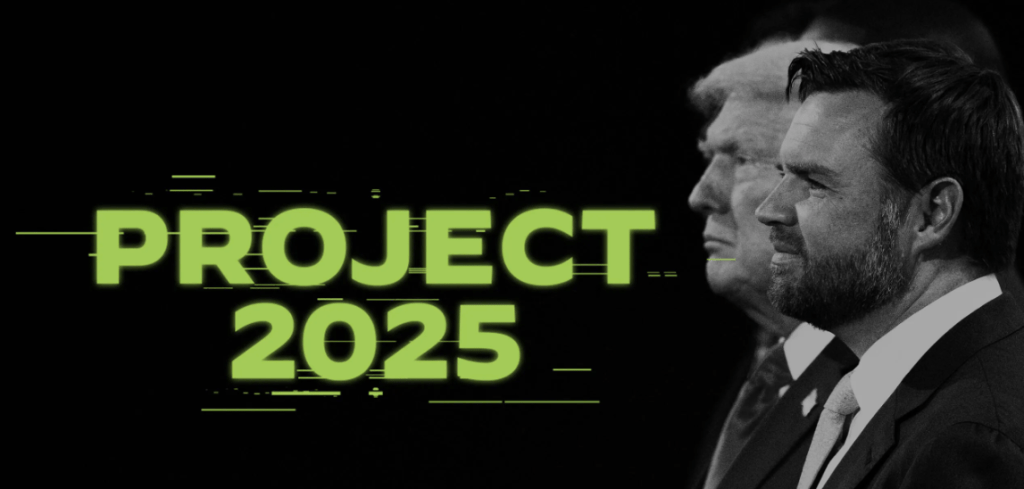
In a second Trump presidency, Project 2025 will be the scaffold for an ugly revolution, and the authors, who consulted with Trump in its creation, have made the grave mistake of being quite clear about what they will do.

Which may be why Trump is so keen to soft-peddle the Project. We need to listen, and we need to vote before it’s too late.

Here’s the Facebook post (reel) from Jonny Thomsom – https://www.facebook.com/reel/343009432203796

# # #

James McCrone is the author of the Imogen Trager political suspense-thrillers Faithless ElectorDark Network and Emergency Powers–noir tales about a stolen presidency, a conspiracy, and a nation on edge. Bastard Verdict, his fourth novel, is about a conspiracy surrounding a second Scottish Independence referendum. His novel-in-progress is called Witness Tree, a (pinot) noir tale of murder and corruption set in Oregon’s wine country.

All books are available on BookShop.org, IndyBound.org, Barnes & Noble, your local bookshop, and Amazon. eBooks are available in multiple formats including Apple, Kobo, Nook and Kindle.

James is a member of Mystery Writers of America, Int’l Assoc. of Crime Writers, and he’s the current president of the Delaware Valley chapter of Sisters in Crime. He lives in Philadelphia. James has an MFA from the University of Washington in Seattle.

For a full list of appearances and readings, make sure to check out his Events/About page. And follow this blog!

You can also keep up with James and his work on social media:
Mastodon: @JMcCrone
Bluesky: @jmccrone.bsky.social
Facebook: James McCrone author (@FaithlessElector)
and Instagram/Threads “@james.mccrone”

Editing and the Vaudeville Hook (pt. 2)

Recently, I related a story about my penchant for (and the dangers of) going on too long, and the vaudeville hook. So, I’ll try to keep this brief!

In early drafts, I tend to over-write. Brevity for its own sake is not the goal of good prose, but over-writing, as I do, projects a lack of confidence, the inability to let the work stand on its own. When I edit my drafts, the first thing I go after are the superfluous words and the sentences and scenes that may go on too long. The goal is to keep the reader engaged, after all.

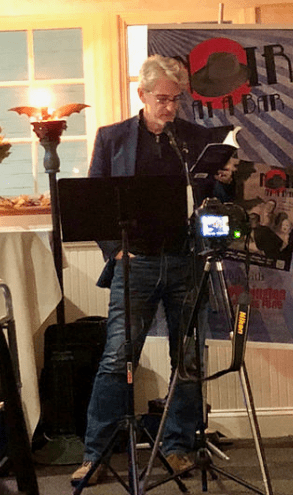
I will be reading at Oxford Bar in Oxford, PA, on November 7th. Readings are delightful for many reasons–meeting readers, other writers, and testing out material. They are very useful for new material.

I have found that doing a public reading of a work-in-progress that has been through a few self-edits can be an excellent means of identifying things I was blind to. Keeping an eye on the audience while reading, you can get a sense of what’s working, or that something goes on too long. The audience starts to shift, or–stab to the heart!–someone glances at their watch. You feel the long hook begin to encircle you.

To the vaudeville hook, I’d like to add the “Chuck-bin.” Charles R. Johnson (author of Oxherding Tale and Middle Passage–for which he won the National Book Award in 1990), was chair of the creative writing department at the University of Washington where I got my MFA, and I took every class he offered. One of the things he told us that has stuck with me, when talking about the need for the story to hold attention, was that we should imagine that the reader is standing over a garbage can while reading our work, and we mustn’t give them any reason to drop it in the trash.

I’ve taken this image so much to heart that as I do my readings, when I sense that the audience might be losing interest, I can hear the pages falling with a clunk into the wastebasket. It’s a high wire act 🙂 After the reading, I often sit with the passage I worked on and begin cutting.

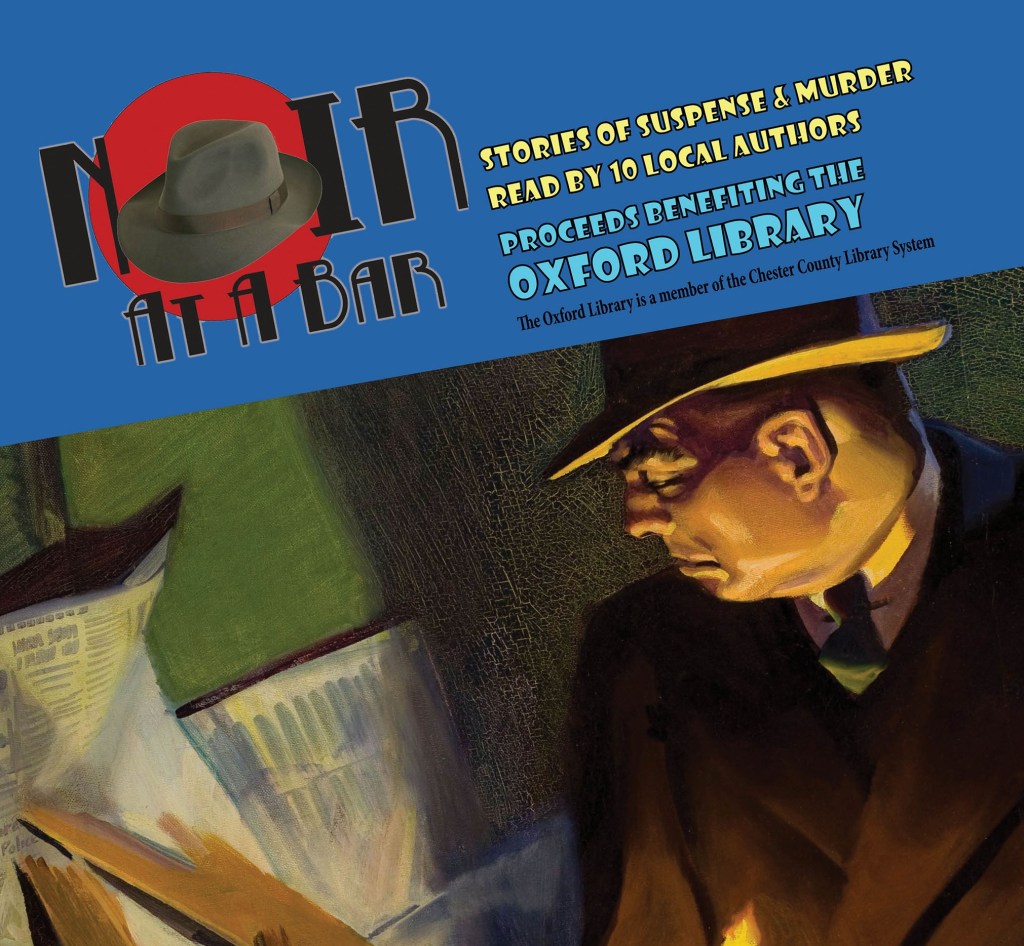
Come see me and twelve other authors on Thurs., November 7th in Oxford, PA for Noir at a Bar. The festivities begin at 6:30. Proceeds benefit the Oxford Public Library Tickets are $25, includes a buffet dinner!

More info on presenting authors here: http://www.noiratabar.com/

# # #

James McCrone is the author of the Imogen Trager political suspense-thrillers Faithless ElectorDark Network and Emergency Powers–noir tales about a stolen presidency, a conspiracy, and a nation on edge. Bastard Verdict, his fourth novel, is about a conspiracy surrounding a second Scottish Independence referendum. His novel-in-progress is called Witness Tree, about a conspiracy set in Oregon’s wine country, a (pinot) noir tale of murder and corruption.

All books are available on BookShop.org, IndyBound.org, Barnes & Noble, your local bookshop, and Amazon. eBooks are available in multiple formats including Apple, Kobo, Nook and Kindle.

He’s a member of Mystery Writers of America, Int’l Assoc. of Crime Writers, and he’s the current president of the Delaware Valley chapter of Sisters in Crime. He lives in Philadelphia. James has an MFA from the University of Washington in Seattle.

For a full list of appearances and readings, make sure to check out his Events/About page. And follow this blog!

You can also keep up with James and his work on social media:
Mastodon: @JMcCrone
Bluesky: @jmccrone.bsky.social
Facebook: James McCrone author (@FaithlessElector)
and Instagram/Threads “@james.mccrone”
2024 Election – Faithless Elector unintended consequences edition

Today we need to discuss the Chiafalo v. Washington, 591 U.S. _ (2020) ruling, and its (potential) unintended consequences. The ABA Journal (link above) notes earlier this year that “A 2020 U.S. Supreme Court decision on faithless electors appears to allow state legislatures to pursue a dangerous strategy for overturning election results…”

Those who read my posts–and my thrillers–know that I have long regarded the Electoral College as an outmoded, arcane system for electing a president; and one that is ripe for mischief from bad actors that only amplifies the anti-democratic underpinnings of our system. Those who claim to defend the Electoral College often say that they are upholding the Founders’ vision, when in fact they are working to exploit its loopholes and undermine faith in its legitimacy for their own ends.

Chiafalo v Washington was a unanimous Supreme Court decision “that states have the ability to enforce an elector’s pledge in presidential elections.” It is the suit that arose from the Faithless Electors lawsuit after the 2016 presidential election. The ABA article quotes a NY Times op-ed by Lawrence Lessig, a professor at Harvard Law School, and Matthew A. Seligman, a fellow at the Constitutional Law Center at Stanford Law School.

In their op-ed, Lessig and Seligman’s describe an all-too possible scenario:
“Charges of fraud cloud a recount. Leaders in the state legislature challenge the presumptive result. In response to those challenges, the legislature votes to direct its electors to cast their ballots for the candidate who presumptively lost but whom the legislature prefers. Any elector voting contrary to the legislature’s rule would be removed and replaced with an elector who complied. This is a critical innovation in the science of stealing a presidential election.” [Emphasis mine]

Lessig and Seligman go on to say: “Congress could amend the federal law governing electoral votes by declaring that any post-election change of the results by a state legislature would not count as votes ‘regularly given,’” they wrote. “States could cement the requirement that electors are to follow the people’s will. Neither path is assured, but we are certain of this: It is a rocky road ahead.” As currently constituted, only the Senate would be likely to take this up. The House has a Trump-controlled majority.(And it is Trump-controlled. As we saw in the failure of the bipartisan Immigration Reform Bill after Trump torpedoed it. Brookings has an explainer “for the perplexed,” though in the end, it’s not hard to figure out.)

My first novel, Faithless Elector came out in early 2016 and presaged some of the insanity surrounding the election. But the third book, Emergency Powers may prove to be more on point (which does not make me feel good, somehow).

Voting is our chance to participate and to hold our elected officials to some sort of accountability. Is it perfect? Hardly, but we may get a lesson in just how bad the alternative is if we don’t vote–all of us. Because the last three years or more have seen a coordinated effort to undercut that chance to make outrvoices heard through bad faith laws, official skullduggery and lawsuits. So much so, that the GOP candidate, Donald Trump, can say, as he did on July 28 of this year, that we “won’t have to vote anymore…”

The election is roughly 3 months from now. The forces that seek to steal our votes have been busy for years. Perhaps knowing that a majority does not support their policies, the GOP has undertaken to shrink the number of eligible voters and (potentially) to usurp the role of Electors.

I’ll talk more about the lawsuits and gerrymandering that’s still going on–and the Supreme Court’s role in it–in a follow-up post.

# # #

James McCrone is the author of the Imogen Trager political suspense-thrillers Faithless ElectorDark Network and Emergency Powers–noir tales about a stolen presidency, a conspiracy, and a nation on edge. Bastard Verdict, his fourth novel, is about a conspiracy surrounding a second Scottish Independence referendum. 

All books are available on BookShop.org, IndyBound.org, Barnes & Noble, your local bookshop, and Amazon. eBooks are available in multiple formats including Apple, Kobo, Nook and Kindle.

He’s a member of Mystery Writers of America, Int’l Assoc. of Crime Writers, and he’s the current president of the Delaware Valley chapter of Sisters in Crime. He lives in Philadelphia. James has an MFA from the University of Washington in Seattle. His current, work-in-progress is a mystery-thriller set in Oregon’s wine country…A (pinot) Noir, called Witness Tree.

For a full list of appearances and readings, make sure to check out his Events/About page. And follow this blog!

You can also keep up with James and his work on social media:
Mastodon: @JMcCrone
Bluesky: @jmccrone.bsky.social
Facebook: James McCrone author (@FaithlessElector)
and Instagram/Threads “@james.mccrone”