
The recent publication of Corinne Purtill’s “The difference between a snafu, a shitshow, and a clusterfuck,” on QZ.com, underscores the need for nuance in thinking, action, and in writing. Purtill’s essay does a nice job of distilling the differences, nuances and attendant dangers.
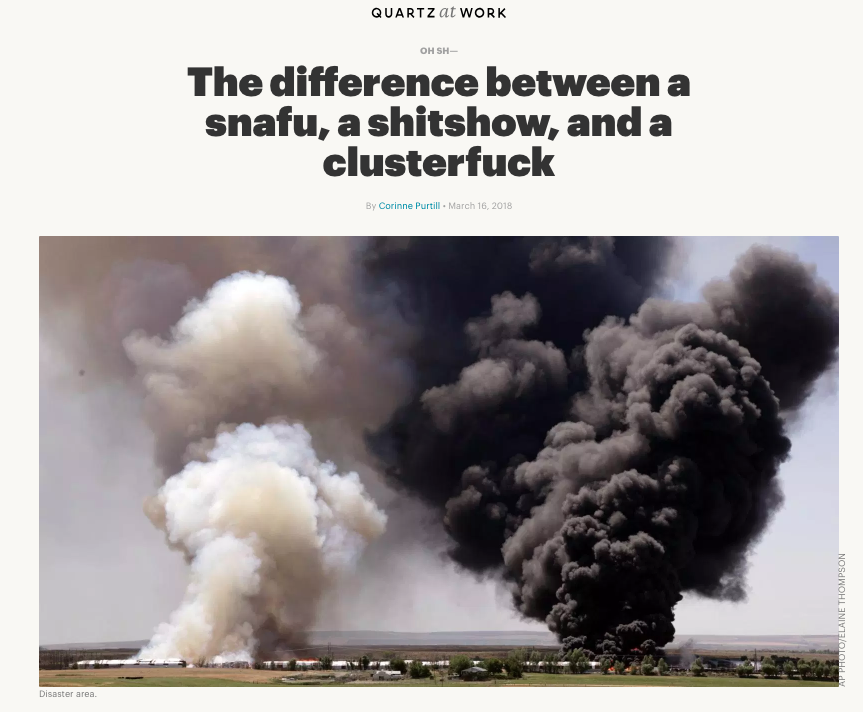 The three main contributors to a clusterfuck are “illusion, impatience and incompetence,” according to Purtill, and I can’t disagree. A clusterfuck is distinguished from a Snafu, for instance, in that a Snafu “refers to the functionally messy state” of many bureaucracies; whereas a clusterfuck is the result of poorly taken, badly executed decisions.
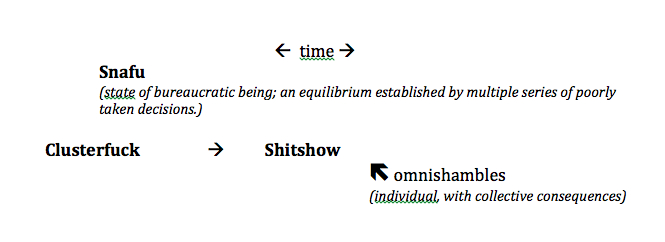
“Shitshow” can be distinguished from Clusterfuck in that the shitshow is the result of a clusterfuck, and therefore describes an end state—and this is important—is not, like Snafu, intransitive. A resultant shitshow describes a moment in time, whereas Snafu continues through time. Thus, the shitshow, resulting from a clusterfuck, may contribute to an overarching bureaucratic Snafu malaise, or it may lead to FUBAR (f’d up beyond all repair).
Ms. Purtill has done a great service to writers, thinkers and planners.
A British friend, and devotee of The Thick of It on BBC, proposes “omnishambles” as a further adjective of Buro-Political disapprobation. It’s so vivid that I feel compelled to locate it along the spectrum.
Initially, I was inclined to regard omnishambles as a synonym or cognate of shitshow, an end state; but its first appearance in 2009, as Malcolm Tucker speaks to a disastrous MP candidate (below) leads me to believe it should have its own spot on the spectrum:
“Not only have you got a fucking bent husband and a fucking daughter that gets taken to school in a fucking sedan chair, you’re also fucking mental. Jesus Christ, see you, you are a fucking omnishambles, that’s what you are. You’re like that coffee machine, you know: from bean to cup, you fuck up.”
— Malcolm Tucker to Nicola Murray, “Series 3, Episode 1”, The Thick of It.
This coinage conjures images of a single, out-of-control Rube Goldberg machine indiscriminately slaughtering (hence the “shambles”) innocents, rather than a bureaucratic clusterfuck. It’s therefore outside of time, carrying its threat at a vector
To sum up:
I’m open to debate and discussion, though perhaps not with Malcolm Tucker…
# # #

A Seattle native (mostly), James now lives in South Philadelphia with his wife and three children. He’s a member of the The Mystery Writers of America, Int’l Assoc. of Crime Writers, Int’l Thriller Writers, Philadelphia Dramatists Center and is the president of the Delaware Valley chapter of the Sisters in Crime network. James has an MFA from the University of Washington in Seattle.
For a full list of appearances and readings, make sure to check out his Events/About page. And follow this blog!
His most recent short fiction is below. The first is available for online reading.

“Eight O’Clock Sharp” in Retreats from Oblivion: the Journal of NoirCon. (free online) Set in Philadelphia’s 9th Street Market, Thomas is a man outside of time, forgotten, but trying to do the right thing while contending with avaricious forces.

“Ultimatum Games” in Rock and Hard Place magazine issue #7 A rare book heist, bad decisions. The narrator and his partner-in-crime clash over evolving bourgeois norms.

“Nostalgia” in Low Down Dirty Vote, vol. 3 An armed group tries to resurrect a past that never was as they struggle with change.

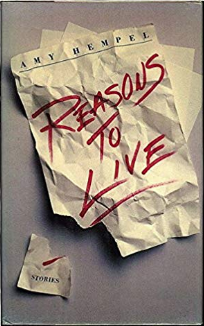 Years ago (1985 or ’86), I ordered a copy of Amy Hempel’s short story collection Reasons to Live at my then-local bookshop, the
 In the Noirpolitik thriller Faithless Elector, the reason the faithless electors give for not voting as they pledged to vote (for switching) is presented as a vote of conscience. In the book, there were seeming irregularities in the Illinois vote count, allowing each faithless elector to say their switched vote was cast as a vote of conscience for the candidate who should have won the presidency.
 Perhaps I should have chosen Florida, particularly since the scandal, irrespective of the truth remains a volatile point of contention across both (now, all three) books and Florida is back in the news again…and likely, again.
 2016 election (March, to be precise), long before either of the parties had chosen their candidates. At the heart of the stories is FBI Analyst-turned-Agent, Imogen Trager, whose patient, analytical approach is regarded as alien and “soft” by many of her colleagues—even while it is precisely her methods that are getting results.
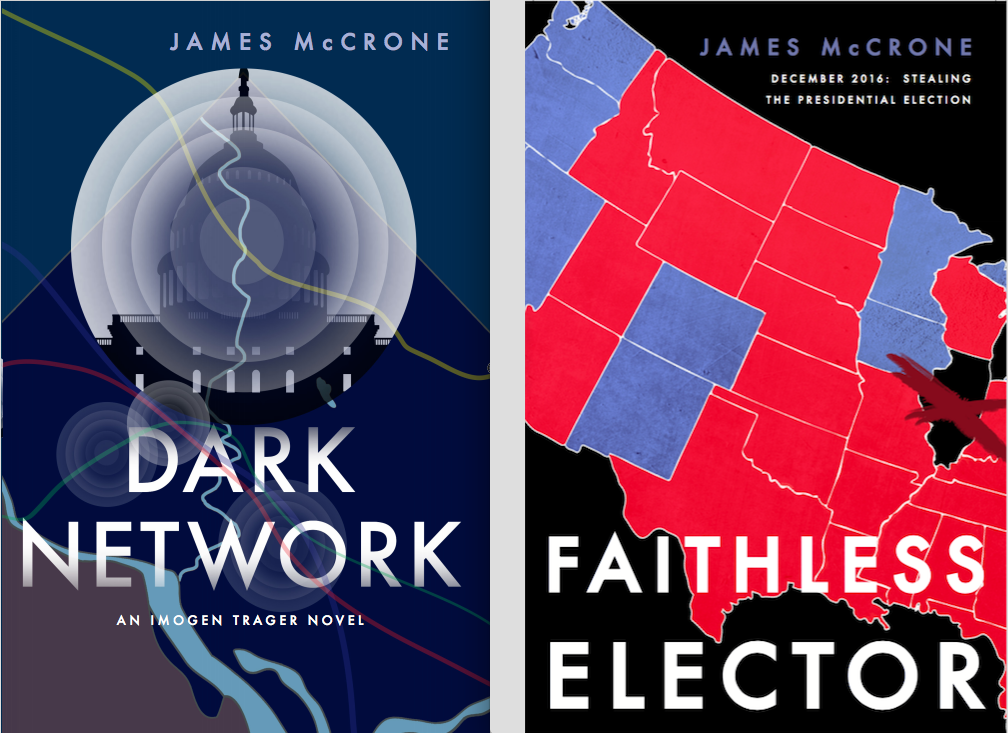 So, did I just get lucky that many aspects of the novels jibe with our collective sense of democracy off the rails? Do I have a crystal ball?
 Chosen Words - James McCrone