Representing

Recently, I’ve seen Facebook posts and a Tweets (each with a dozen attending comments) regarding fellow writers’ concerns about in-person readings and book signings; and I’ve heard privately from others about their discomfort over large gatherings. I absolutely get those concerns, and I would never disparage or second-guess another person’s reasons for wanting to remain safe and healthy.

What I would like to do is talk about the importance and value of these get-togethers, and my hope that they will return in full force sooner rather than later. The Zoom readings do have value in a number of ways, but they are no substitute for a live gathering.

Annamaria Alfieri and Gary Cahill

Last night (Tues., April 12, 2022) I was the first reader in the latest installment of the MWA-NY Reading Series at KGB Bar, along with Gary Cahill, Tom Avitabile, Bill Chambers, A. J. Sidransky and Albert Tucher–and it was wonderful! It felt great to be out and about, to (re)connect with old friends, meet new people, and to hear first-hand what others are doing and working on. The place filled up nicely, too. A good mix of people (say, 20+) came out on a Tuesday night to hear crime stories. There was an energy and vitality in the room that you can’t get over a screen.

At KGB, as is true at Shade Bar, in Wilmington, West Chester and other venues, the audiences are generous, knowledgeable, and attentive. As I’ve written elsewhere there’s no substitute for a live audience, and these readings series and Noirs at the Bar give us one filled with writers and readers who are both avid fans.

Like many writers, I use these short readings as a way to try out new work or work-in-progress. It’s similar to stand-up comedy, I think, in that there’s no buffer. You wrote the words, and you’re speaking and representing them. You’re putting it out there. And there’s no mistaking a moment when you’ve lost the audience. These writers and readers know what grabs them, too, and you can see it in their faces when something you’re reading doesn’t sound right…or drags on too long.

Which, when/if it happens is a horrible moment (not that I would know, personally! :). But it’s a necessary moment, and it’s far better to be forced to grapple with why and how something isn’t working early(ish) in the process before you start pitching and querying. Even when you’re reading something that’s already out in the world, audience reactions can inform and inspire a current work.

As a reader/performer, I think, you have at least two reciprocal roles for the evening–performer and audience member. As writers in a community, we do more than just cheerleading. It reminds me of moments when you hear professional athletes speak about a fellow athlete, sometimes even a competitor. They’re fans, too! They understand and respond to another athlete’s playing on an informed level.

There’s also the serendipity of being in a room full of people who care about writing and story. One of the readers last night, Tom Avitabile was answering a question from someone who was clearly very taken with Tom’s reading. In his response, a single word leapt out at me that fused a lot of things I had been thinking about my own work, an image grew in my mind for how I should think about the structure of the rest of the book. I’m not sure when or if that spark would have come without his comment–one about something else entirely, and not even directed to me. (And bonus, his new thriller hits the ground running, and sounds fabulous.)

Finally, it’s just fun to be out and hearing stuff!

The next MWA-NY/KGB Reading Series is June 14 (I think). I’m planning to go, and I hope to see all of you there.

# # #

The selection I read Tuesday night, from Witness Tree is months away from being finished. But you can check out my latest short stories and novels below:

“Eight O’Clock Sharp” in Retreats from Oblivion: the Journal of NoirCon.
Set in the 9th Street Market, Thomas is a man outside of time, forgotten, but trying to do the right thing while contending with avaricious forces.

“Ultimatum Games” in Rock and Hard Place magazine issue #7
A rare book heist, bad decisions. The narrator and his partner-in-crime clash over evolving bourgeois norms.


“Nostalgia” coming May 15 in Low Down Dirty Vote, vol. 3
An armed group tries to resurrect a past that never was as they struggle with change.
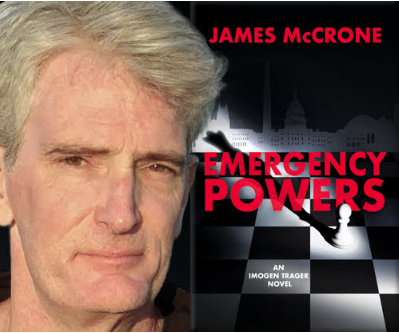
James McCrone

James McCrone is the author of the Imogen Trager political suspense-thrillers Faithless Elector, Dark Network , and Emergency Powers–noir tales about a stolen presidency, a conspiracy, and a nation on edge. All books are available on BookShop.org, IndyBound.org, Barnes & Noble, your local bookshop, and Amazon. eBooks are available in multiple formats including Apple, Kobo, Nook and Kindle.

His next book, w/t Bastard Verdict, is a noir political thriller set in Scotland. He’s currently writing a mystery-thriller set in Oregon’s wine country…A (pinot) Noir, w/t Witness Tree.

A Seattle native (mostly), James now lives in South Philadelphia with his wife and three children. He’s a member of the The Mystery Writers of America, Int’l Assoc. of Crime Writers, Int’l Thriller Writers, Philadelphia Dramatists Center and is the vice-president of the Delaware Valley chapter of the Sisters in Crime network. James has an MFA from the University of Washington in Seattle.

For a full list of appearances and readings, make sure to check out his Events/About page. And follow this blog!

Political institutions are the problem, but it’s institutions that will save us.

I’m pretty sure that’s not what Adam McKay would say about institutions (the law, courts, norms, democratic rule) but I would nevertheless love for him to read and respond to my Faithless Elector thriller series. Because as gratifying as it’s been for the books to find readers who see the political moment reflected in the pages of my books, the larger narrative sometimes gets lost; that the present moment has been a long time coming. And the moment isn’t over.

Speaking to David Marchese in the NY Times magazine, McKay talks about what “hooked” him in Michael Lewis’s The Big Short (which he produced for the screen). Reading the book in one night, he says that “[Lewis] does two things. Number 1, we all love the taste of making a lot of money. The other thing we all love is knowing things that we’re not supposed to know. Lewis tells me things that most people don’t tell me…” He goes on to say that what he asks of a work is: “Is there a sincere attempt to understand the world, or is the action just one of manipulation and distraction?”

In the three books that make up the series—Faithless Elector, Dark Network and Emergency Powers—I’ve tried to do just that–to tell a story that tries to understand the world, one that doesn’t talk down to the reader, nor one that has an axe to grind. They’re about insider politics, and delve into things you thought you knew about in a new way: strong, character-driven stories set within a context of conflicted, dangerous politics. The conspirators exploit weaknesses in our legal/constitutional institutions to effect their power grab—motivated, as McKay discusses “by pure power and reactionary beliefs.” And if they can get hold of all the levers of power, they may very well succeed.

The “Faithless Elector” conspiracy, and the forces arrayed against America in my stories didn’t rise with Trump (he’s nowhere in their pages). Rather, it’s part of a much longer trajectory and deeper worry. And those forces haven’t gone away now that Trump’s making his noise offstage.

I would urge anyone thinking or writing about politics to give the interview a good read. It’s the kind of insightful, reasoned (yet still passionate and opinionated) discussion many of us lament as lacking these days. He also zeroes in on the dearth—in literature and in politics—of working people’s voices. Which, again, my work strives to bring into the conversation. Meetings between the FBI and “regular” folk aren’t caricatures, but are meant to be rounded people, to add nuance and complexity to the plot—and the stakes—as the story unfolds.

Later in the interview, McKay makes an interesting claim about center-left and center-right politics, putting himself in the CL corner, and Aaron Sorkin’s work on the CR. It’s Sorkin’s faith in institutions (again, the law, courts, norms) that pushes him rightward in McKay’s view. (McKay is careful not to claim that Sorkin is a right-winger). McKay’s observations and phrasing are in keeping with a balanced, long-view perspective. By McKay’s rendering, I guess I’d end up CR, too. Which is an uncomfortable feeling…

But insofar as my work enlightens, as it is a sincere attempt to understand the world, I’ll accept it.

Far from contributing to the politics of distraction and outrage porn, the Faithless Elector series reads, in the words of one reviewer, like an “insider’s view” of power politics. The conspirators manipulate the Electoral College, the congress and the bureaucracy from the inside–and for their own ends–with the future of the nation in the balance. It is characters in and out of government who risk their lives to right the ship of state. What my characters oppose is not bureaucracy, or legal authority, but the perversion of those institutions.

There’s a quote posted above my home computer, from Professor Emilios Christodoulidis at the University of Glasgow School of Law:
“Any separation between legal and political power is purely conceptual…there can be no real legal authority without some political power…[and] there is rarely political power without some legal authority.”
(from Jurisprudence: Themes and Concepts )

As the tagline for Dark Network notes: “Without law, there’s only power.” To which, perhaps I should add, And what about when law protects and abets the powerful?

#   #   #

James McCrone

James McCrone is the author of the Imogen Trager political suspense-thrillers Faithless Elector and Dark Network , about a stolen presidency, a conspiracy, and a nation on edge. The third book, Emergency Powers, is available NOW!
All books are available on BookShop.org, IndyBound.org, Barnes & Noble, and Amazon. eBooks are available in multiple formats including Apple, Kobo, Nook and Kindle.

He’s at work on a fourth thriller, set in Scotland, w/t Bastard Verdict.
A Seattle native (mostly), he now lives in South Philadelphia with his wife and three children. James is a member of the The Mystery Writers of America, Int’l Assoc. of Crime Writers, Int’l Thriller Writers, Philadelphia Dramatists Center and the Sisters in Crime network. James has an MFA from the University of Washington in Seattle.

Writing in the Trump era

When evil is also stupid, what are we left to work with?

There’s been a great deal of concern about what it means to create in Trump’s America, from shock at the impending de-funding of the National Endowment for the Arts (NEA) to a recent piece in New Republic, “Is Trump Ruining Book Sales?” which ominously intones, “in a world where reality has become stranger than fiction, actual books are no longer selling.”  Many books, they add, that were “released in the wake of the Trump election were written with a very different understanding of the world than the one we have now.”NewRep.Trump ruins lit

To this discussion, though he beat New Republic to the punch by three months or so, I would add Glenn David Gold’s “Writing (and not writing) during a political maelstrom” (LA-Times), who writes about the difficulties the thriller author Ross Thomas had writing during an earlier era.  Thomas wasn’t sucked into Facebook or Twitter (this was the ‘eighties), but by the radio, which despite his best efforts stole his focus and attention.

RossThomas.author

Ross Thomas

Thomas’s lament, however, will sound familiar to any writer today:  “He said that every morning he sat down at the typewriter and he told himself he wasn’t going to listen to [the Iran-Contra hearings], but the radio beckoned, and he turned it on, and he fell into them so completely he couldn’t work. Every. Single. Day.”  Worse, Thomas went on to say, “if [my] characters had conspired like this, they would have had a sense of wit about them that none of the clowns in Iran-Contra actually had. The actual level of deceit, venality, self-righteousness, collusion, the real-world consequences of doctrinaire actions, and the deep, unaware stupidity of it all were so far beyond anything [I] could make up.”

As I stare at the bleak landscape that stretches before us for (perhaps) another three and a half years, I’ve lamented this very thing.  My two thrillers (a third is on the way) are about a conspiracy to steal the presidency. The conspirators in Faithless Elector and the upcoming Dark Network deal in deceit, machiavellian deals and murder to achieve their goal.  I have also felt “knee-capped” by reality, to use Thomas’s vivid expression–so much so I almost feel like I should apologize to readers for the deadly efficiency and lean plausibility of my conspiracy.

Despite this dreary outlook, I stand in hope.  Tom Clancy famously said that “the difference between fiction and reality is that fiction has to make sense.”  And even in the depths of his writerly depression, Thomas seems to know this, and offers us all hope when he touches on the notion of fictional wit and elan.  A writer today, like Thomas before us, looks aghast at the bungling intrigue of the past six months and laments the lack of vision.  When evil is also stupid, what are we left with?

Gold hints at the ability of stories to make meaning, but I disagree with his final thoughts on the subject when he says, “Fiction has to be our consolation prize. Inherently lesser than reality, always behind the times.” I would say fiction and reality are not in competition.  Fiction is not well-crafted journalism; nor is it history.  I would stop short of saying fiction should strive to be prophetic, but it can and should weave meaning about where we are and where we’re going, even if the precise things we write about don’t come to pass.

And we’re left exactly where we’ve always been, striving to make sense and trying “to write–intelligently, creatively, evocatively–about what it’s like living in the world at this time” (Oliver Sachs).  That’s the meaning good stories offer, and those will rise to the top.


Here is an LA Review of Books retrospective on Ross Thomas, by Woody Haut (August, 2013) “Are the Fools in Town Still on Our Side“.  Excellent reading.  My nightstand stack just got a lot bigger.

James McCrone is the author of the suspense-thrillers, Faithless Elector, Dark Network and the forthcoming Consent of the Governed. Publishers Weekly calls Faithless Elector a “fast-moving topical thriller.” Its “surprising twists add up to a highly suspenseful read.”

Dark Network, is on-sale October 20.JMc-author2.2017

Faithless Elector is available through Amazon.
If you live in Philadelphia, pick up a copy at Head House Books -or- Penn Book Center.  Follow this blog, and like James’s FB page.


Faithless Elector penalties upheld…for now

[Originally published 2017.03.16]
The fines leveled against the four Washington State Faithless Electors issued by the Washington State secretary of state, have been upheld on appeal by a state judge, the Seattle Times 
reports.


Washington State first put the Faithless Elector laws into place after Mike Padden, a Republican Elector back in 1976, voted for Ronald Reagan instead of his party’s candidate Gerald Ford.  Screen Shot 2017-07-17 at 7.28.15 PM

Many states have such laws.  Most think they would not stand constitutional scrutiny. Indeed, the judge in the case seems to say as much when he notes that he doesn’t have the authority to rule on the plaintiffs’ argument that the Constitution doesn’t give the state the power to punish electors for contrary votes, but that they could argue the constitutionality of the law on appeal.


It has long been held by those who study US elections (see Professor Robert Alexander‘s response, right) that electors were free agents.


People on either side of the issues concerning the Electoral College concede that as conceived–and written–in Article 2, Section 1 of the Constitution, electors are independent actors.  It remains to be seen whether the Supreme Court will agree.


This is the first election where fines have been leveled against electors.  Thus far, no one has had to appeal a fine levied by a state against a faithless elector, so no one had “standing” to bring a case, and the question has never come before the Supreme Court.  It may now.