
In the past, I’ve joked that there’s a well-worn path between downtown revitalization non-profits and writing thrillers…because let’s face it, there isn’t. Lately, as I think about it, I’m not so sure it’s a joke.
My former jobs were perfect training for writing thrillers.
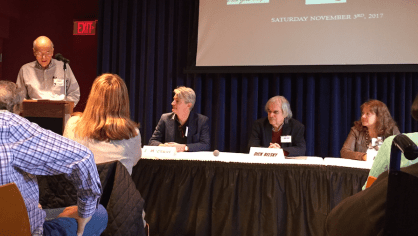
A Mysterious Affair in Princeton
Recently, I was a late addition to a panel at “A Mysterious Affair in Princeton” put on by the Cloak & Dagger bookstore, which was a fantastic “affair,” with great speakers and a very nice turnout of mystery-thriller readers who had insightful questions.
The day’s final speaker was SJ Rozan, best known for the Lydia Chin/Bill Smith series and other mysteries. Her talk revolved around why people are drawn to mysteries and thrillers.

SJ Rozan
She began by discussing “ur” stories, or essential narratives, that we tell ourselves over and again. The job of mysteries, she said, going back to their essence as “ur” stories, “is to provide an explanation” for what happened in an otherwise arbitrary, indifferent world.
The essence of a thriller, she noted, my ears pricking up farther, is simply: “is there enough time?” Can the hero(es) stop the ticking bomb or thwart the bad guys? What will it take to stop it?
As good as her talk was, I’m afraid I started thinking a lot about thrillers and stopped listening. My thrillers are indeed predicated on timing. In Faithless Elector, the tension concerns whether the heroine and hero can get the information out in time to stop the conspiracy, and in Dark Network, they’re confronted with a plot no one initially believes exists. In both cases, if the presidency is stolen—as we’re seeing now in the real world—it’s next to impossible to effect meaningful change after the fact.
This past week, I applied for a part-time job with a commercial district management organization. As I worked on my cover letter, wondering how much (or even if!) I should discuss writing novels as the reason for my hiatus from the world of non-profits, I found myself thinking about what leadership of a non-profit entailed.
 It turns out, managing a commercial district is perfect training for thrillers. Not that death and mayhem are ever part of the work, thankfully, but the planning and execution is eerily similar to plotting a thriller.
First, (Act One, let’s call it) there is a cast of characters in any district. In order to be effective, the district manager must know who the main players are, who the ancillary players are, how they interact and what it is they want. Scene setting, exposition. Often what they want is at odds with what others want, and they will coalesce into mini interest groups—Conflict!
And then something happens to disrupt the equilibrium (such as it is). Information that wasn’t meant to come to light is revealed, or someone is murdered…or there is a block grant available. Which takes us to Act Two.
Act Two, then, is where the main character encounters obstacle after obstacle toward achieving his/her goal of exposing the conspiracy or beginning a façade improvement program. Anyone who has worked in non-profit/local government will recognize this trope, and any such person might be forgiven for having daydreamed a timely murder or two.
Act Two sees the “first culmination” wherein it looks like the hero(ine)/district manager will achieve their goal. Inevitably, everything falls apart, leading to the “midpoint,” where it seems all hope is lost.
This leads naturally to Act Three, and the “climax” –the point of maximum tension where the opposing forces confront one another (Board meeting, anyone?). Act Three, then, shows how the world/commercial district returns to equilibrium having successfully navigated the obstacles—or failed miserably.
It’s the ending, however, where the non-profit and the fictional worlds diverge. The thriller writer Tom Clancy once famously said: “The difference between reality and fiction is that fiction has to make sense.” He might just as easily have been talking about the difference between non-profit district management and thrillers.

James McCrone is the author of the Imogen Trager political suspense-thriller series Faithless Elector and Dark Network.
Find them through Indybound.org.
They are also available at Amazon, Barnes & Noble, and Powell’s Books. Link to REVIEWS
 Apparently, Imogen Trager, the heroine of my books, Faithless Elector and Dark Network has a larger online presence than I do!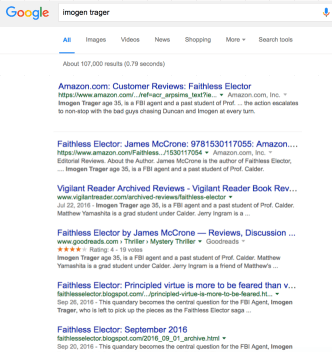
 Perhaps the difference between now and 25 years ago is the nature of status: how it’s achieved, and what it represents. In the indy-publishing business, we live by ‘mentions,’ ‘likes,’ and ‘follows;’ by ‘shares,’ author- and sales rankings–all of it contributing to our rank (our “status?”) in search engines. To be on page two of the search results is almost as bad as not existing.
 Will Imogen and her red hair continue this life of their own? Will her status grow and mine wane?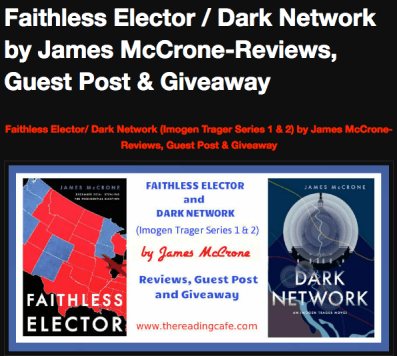
 These state laws have stood for years because until now, no one had standing to bring a case.
 “Whether you agree that they have a constitutional right to vote how they want or not, this election has opened up the door, and it’s really important for the Supreme Court to clarify what the rule is,” [professor] Lessig says. “We don’t want to get another close election and have this uncertainty affect the actual results. Either way the court ought to clarify, and our hope is this we’ll have a vehicle to give them a chance to do that.” (full story here, in
  Chosen Words - James McCrone