
Café de Flore, Paris. Spring 1984
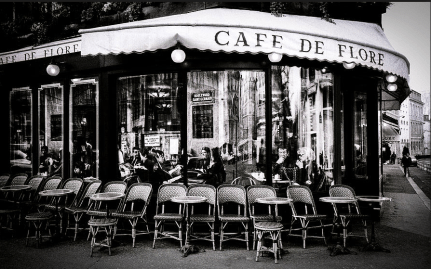 In 1984, when I was twenty, I visited my parents, who were studying in Paris. Bless them, they gave me a tidy daily allowance during my ten-day visite, and I made myself scarce during the day while they worked.
Their flat was on Rue du Cherche Midi near Saint Germain. I had spent four months in the southwest for a semester during my senior year of high school, and it was my first time back in France in three years. Each day, from about ten in the morning until we would meet up for dinner in the evening, I had the city to myself, and a few francs to spend.
The Boulevard Saint Germain was straight up Rue du Dragon from their flat, and it was to Saint-Germain that I would go each morning. I had heard of Les Deux Magots cafe, and I went there the first day. It was packed, and I didn’t see anywhere to sit outside and drink coffee like a proper French person. Café de Flore, right next to Duex Magots, seemed more inviting, and I sat down. Had Deux Magots not been so crowded that day, things might have gone differently.
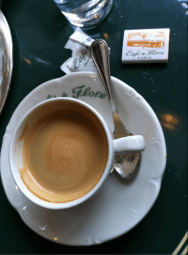 Café de Flore was brisk and casual. “Monsieur” was all the waiter would say when he arrived at the table. “Un café, s’il vous plait,” I’d say. He would deliver the espresso, take my money, tear the receipt ticket as he made change from a pocket in his vest and lay it with the change in a little saucer.
I decided I liked Café de Flore and its formal informality, so I came back the next day, and the next. I would sit, watching the people go by, and try to think of something to write in my journal. (I know—and it gets worse: as well as a journal, I had brought along Moveable Feast, The Sun Also Rises and Down and Out in Paris and London). On that second day, as I got ready to leave to find lunch somewhere a bit more affordable I noticed a group of professional looking people at another table drinking something and using a seltzer bottle to top up whatever was in their glasses.
The seltzer bottle was gorgeous, the glass thick, slightly green, and the bottom two-thirds covered with a pounded pewter skin. The skin had intricate squares cut out all over it, so that you could see the water level inside. As I stood up to put on my jacket, I noticed some other seltzer bottles along the back wall of the bar inside. I resolved to come back that afternoon for a whiskey and soda, using the seltzer bottle.
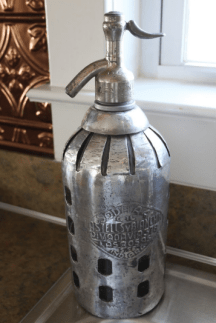
similar to those in 1984
Against all experience and judgment, I expected the waiter to offer a glimmer of recognition for the young man who drank his coffee there in the late mornings when I returned that afternoon at four, but he did not. “Monsieur,” he said.
“Un whiskey-soda, s’il vous plait,” I said.
Quickly, he brought a high-ball glass with a good shot and a half of whiskey, a bucket with ice and tongs and a bottle of Perrier. Not only did I have to pay for the whiskey, which was expensive, but also the Perrier.
“Pardon,” I protested, I didn’t want Perrier.
He looked dismayed—hadn’t I asked for a whiskey soda?
“Oui, mais…”
–he gestured at the table; “’et voila,” he said and repeated the price.
In halting French, I tried to say “I saw a bottle on one of the tables earlier today, a…a pressure bottle….do you know the word ‘seltzer’?
“Non, monsieur,” he said. Did I want the whiskey-soda?
Yes, I said. I paid, and he left.
I sat back in the wicker chair, defeated. I dipped into my shoulder bag for my Bantam New College English-French dictionary. I sat back and absently poured a dash of Perrier into the whiskey and began scanning the “s” section for “seltzer bottle.” There was no seltzer nor soda entry. I put the book down—sedulous, selvage, semi-conductor were all included, but real, needful words like seltzer were nowhere in evidence.
The bitter injustice of it all became more real as I sipped my drink. I knew that Perrier was mineral water, but I had never been able to taste the minerals until that day. Added to the whiskey, the cocktail I had looked forward to since before lunch became bad whiskey cut with rusty, mildly sulfurous water.
That evening, before bed, I scanned my parents’ thicker Larousse English-French dictionary, but again, no seltzer bottle. The next afternoon, I returned at one. I ordered a Pastis this time, and he brought the bucket and a little carafe of water. Was he sneering? I wondered. Was he smiling enigmatically ? No. He was impassive, a chess master.
“Monsieur,” I tried again in stilted French. “Yesterday, I saw a bottle on one of the tables….a bottle for soda…but it wasn’t Perrier. Do you remember?”
“Non, monsieur, “ he said, “Désolé.” He tore my receipt and moved to another table.
I stared after him. He wasn’t sorry; wasn’t ‘désolé.’ That much was certain. He was enjoying this.
As he stood at the other table, he glanced back at me, and this time there was a flicker of something in his expression. Sometimes, a woman sitting alone or with friends notices your attention; she will meet your gaze for a moment, glance down and smile to herself as she looks back at you. Or rather, her inward smile will bloom enough within her for it to flicker briefly across her face as she looks back.
The waiter’s flicker was the opposite. The waiter’s eyes met mine, he looked down, and when he returned his gaze to me, his mouth hardened and turned down slightly at the corners, a very French mixture of pity with a splash of contempt. Both expressions—the woman’s and his—are alike in that each is meant to invite you on; both make clear that the next step is yours.
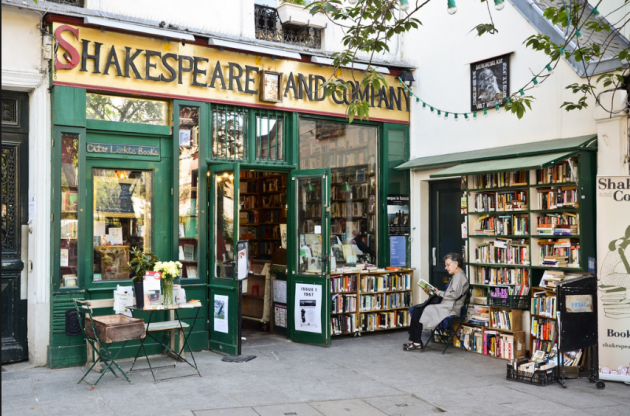 I resolved that I would join this battle. I finished my drink and hurried over to Shakespeare & Co, where I knew they had an encyclopedic English-French dictionary. I had been nosing around Shakespeare & Co already. As a twenty year-old American, visiting Paris, it seemed apt to be reading The Sun Also Rises together with A Moveable Feast, and I had already begun using these works to guide my tours of the city. I had gone
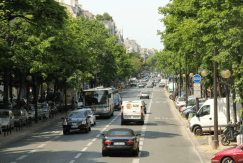
Blvd Raspail
to Shakespeare & Co my first full day in Paris, I had paid my respects at 14 Rue de Tilsit where Scott and Zelda had lived; and I was pleased to note that seventy or more years on, Boulevard Raspail, near to Cherche Midi, was as “bored, dead and dull” as Jake Barnes had found it sixty years earlier.
I moved toward Shakespeare & Co that day with a sense of purpose, no longer a passive tourist, but a man engaged in a noble struggle. The Larousse dictionary lay open on a lectern near the front of the shop. Five inches thick, crammed—presumably—with useful mots. There was nothing to help me there, however, and I began to doubt the importance of my quest. I wandered disconsolately down to the Pont au Double and looked across at Notre Dame catching a whiff of sulphur-scented defeat.
The following day, I had my morning coffee at Café de Flore, but I couldn’t bear to return that afternoon, and so spent my time browsing books stalls and looking in vintage shops. That night, back at my parents’ flat, I picked up The Sun Also Rises with an air of resignation. A book that had at first held out such promise for me had failed to deliver. I 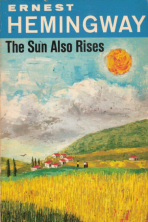 had hoped that re-reading the novel while in Paris would give form to some of the writer’s observations, breathe life into the expatriate’s lives. The very language of the novel, however, increased their distance from me, and their lives seemed all the more remote for it—people are “tight” not drunk; things are kept in a “press” not a cupboard.
And then, there it was. Brett and the Count had come to Jake’s apartment for a drink. Jake went to the press for the “siphon” to make brandy-and-sodas. I put the book down. Yes, people used to call it that. Siphon….siphon. Bring the seltzer bottle….amenez le siphon. The waiter couldn’t hold me any less pitiable and contemptible than he already did; and if my gambit failed, I’d have to find another café. But if successful, how much greater the share of glory? Le siphon.
I went to Café de Flore a little later than usual the next day. Jake and his pals may have been able to drink cocktails at all hours, but even on vacation ordering “un whiskey-soda” earlier than three of four in the afternoon seemed a bit much. I sat down promptly at three that day in my accustomed area at Café de Flore.
“Monsieur.”
“Un whiskey-soda, s’il vous plait.”
“Oui, monsieur,” and he turned quickly.
“Mais!” I said, forcing him to stop and turn back. “Pas de Perrier, aujourd’hui. Amenez le siphon, s’il vous plait.”
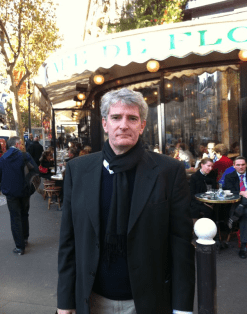
30 years later…
His face fell. He refused to look me in the eye. “Oui, monsieur.”
I spent that entire day’s allowance at Café de Flore. I walked heavily down Rue du Dragon to Cherche Midi in the early evening, feeling the glow of drunken expats all around me.
It was a simple exchange of values—we gave one another purpose, the waiter and I.
Or at least it was pretty to think so….
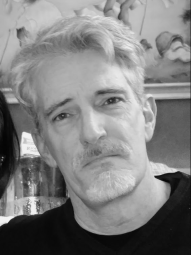 James McCrone is the author of the Imogen Trager political suspense-thriller series Faithless Elector and Dark Network. The final book in the series is due out at the end of this year.
Find them through Indybound.org. They are also available at Amazon, Barnes & Noble, and Powell’s Books. Link to REVIEWS
 In the name of verisimilitude (and telling a good story), I’ve been struggling to get right the atmospherics of our time; to isolate and describe the tactics and threat posed by reactionaries. I wonder at how close I seem to be coming. In that same post, I noted the novels are “about Power,” and that where there is no law, there’s only power.
 James McCrone is the author of the Imogen Trager political suspense-thriller series
  William McIlvanney (Laidlaw, The Papers of Tony Vetch, Docherty) still schools me. In a recent
  despairs of catching the “monster” who has committed a horrific crime with, “Look, other people can afford to write ‘monster’ across this and consign it to limbo…We can’t afford to do that.” In the scene he’s talking about detectives, but he could just as easily be hectoring writers (like me) looking for shortcuts.
 Chosen Words - James McCrone