Justice Delayed, Lagging Indicators

The Imogen Trager novels are a fearless examination of our current moment, but the books were years in the making.

A lagging indicator is an economic term for “a measurable economic factor [e.g. interest rates, inflation, unemployment rates] that changes only after the economy has begun to follow a particular pattern or trend.” (Investopedia.com) But there are lagging indicators in the political realm, too, where by the time something registers as an issue or problem it’s already happening, fully formed.

If the daily newspaper is the “rough draft of history,” as Philip Graham of the Washington Post claimed, then fiction, a game of “what-if?” can serve as history’s cadastral surveyor, articulating context, delineating boundaries and contending with problems.Screen Shot 2018-04-30 at 11.47.44 AM
The Imogen Trager novels are a fearless examination of our current moment, but the books were years in the making. The outlines were there to see; and while the outcome wasn’t inevitable, the trajectory was real, and frightening. Faithless Elector, told through the story of an idealistic young researcher who’s in way over his head, spotlighted the inherent weaknesses in the Electoral College—weaknesses which remain latent and could still be exploited. Dark Network focuses on the gritty work of arresting a power grab and the forces arrayed to abet that seizure, told through the story of its feisty, committed heroine, FBI Analyst, Imogen Trager.

Imogen.site1In the real world, we’re shocked to be now confronted with authoritarian propaganda at the highest levels, dismayed by craven apologia for that propaganda; by an increasingly irrelevant, neutered main stream media, and an administration that has its hands on all the levers of power. But this state of affairs has been apparent to anyone with imagination. It’s disturbing just how much these first two Imogen Trager novels get right regarding the context and background in which the conspirators operate—a pliant media, cowed by power, machinations at the highest levels of the Justice Department; fake news, false claims of voter fraud, collusion and corruption.
Screen Shot 2018-04-30 at 11.47.11 AM

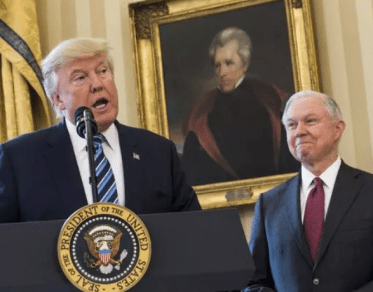
Pres. Trump, Att’y Gen., Sessions (A. Jackson)

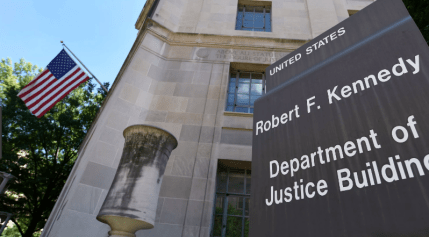
Long before Donald Trump assumed the presidency, Dark Network grappled with the frightful possibility of a president with no check to his power aided by a politicized Justice Department. Both novels were written before the current administration. Trump and Sessions and McConnell are absent from their pages. But their outlines are unmistakable.


 JMc-author2.2017James McCrone is the author of the Imogen Trager political suspense-thriller series Faithless Elector and Dark Network.  The final book in the series, is due out at the end of this year.

Find them through Indybound.org.  They are also available at Amazon, Barnes & Noble, and Powell’s Books.  Link to REVIEWS
If you live in Philadelphia, pick up a copy at Head House Books -or- Penn Book Center 


Post-Modernist Bilge

In my Chosen Words post from earlier this week (3/16) on the difficulty of writing about what the conspirators in the Imogen Trager books want, I said, “the bright line between fact and fiction, party and faction, virtue and vice is growing dim.”

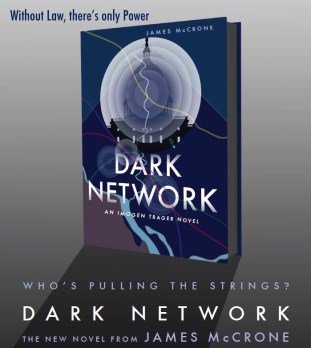
DarkNet.ad-poster-WITHOUT LAWIn the name of verisimilitude (and telling a good story), I’ve been struggling to get right the atmospherics of our time; to isolate and describe the tactics and threat posed by reactionaries. I wonder at how close I seem to be coming. In that same post, I noted the novels are “about Power,” and that where there is no law, there’s only power.

Today, two front page articles in the NY Times discuss both of my major themes:

How Trump Consultants Exploited the Facebook Data of Millions
“Rules don’t matter for them. For them, this is a war, and it’s all fair.” (Christopher Wylie)

Trump and the Truth: A President Tests His Own Credibility
“Advisors say privately that Mr. Trump may not always be precise but is speaking to a larger truth that many Americans understand….To them, the particular facts do not matter as much as this deeper truth.”

This is post-modernist bilge, of a kind rightly derided on the left and right. When the rule of law is nakedly abandoned, when all facts are dismissed as subjective—as having an agenda—when truth is “provisional,” when learning and expertise are assaulted, we’re left with Power as the only true north; and power does not seek the best and brightest, nor the good to its cause; but rather the chancers, hucksters, opportunists, nihilists. Corruption is their by-word.  They leave destruction, misery (and in my books, death) in their wake.

It’s not that I’m reading the newspapers and—collage-style—cobbling together a plausible, dystopian thriller series. Our current state has been years—and millions of dollars!—in the making.  The Imogen Trager series has likewise been growing (albeit with a fraction of the monetary support).

I wrote the rough draft of Faithless Elector in 2000. It had been knocking around in my head for some years prior to that, but the Bush-Gore election demonstrated how finely poised our democracy had become.  Subsequent national elections continue to expose the problems of the Electoral College.

Since then, the threat from reactionaries has grown and has proved to be all-too real.  I followed up Faithless with Dark Network (conceived in 2015-16), about, among other things, problems at the FBI.  I’m generally worried about what I’ll inadvertently get right with this last book.

 JMc-author2.2017James McCrone is the author of the Imogen Trager political suspense-thriller series Faithless Elector and Dark Network.  The final book in the series, is due our at the end of this year.
Find them through Indybound.org.  They are also available at Amazon, Barnes & Noble, and Powell’s Books.  Link to REVIEWS

If you live in Philadelphia, pick up a copy at Head House Books -or- Penn Book Center 


When Ideologies Collide – The Imogen Trager Novels

“Virtue is more to be feared than vice, because its excesses are not subject to the regulation of conscience.” –Adam Smith

Dark Network, the second Imogen Trager novel, follows up on the “gripping” thriller, Faithless Elector. The quote above, from Adam Smith, is the epigraph for Dark Network.  It serves to underline the posture of both sides in the book, and it points up the dangers of the stark polarization we see in the real world: people who think they’re right (virtuous) rarely question what they do or why they do it; whereas those who admit to themselves that what they’re doing is wrong (vice) at the very least have qualms and need to justify what they do.Fe-DarkNet

In Dark Network, the bright line between fact and fiction, party and faction, virtue and vice is growing dim. Imogen Trager, the determined heroine of Faithless Elector returns, desperate to stop a murderous dark network intent on seizing the presidency. Once in the White House, with a pliant Attorney General and a do-nothing Congress there will be nothing to stop them.

But first they have to get there.

Taken together—or separately (both thrillers were created to stand alone; there’s no homework required!)—they’re stories about individual courage in the face of adversity, and about what we become in the process. Imogen will have to confront her own outlook as she chases the conspirators. The ultimate question becomes not only, will Imogen stop them seizing the presidency, but what kind of America will be left, even if she does? As she crosses the line between the need for action and her own morals and beliefs (“Imogen stared at the table top, wondering which Constitutional right she would be complicit in violating today. But just as quickly came a flash of anger. Deptford was  conspiring to subvert the electoral process and corrupt the Constitution. Now he wanted it to protect him?“), she begins to worry she’s facing a juggernaut that nothing can stop.

Dark Network is about power. The umbral conspirators are bent on taking power for themselves at the expense of everything we hold dear. The chilling, dark recognition at the heart of the plot is that the conspirators would say they were seizing power in order to preserve everything we hold dear. They are doing the right thing, they would say…for us. And people who think they’re doing the right thing are rarely troubled by scruples or conscience.

The tension for the characters in the novel centers on how far they are prepared to go in defense of their principles before they have abandoned them all.

While the thrillers Faithless Elector (March 2016), and its sequel, Dark Network (Oct. 2017) take current events as their impetus and resonate with the daily outrages and machinations of our time, they are first and foremost taut, plot-driven stories. They contend with themes that endure after the headlines have faded and events in the real world appear to have moved on. The latent weaknesses so plausibly exploited by the conspirators still exist.

The Imogen Trager stories are about courage, duty, fidelity and ideology: and what happens when those qualities and ideologies collide.

In Faithless Elector, a small, deadly efficient conspiracy seeks to overturn the result of a close election by getting a number of Electors to switch their votes, to become “faithless electors.”  The conspirators operate in the shadows, but it’s getting late in the day and the shadows are lengthening.

In Dark Network, it becomes clear that the conspirators are still trying to influence the outcome.  The protagonist, FBI Agent Imogen Trager, must fight against time, a sinister network–even her own colleagues–to find out who’s still trying to steal the election and stop them. There’s barely a month until the inauguration…

 JMc-author2.2017James McCrone is the author of the Imogen Trager political suspense-thriller series Faithless Elector and Dark Network.
Find them through Indybound.org.  They are also available at Amazon, Barnes & Noble, and Powell’s Books.  Link to REVIEWS

If you live in Philadelphia, pick up a copy at Head House Books -or- Penn Book Center 

It’s not yet two o’clock…

I’ve been thinking about moments lately as I push on toward the ending of my third Imogen Trager novel. The point of a dramatic moment is that it destroys the equilibrium that existed an instant before. At the beginning of a story, things are as they are. They may be bad or good from the point of view of the main character, but there is some sense that this is how things are, how they’ve been and will be.

And then something happens.

That something requires a choice—either go forward or retreat; follow the clues or bury your head in the sand. These moments represent a place from which the hero(ine) can’t go back – even if they’d like to do so.  Like Adam and Eve, after the fall: you can’t unknow something, can’t undo what’s happened. Gatsby is famously shaken by the sight of Daisy and Tom’s little daughter—it’s all well and good believe you can repeat the past, but quite another thing when you’re confronted with a living, breathing manifestation of why you can’t. Moments are the heart of drama, and character will be revealed in the conflict that ensues.

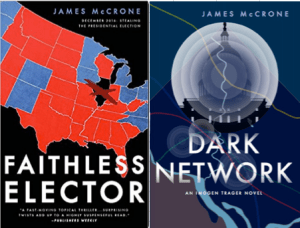
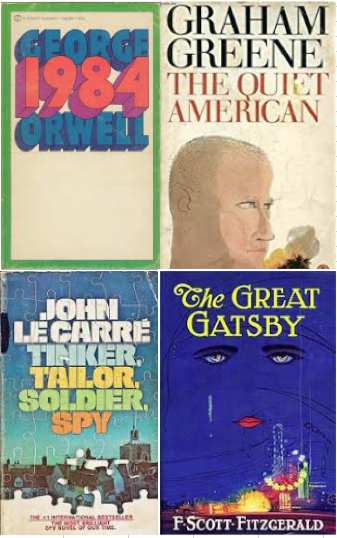
In the novel 1984 Winston Smith decides to keep a journal, bringing him to the Party’s 4 booksnotice; in The Quiet American, the cynical Fowler meets the destructive innocent Alden Pyle; Ricky Tarr turns up with evidence of a mole in Tinker, Tailor, Soldier Spy; Nick Carraway meets Gatsby. In Faithless Elector, Matthew Yamashita finds an unexplained number of deaths among electors. In Dark Network, Imogen Trager finds that the conspiracy is still at work, still trying to win.

For my characters, the need is to restore equilibrium (and the rule of law). These stories were never meant to be prophetic, but taut thrillers playing out a distressingly plausible scenario. As I’ve written elsewhere , these fictional stories have sailed just a bit too close to the wind. As I work toward the end of this third book, I worry again about what I’ll get right.

Fe-DarkNet

Because moments don’t exist only in fiction. William Faulkner has written that every Southern boy can conjure in his imagination that moment when “it’s still not yet two o’clock on that July afternoon in 1863” at Gettysburg, and everything is still possible. I re-read the passage recently, and it’s brilliant. It’s a meditation on whether the course to destruction had been set earlier and this was just one act along that road, or whether Pickett’s charge was the moment that set them on that road.

The nation is poised upon a moment. We know only that Mueller has filed indictments, is taking testimony. Will what the investigation reveals stabilize the status quo, or will it throw the nation further into upheaval? Is the coming moment one of destruction or resurrection? And for whom?

It’s not yet two o’clock, and many things are possible.

 JMc-author2.2017James McCrone is the author of the Imogen Trager political suspense-thriller series Faithless Elector and Dark Network.  Find them through Indybound.org.  

They are also available at Amazon, Barnes & Noble, and Powell’s Books.  Link to REVIEWS

If you live in Philadelphia, pick up a copy at Head House Books -or- Penn Book Center